What should a 5-year-old learn? 6 activities and how to choose by your child’s temperament
Swimming, martial arts, music, dance, art, English or “thinking math”? When children turn 5, many parents start looking for classes – and every option looks good. We are Japanese, teach soroban to children from age 5 in Hanoi, and are often asked: “What should a 5-year-old learn?”. The honest answer: no activity is best for every child – there is only the one that suits your child right now.
A 5-year-old does well with 1–2 activities they enjoy, chosen for their personality rather than for what’s trending.
- At this age, play and movement are still the main “learning”
- Each activity builds something different – none is clearly better
- A balanced mix: one active, one quiet
- Energetic child: start with movement; careful, patient child: art, music, soroban
- Always try a trial lesson before signing up
- Tired, cranky, doesn’t want to go: a sign to cut back
What stage is a 5-year-old at?
Before choosing an activity, look at your child. Most 4- and 5-year-olds share a few traits:
- They learn through play: they remember what they get to touch and try.
- They love to move: running, jumping and climbing almost all day.
- Their language grows fast: asking “why?” over and over, loving to tell stories.
- Their hands are getting nimble: holding a pencil, cutting paper, doing up buttons.
- Their focus is still short: usually about 10–15 minutes on one task.
- They start to enjoy playing with friends: they can take turns, but still need an adult’s help.
So a good class for a 5-year-old usually has lessons split into many short parts, with games, movement and little pressure to perform. Every child has their own pace: some can sit and draw for a long time, others want to run off after a few minutes – both are normal. If sitting still is hard for your child, see My child can’t focus when studying.
6 popular activities for 5-year-olds: what does each build, and who does it suit?
Here are 6 popular choices for 4- and 5-year-olds. The order is not a ranking – every activity has its strengths and things to watch for.
Getting used to water, safety skills, whole-body exercise. Suits almost every child – even those afraid of water, if they get used to it slowly. Note: choose a small class where the teacher stays close to your child.
Stamina, coordination, following rules and taking turns; team sports teach children to play together. Suits high-energy children. Note: choose a class that puts fun and safety ahead of competition.
A feel for rhythm, sharper listening, nimble fingers (with piano or another instrument), confidence in front of others. Suits children who sing a lot or love moving to music – boys and girls alike. Note: instruments need a little practice at home every day; in dance, avoid forcing poses beyond what their body can do.
Imagination, skillful hands, expressing feelings without words. Suits children who love coloring, cutting and pasting, and telling stories in pictures. Note: choose a class that lets children create freely, not just copy a model.
Getting to know the sounds of a new language through songs, games and stories. Suits children who love to talk and imitate. Note: at 5, the goal is that your child enjoys listening and dares to speak – not a word count.
There are many methods; soroban is one. Number sense, nimble fingers, the habit of sitting down to learn. Suits children who like puzzles, counting and following rules. Note: wait until your child can count to 10 and sit for about 15 minutes.
About swimming: according to the World Health Organization (WHO), drowning is one of the leading causes of death among children in Vietnam. The American Academy of Pediatrics (AAP) points out that swim lessons may help lower the risk, but no class can make a child completely safe – an adult must always stay close when children are near water.
The question to ask is not “which activity is best?” but “which one suits my child right now?”.
Choosing an activity by your child’s personality
Even at the same age, every child is different. Watch your child for a week: in their free time, what do they choose to do? That often gives you a clearer answer than any ranking.
Start with something active: swimming, martial arts, soccer, dance. Once they have had a good run around, quiet activities come more easily.
Art, puzzles and soroban suit children who like working step by step. Add some light exercise for balance.
Children who sing along and drum on the table may really enjoy a music or dance class.
Choose a small class where the teacher can see each child. Even just watching for the first few lessons is learning.
Three things not to base your choice on:
“Boys do martial arts, girls do dance.”
Interests and personality matter more than gender. A boy may love dance, a girl may love soccer – let your child try.
“The more activities, the better.”
Free play, enough sleep and family time are learning too. One activity your child loves beats three they are dragged to.
“Choose something that helps with schoolwork.”
Every activity builds focus, listening to instructions and taking turns. And children usually stick with what they enjoy.
The best activity is the one your child can’t wait to go back to next week.
How many activities should a 5-year-old do?
For most 5-year-olds, 1–2 activities is about right: one active and one quiet – for example swimming and art, martial arts and soroban, dance and English.
Children still need plenty of time to play and sleep. WHO recommends that children aged 5 to 17 get at least an average of 60 minutes of moderate- to vigorous-intensity physical activity a day. Most of that time can be running around and playing outdoors. According to the American Academy of Sleep Medicine (AASM), endorsed by the AAP, children aged 3–5 need 10–13 hours of sleep a day, including naps.
So don’t let the class schedule eat into playtime and sleep. If your child wants to start something new, consider swapping out an old activity instead of adding one.
Signs your child is overloaded: not wanting to go to a class they used to love; bedtime getting later because of classes; often tired, cranky or crying over small things. If it goes on, drop one activity or give your child a break for a while.
Before signing up for a class for your 5-year-old: 5 things to check
A good class isn’t always the right class for your child. Before signing up, check:
- Try a trial lesson. See whether your child has fun, understands the instructions and wants to go back.
- Ask your child. Ask “Which part did you like best?” instead of “Did you like it?” – you’ll get a more specific answer.
- Check how many children each teacher looks after. In a small class the teacher can correct each child, and shy children settle in more easily.
- Think about distance and travel time. A class near home is usually easier to keep up than one far away through rush-hour traffic.
- Pick a time slot you can keep long-term. One that doesn’t clash with naps, dinner or bedtime, and that fits your drop-off and pick-up.
At the trial lesson, notice how the teacher talks to your child when they make a mistake. A teacher who can patiently wait for your child matters more than the textbook or a nice classroom.
Kindergarten class for 5-year-olds at Kodomo Soroban Center
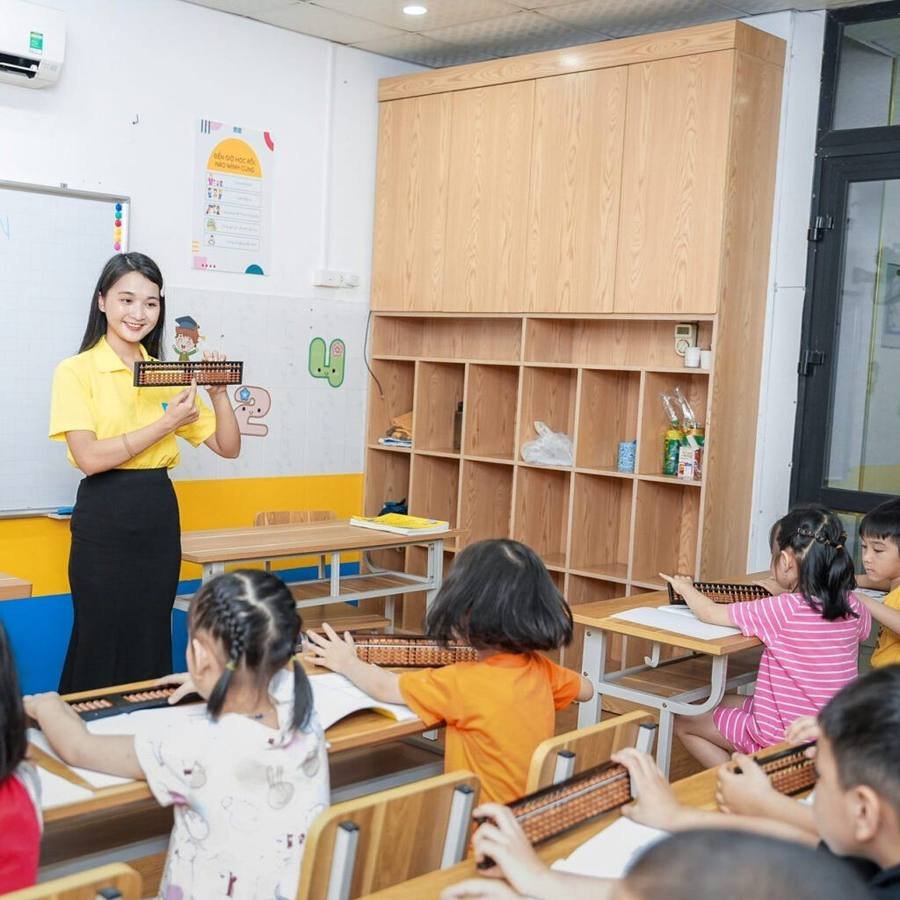
If you are considering thinking math, we run a soroban Kindergarten class for children from age 5 at our center in Vinhomes Gardenia, Hanoi.
- 3–5 children per class
- Games between the learning parts
- A slower pace than the primary class
- Free trial lesson
The best way to find out whether soroban suits your child is to try one lesson – and if another activity suits them better, that is a good answer too. See also What age should a child start soroban?, Getting your child ready for grade 1 math and the class schedule at our center. Sign up for a trial lesson on our Contact page or call or message us on Zalo at 096.802.8484.
Frequently asked questions
How many activities should a 5-year-old do?
Usually 1–2 is about right: one active and one quiet, for example swimming and art. Children still need plenty of free play and enough sleep. If your child doesn’t want to go, goes to bed later or is often cranky, drop one activity.
What activities are good for a 5-year-old boy?
No activity is just for boys or just for girls. Choose by your child’s interests and personality: an energetic child might start with swimming, martial arts or soccer; a careful, patient child might enjoy art, piano or soroban – whether a boy or a girl. Let your child try, then see which class they can’t wait to go back to.
Can a 5-year-old start thinking math?
Yes, if they can count to 10, recognize the digits and sit and focus for about 15 minutes. At this age, a thinking math class should teach with objects and games and split the lesson into short parts. If your child isn’t ready yet, play counting games at home for a few months and try again.
Should a 5-year-old learn English?
They can, if they learn through songs, games and stories and enjoy it. At 5, a sensible goal is that your child likes listening and dares to speak – not memorizing lots of words or taking tests. Reading picture books and listening to English songs together at home is also a good way to start.
How should my child try out a class?
Call the trial lesson a “new game”, not a test. During the lesson, watch whether your child has fun and follows instructions, and how the teacher responds when your child can’t do something yet. Afterwards, ask which part they liked best. If you can, try 2–3 different activities before deciding.
Try a free soroban lesson
Classes of 3–5 children at Vinhomes Gardenia (Hanoi), 60 minutes each, taught exactly as in Japan. Phone · Zalo 096.802.8484.

Written by the teaching team of Kodomo Soroban Center, following the method and textbooks of Kodomo School (Japan, teaching soroban since 1976). The center is licensed by the Hanoi Department of Education and Training, and our project is a 2026 EDU-Port Nippon supported project of Japan’s Ministry of Education (MEXT).
About usEDU-Port NipponEducation licenseRelated articles
Why do Japanese students clean their own schools – and how to bring the habit home
Why do Japanese students clean their schools every day? What cleaning time looks like, what children learn from it, and how to…
A day in the life of a Japanese elementary school student: what time school starts, how lunch works and when summer break is
What time do Japanese elementary students go to school, when do they start school and how long is summer break? A typical…
How to learn the times tables fast: 7 fun ways for kids, tips for the 7, 8 and 9 tables and a free worksheet
How to help your child learn the times tables fast: understand multiplication first, start with easy tables, only 36 facts to learn,…