Why learn soroban the Japanese way?
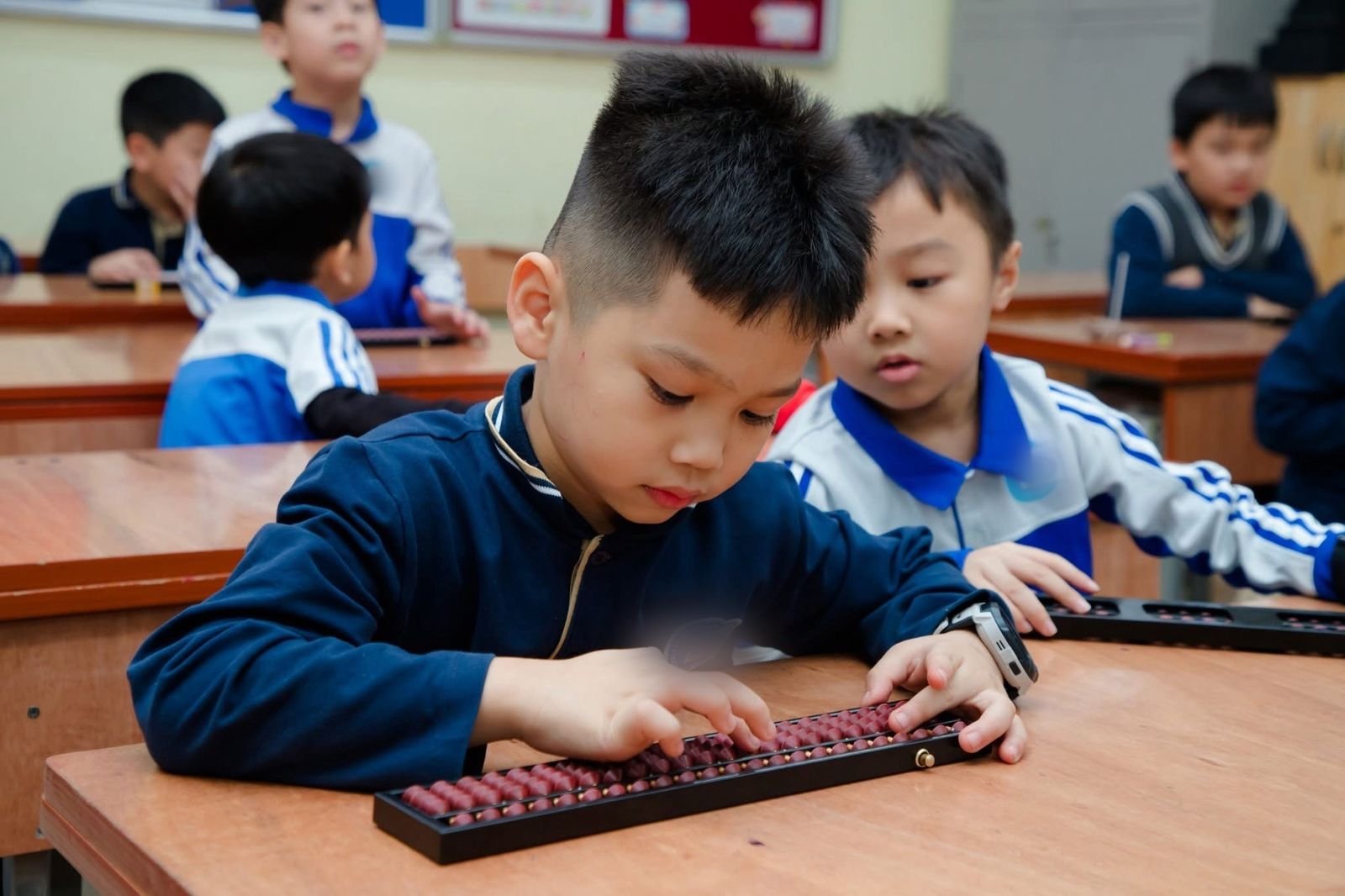
The soroban (そろばん) is the Japanese abacus, a learning tool that has been used in Japanese education for centuries. It is designed for training fast mental calculation: children start by moving real beads, then learn to picture the beads in their mind and calculate without the tool at all.
From real beads to mental calculation
Move real beads
Children learn place value with their own hands: one bead, one number.
Picture the beads
The image of the soroban moves into the mind. This is visual, right-brain thinking.
=72
Mental calculation (anzan)
Children add and subtract multi-digit numbers quickly and accurately, without paper.
Isn’t all soroban the same?
Isn’t all soroban the same – just “math for developing thinking skills”?
In fact, the way soroban is learned varies a great deal depending on the country it comes from.
In Vietnam today, parents often assume that all soroban is the same. But there is a Malaysian way of learning soroban, a Japanese way, and others. Soroban is also easily confused with Finger Math.
Each country has its own goals and approach when children practice soroban. In Japan, soroban is a tool for building patience and perseverance along with sharp, quick thinking.
Soroban in Japanese education
Soroban is still one of the most popular after-school activities in Japan today. It is no exaggeration to say that soroban, soccer and English are the three big after-school lessons for Japanese children.
Soroban is also part of Japan’s national primary school math curriculum (grades 3 and 4).
Why Japanese-style soroban?
A soroban is just a tool. What makes the Japanese method different is how the class is run: the habits children build stay with them long after the beads are put away.
Posture and form
Sit up straight, place the soroban correctly, and use the thumb and index finger the right way. Children learn that how you do something matters as much as the result.
Concentration
Short timed drills and dictation (yomiage) train children to keep their full attention for the whole lesson.
The will not to give up
Each level asks a little more. Children learn that repeated effort brings results, and that an exam they did not pass is just one step along the way.
Routine and respect
Greetings at the start and end of class, getting out and putting away their own materials, and respect for teachers and classmates.
Six benefits of learning Japanese soroban
Soroban develops the right brain: visualization, mental calculation and focus. The school math curriculum builds logical thinking. The two reinforce each other – soroban complements math at school rather than competing with it.
Stronger thinking skills
Children see numbers as images of beads, so they understand place value and how numbers are built in a very visual way – not just by memorizing.
Fast calculation
Every lesson includes timed practice, so children gradually build up their own speed, little by little.
Better concentration
Moving the fingers correctly while getting the right answer takes eyes, hands and brain working together – helping children build a habit of deep focus.
Accurate calculation
By moving each bead carefully, children learn to solve every problem correctly and completely within the time limit.
More motivation to learn
Children record their own times and scores and can clearly see their progress; the joy of “I did it!” grows into confidence.
Whole-brain development
Grid calculation (left brain), together with soroban and mental calculation (right brain), helps children use both sides of the brain.
What does research say about soroban?
Soroban and the “mental abacus” have been studied by cognitive scientists and neuroscientists for four decades. We present the findings honestly – including the limits of the research.
Numbers are held as images
Expert soroban mental calculators in Japan can remember about 15–16 digits (a typical adult remembers about 7). This advantage applies only to numbers, not to letters or words – because the numbers are held as an image of the soroban. (Hatano & Osawa, 1983)
Faster, more accurate calculation
Children who learned the mental abacus calculated faster and more accurately than children who did not. The process relies on visual-spatial memory; children can hold about 3–4 columns of digits at once, tied to place value. (Stigler, 1984; Frank & Barner, 2012)
Using the brain’s visual-spatial areas
Brain imaging of experts shows that they rely heavily on visual-spatial areas, rather than the language areas that untrained people usually use. That is what “training the right brain” alongside the left brain means. (Tanaka et al., 2002; Hanakawa et al., 2003)
Effective when children truly master it
A three-year randomized controlled trial with 204 children aged 5–7 found clearly greater gains in arithmetic and in understanding place value (Cohen’s d ≈ 0.6 on the program’s own measures; ≈ 0.24 on standardized tests). Another one-year trial found no clear difference, because only about one in five first graders mastered multi-digit mental images during that year. (Barner et al., 2016; 2017)
What this means for our program
The clearest benefits are in calculation itself and in understanding place value – and they appear only when children truly master the mental image of the soroban. That is why the KSC program builds mastery before raising the difficulty, keeps practice short, regular and focused, always reads numbers from the leftmost place, and checks progress three times in every module.
We say the program helps children calculate fluently, understand place value, concentrate and build good study habits – because that is what the evidence supports. Broader cognitive benefits are possible and are still being studied. The results seen in experts come from many years of practice; for children who learn for 1–3 years, one lesson a week, results are more modest and depend on regular attendance and practice at home.
References
- Barner, D., Alvarez, G., Sullivan, J., Brooks, N., Srinivasan, M., & Frank, M. C. (2016). Learning mathematics in a visuospatial format: A randomized, controlled trial of mental abacus instruction. Child Development, 87(4), 1146–1158.
- Barner, D., Athanasopoulou, A., Chu, J., Lewis, M., Marchand, E., Schneider, R., & Frank, M. C. (2017). A one-year classroom-randomized trial of mental abacus instruction for first- and second-grade students. Journal of Numerical Cognition, 3(3), 540–558.
- Frank, M. C., & Barner, D. (2012). Representing exact number visually using mental abacus. Journal of Experimental Psychology: General, 141(1), 134–149.
- Hanakawa, T., Honda, M., Okada, T., Fukuyama, H., & Shibasaki, H. (2003). Neural correlates underlying mental calculation in abacus experts: A functional magnetic resonance imaging study. NeuroImage, 19(2), 296–307.
- Hatano, G., & Osawa, K. (1983). Digit memory of grand experts in abacus-derived mental calculation. Cognition, 15(1–3), 95–110.
- Stigler, J. W. (1984). “Mental abacus”: The effect of abacus training on Chinese children’s mental calculation. Cognitive Psychology, 16(2), 145–176.
- Tanaka, S., Michimata, C., Kaminaga, T., Honda, M., & Sadato, N. (2002). Superior digit memory of abacus experts: An event-related functional MRI study. NeuroReport, 13(17), 2187–2191.
A free book for parents (in Vietnamese)
“An introduction to soroban for adults” – the parts of the soroban, how to move the beads, and the rules for addition and subtraction, explained simply.