What happens in a lesson?
Every lesson follows the same rhythm. First comes grid calculation, which builds basic calculation skills (left brain); then soroban and mental calculation, which build the ability to work with numbers as images (right brain).
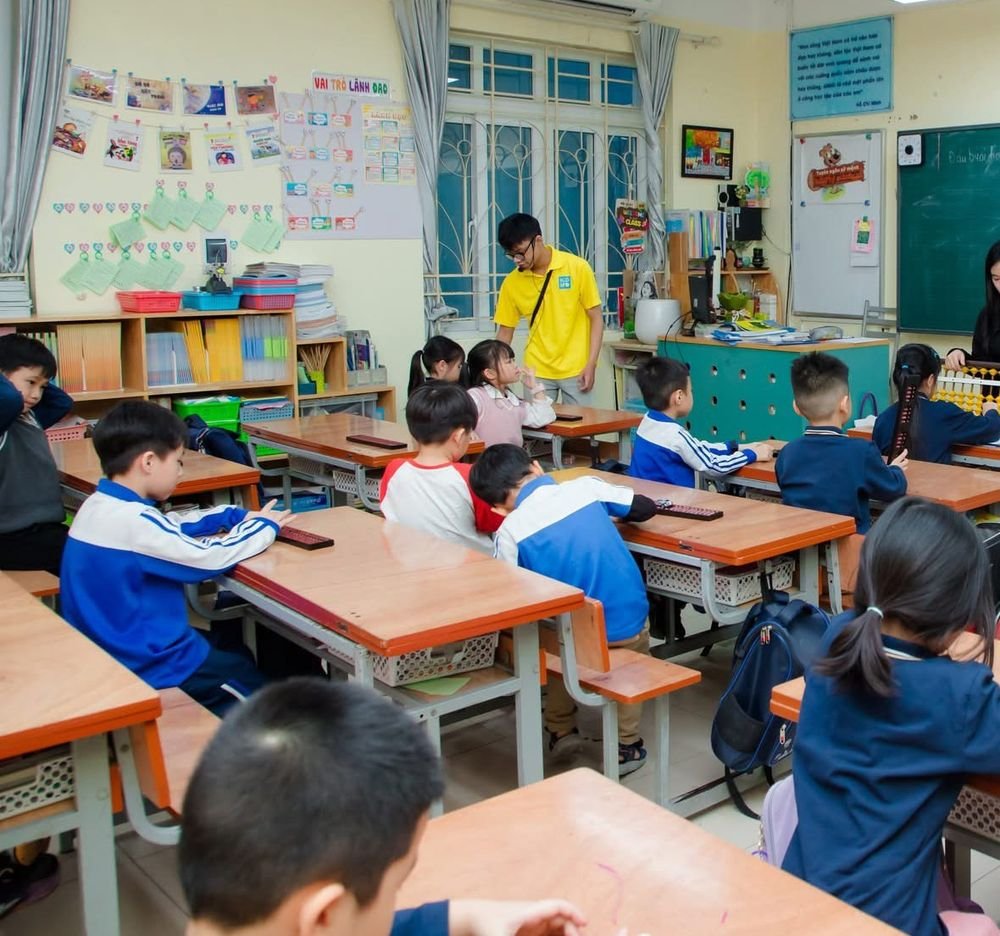
An in-school club lesson (60 minutes)
Always in this order: a short drill for fluency first, then 41 minutes on the soroban and in the mind. The numbers in grid calculation never go beyond what the child can already do on the soroban.
Depending on the school timetable, a lesson can fit into 45–60 minutes, with the time for each part adjusted to match. At the center, each Primary class lesson lasts 70 minutes.
The 7 parts of a lesson
Opening greeting
Children stand up, bow, and the whole class says “Onegaishimasu” in Japanese. This helps them switch into learning mode.
Getting ready · tidying
Put materials in their set places and clear the soroban to zero (gohasan).
Grid calculation
A timed calculation drill. Children record their own time and get a feel for their speed.
Soroban
Children watch the teacher introduce something new on the large demonstration soroban, then practice with the textbook.
Mental calculation · Flash Anzan
With eyes closed, children calculate on a soroban they picture in their mind (mental calculation from session 4, Flash Anzan from session 6).
Clean-up · tidying
Clear the soroban to zero, put materials back where they belong, and check that everything is neat.
Closing greeting
Children record the day’s results on their progress sheet and finish with a thank-you: “Arigatō gozaimashita”. Every lesson comes with a homework sheet.
Japanese manners in every lesson
Manners are not an “extra” separate from calculation practice. As the foundation of learning, they are built into the rhythm of every lesson – and they are one of the first things schools and parents notice.
Ojigi · bowing and greeting
At the start and end of each lesson, the whole class stands, bows and says “Onegaishimasu” (Please teach us) and “Arigatō gozaimashita” (Thank you very much). Children learn respect, gratitude and how to switch from one mode to another. This is the first and most important habit, taught in the very first lesson.
Seiri Seiton · keeping things tidy
Children put their own materials in the right places and clean up after class. When their surroundings are tidy, the mind settles and concentration follows.
All teaching is in Vietnamese. Children learn Japanese only for the greetings and the names of the parts of the soroban.