
Free soroban & mental math worksheets
22 practice sheets: 12 soroban sheets in the exact order we teach at Kodomo Soroban Center (from direct addition and subtraction to the 5-friend and 10-friend rules, mitorizan, multiplication and division), 6 mental-math sheets for grades 1–2 that need no abacus, and 4 grade-1 thinking-math sheets. Each sheet is a 2-page PDF: the problems and an answer page so you can mark together. Sheet 01 opens right away; register once (name, phone number, your child’s grade) to unlock all 22 – and receive new sheets via Zalo when they come out.
How to use the worksheets
The sheets follow the KSC learning path. Use the sheet for the level your child is at; if your child has not learned soroban yet, start with sheet 01.
Pick the right sheet
Match your child’s current level (see the table below). One sheet a week, done 3–5 times.
Print and time it
Print page 1 for your child and keep page 2 (answers). Time it, and let your child write the time in the box on the sheet.
Mark together · move on
80% correct in a reasonable time is a pass – the same standard as KSC tests. Then move on to the next sheet.
Download by level
Each sheet is a 2-page A4 PDF (headings in Vietnamese, but the content is all numbers). Sheets 01 and 13 open right away; the rest unlock after a one-time registration in the box below.
Level 0 · Getting used to the soroban
Setting and reading numbers, and direct addition and subtraction – only adding and removing beads, no exchanges yet. For weeks 1–8, or for parents starting out.
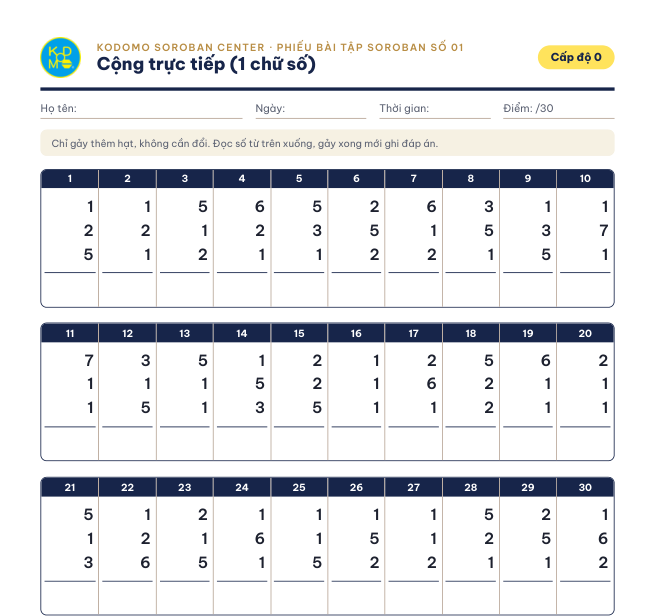
Direct addition (1 digit)
30 problems, 3 numbers each. Only adding beads, no exchanges. The first sheet for every beginner.
Download PDF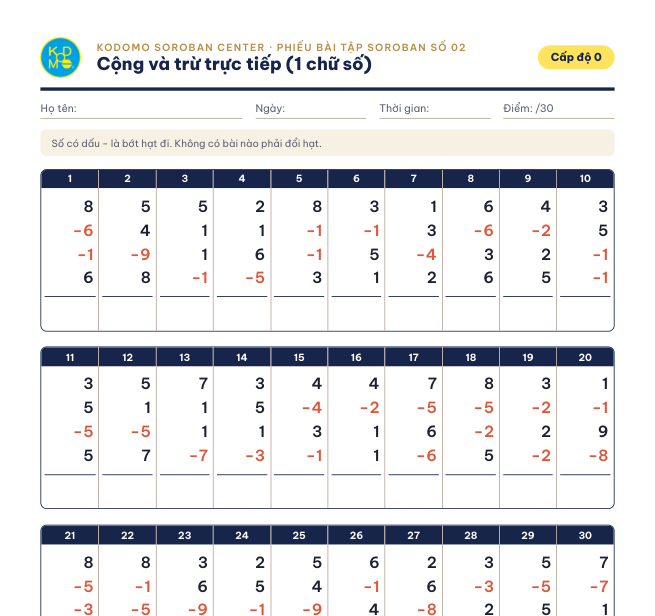
Direct addition and subtraction (1 digit)
30 problems, 4 numbers each, with minus signs. Practicing removing beads with the index finger.
Register to download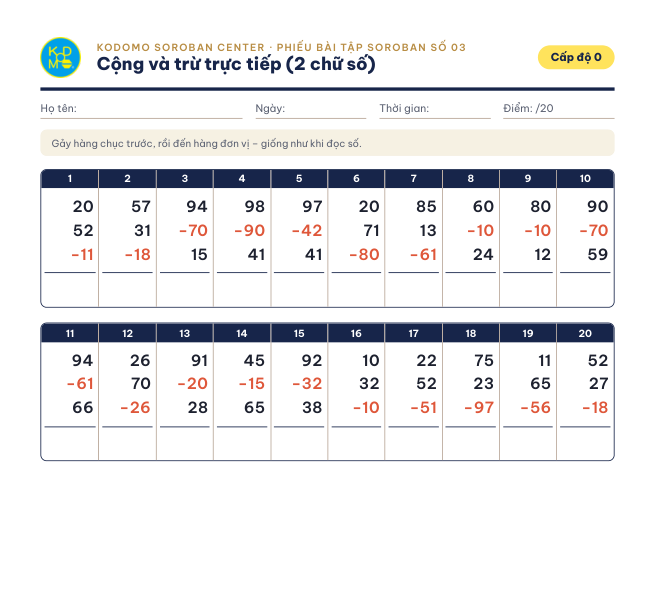
Direct addition and subtraction (2 digits)
20 problems, 3 numbers each. Tens first, then units – the way you read a number.
Register to download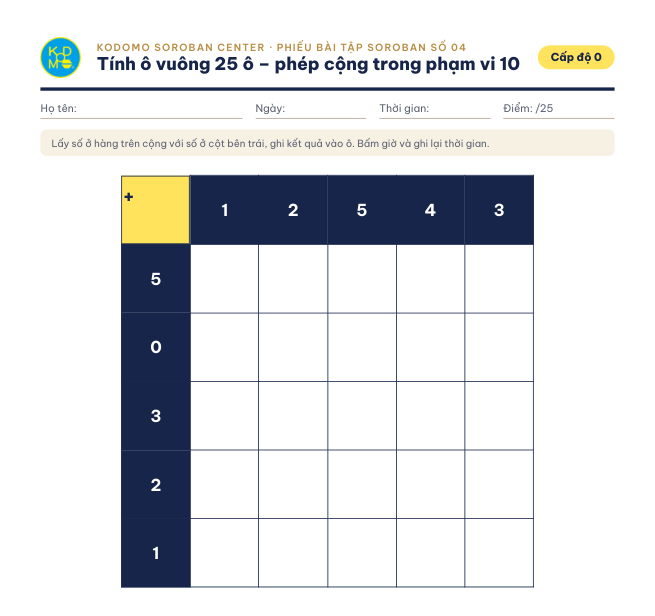
25-cell grid – addition up to 10
The timed “grid calculation” that opens every KSC lesson: building the calculation base.
Register to downloadLevel 1A · The 5-friend and 10-friend rules (addition)
When there are not enough beads: exchange through 5 (the 5-friend) or through 10 (the 10-friend). Each sheet contains only problems that need that rule, so each rule is learned solidly.
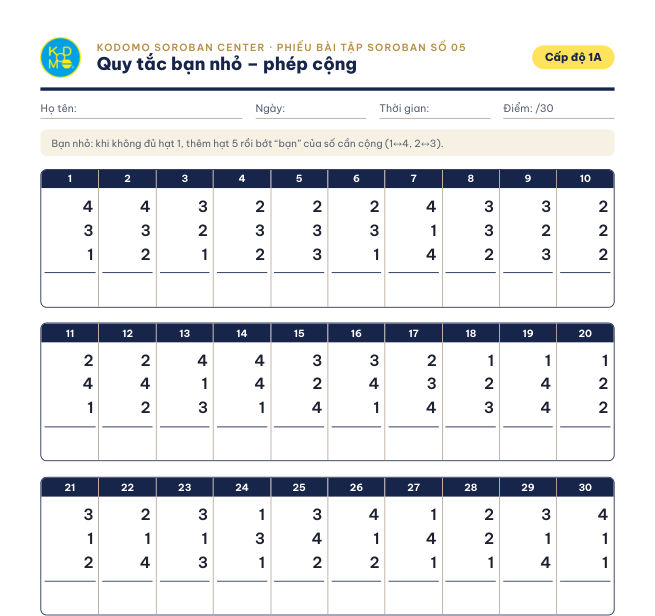
5-friend rule – addition
30 problems. Add the 5-bead, then remove the “friend” of the number (1↔4, 2↔3). No carrying to the tens yet.
Register to download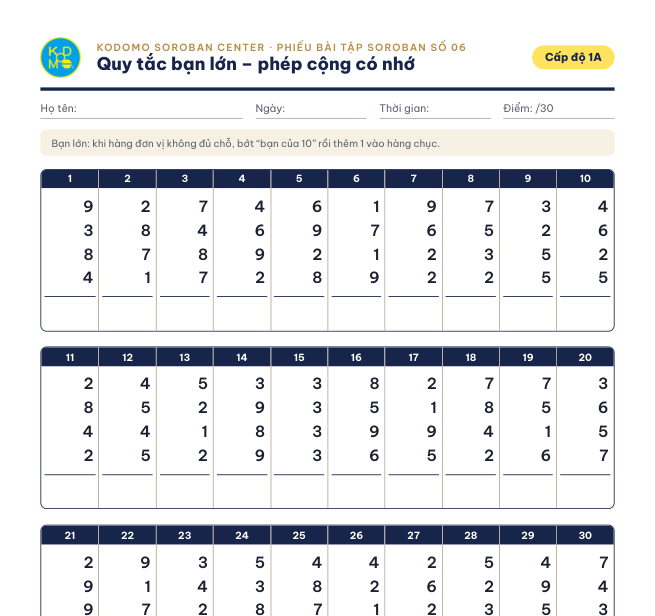
10-friend rule – addition with carrying
30 problems, 4 numbers each. Remove the “friend of 10”, then add 1 in the tens. Every problem carries at least once.
Register to download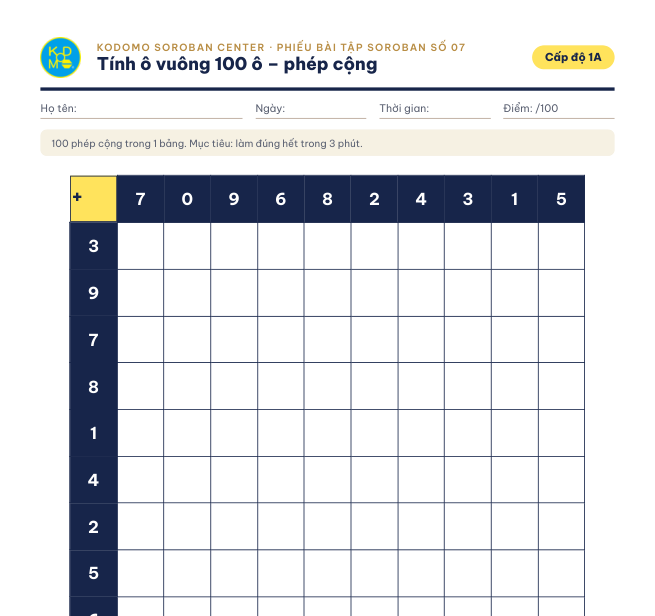
100-cell grid – addition
100 additions in one grid. Goal: all correct in 3 minutes. Record the time every time.
Register to downloadLevel 1B · Subtraction, combined rules, mitorizan
Subtraction with borrowing, then columns of numbers to add and subtract (mitorizan) – the format of the Japanese grading exams.
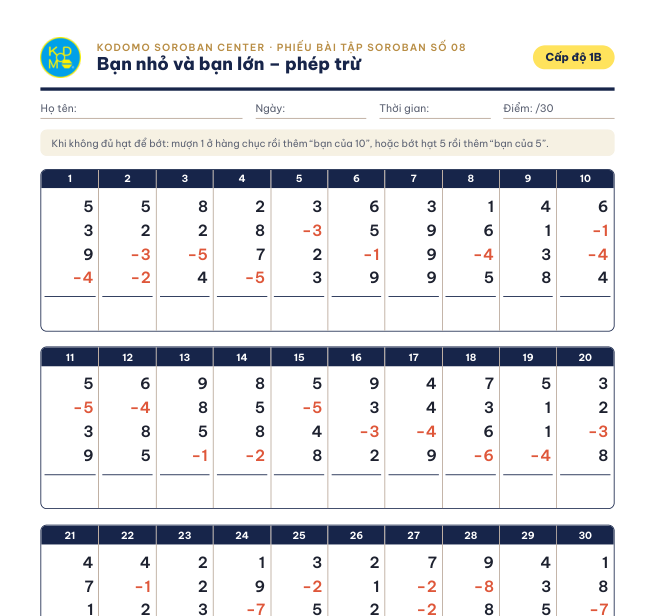
5-friend and 10-friend – subtraction
30 problems. Borrow 1 from the tens and add the “friend of 10”, or remove the 5-bead and add the “friend of 5”.
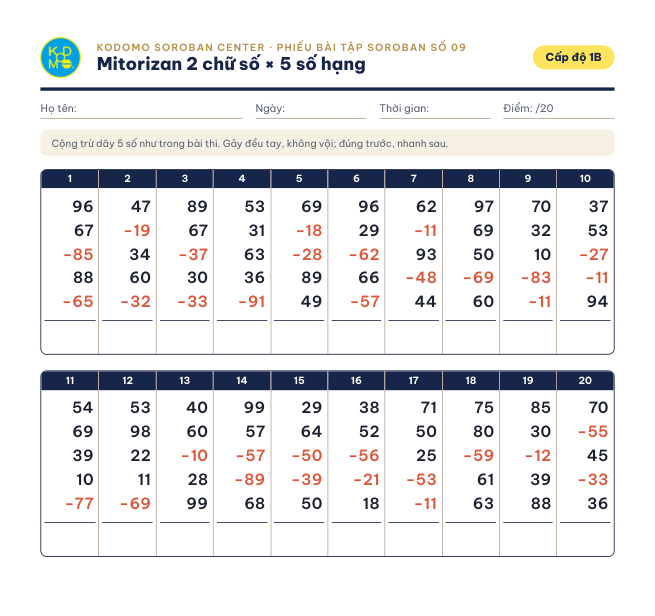
Register to downloadMitorizan 2 digits × 5 numbers
20 problems mixing every rule, including combined ones. Accuracy first, speed later.
Register to download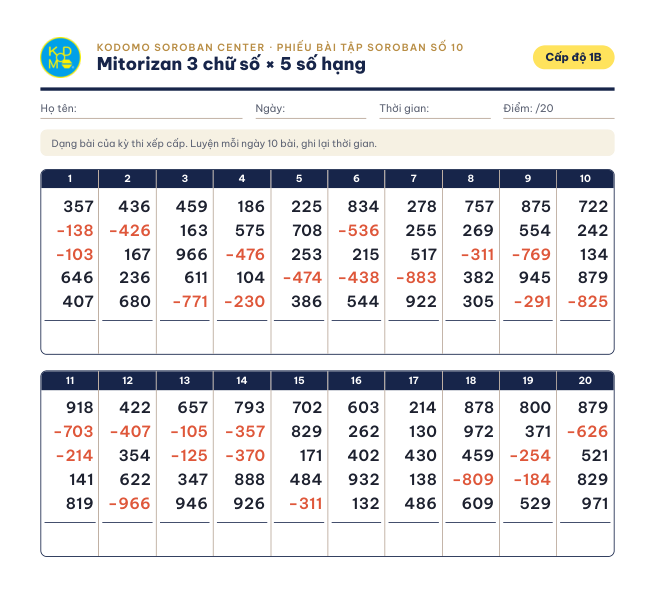
Mitorizan 3 digits × 5 numbers
20 problems in the exact exam format. Ten a day, recording the time.
Register to downloadLevel 2 · Multiplication and division
The times tables chanted the Japanese way, multiplying by one digit, dividing by one digit.
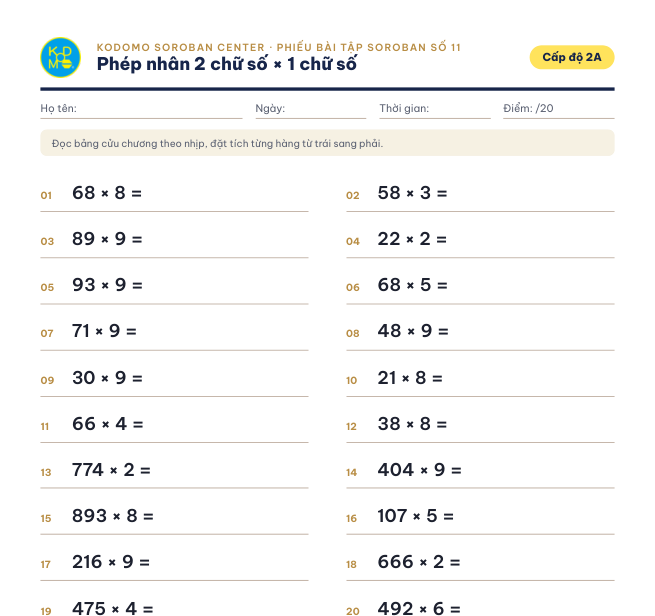
Multiplication 2 digits × 1 digit
20 problems: 12 with 2 digits and 8 with 3 digits. Place each partial product from left to right.
Register to download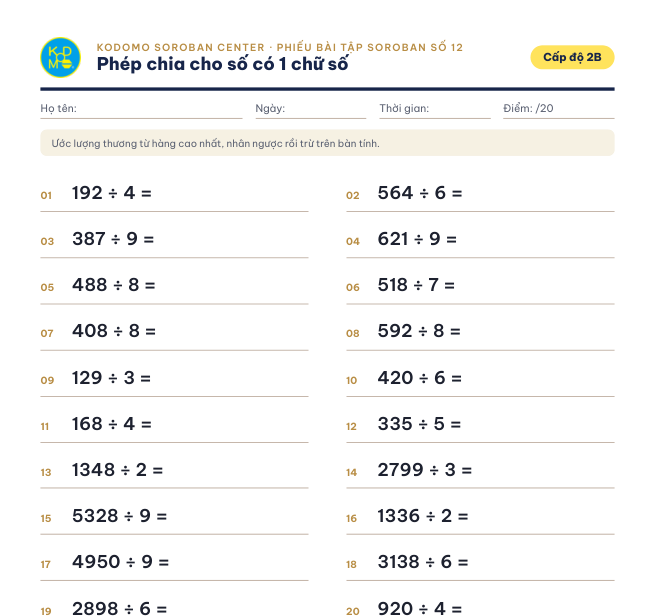
Division by a 1-digit number
20 problems with no remainder, 2–3-digit quotients. Estimate from the highest place, multiply back and subtract.
Register to download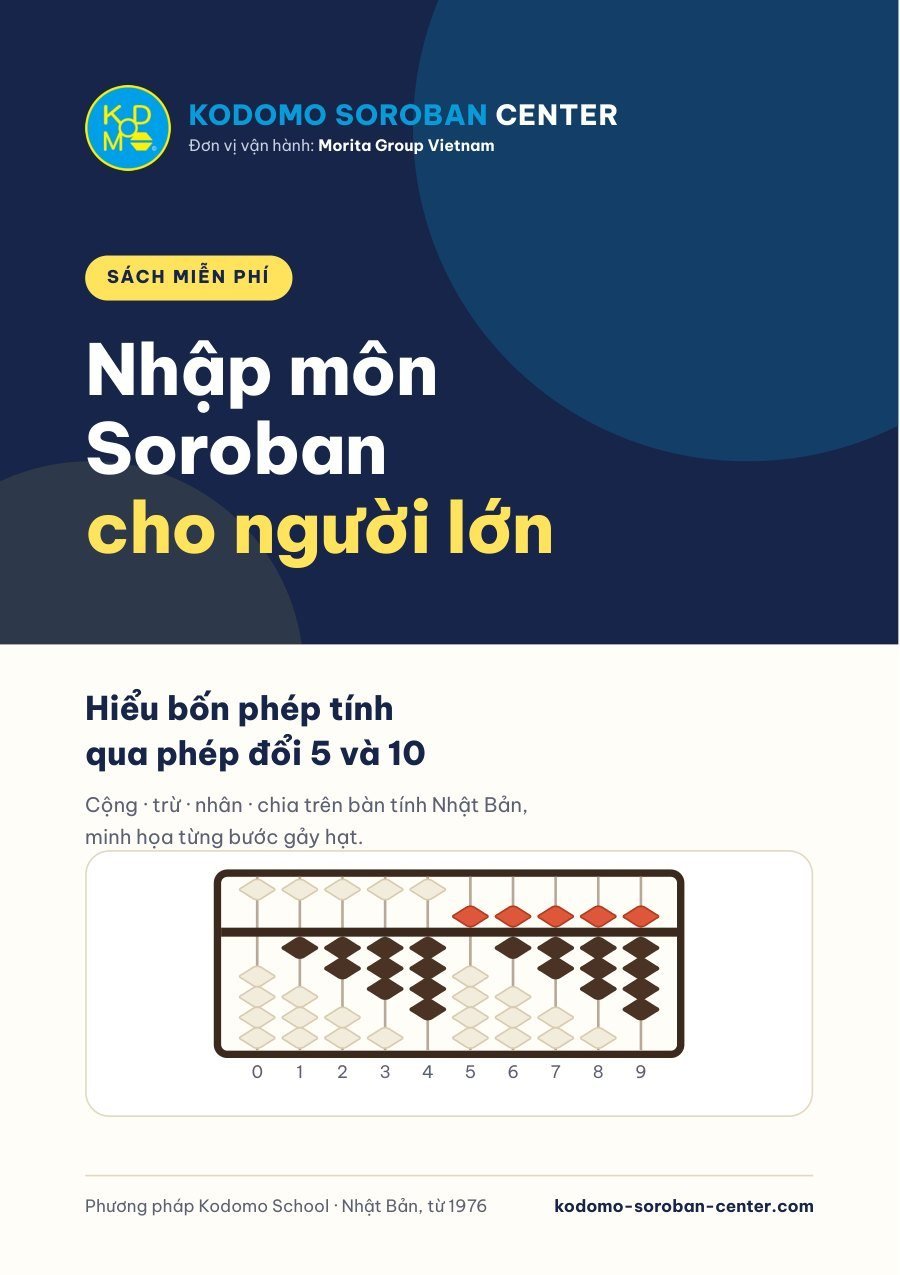
Introduction to Soroban for Adults (Vietnamese)
Want to understand why these rules work? A free book that explains each step with bead diagrams, with answers.
See the bookMental math for grades 1–2 · no abacus needed
For every parent of a child in grades 1–2, even without soroban. The right order: up to 10 → crossing 10 → up to 100. Step-by-step guidance in Teaching a first-grader mental math.
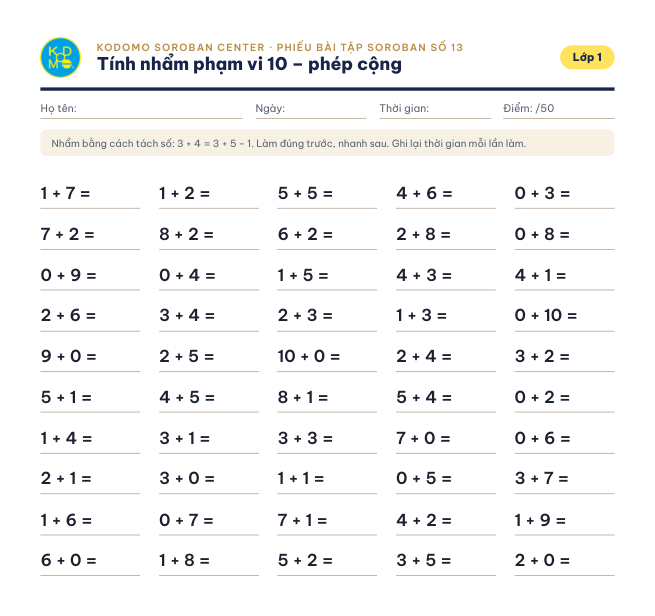
Mental math up to 10 – addition
50 additions within 10. The warm-up for every first-grader; this sheet opens right away.
Download PDF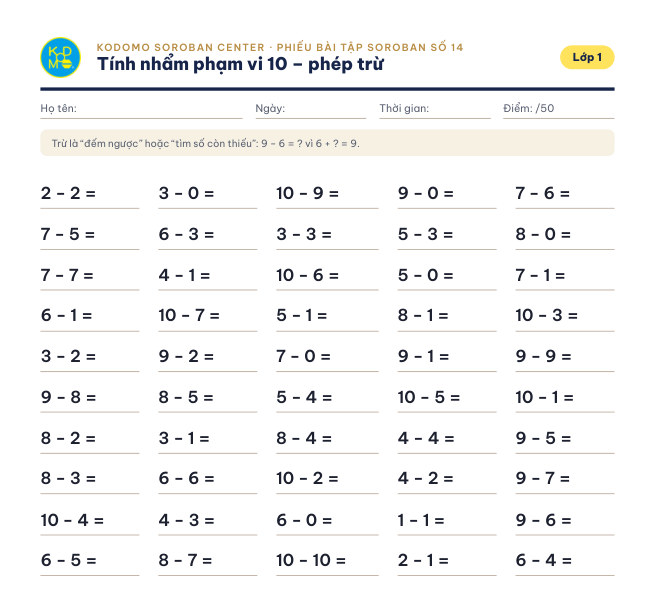
Mental math up to 10 – subtraction
50 subtractions. Subtraction is “finding the missing number”: 9 − 6 = ? because 6 + ? = 9.
Register to download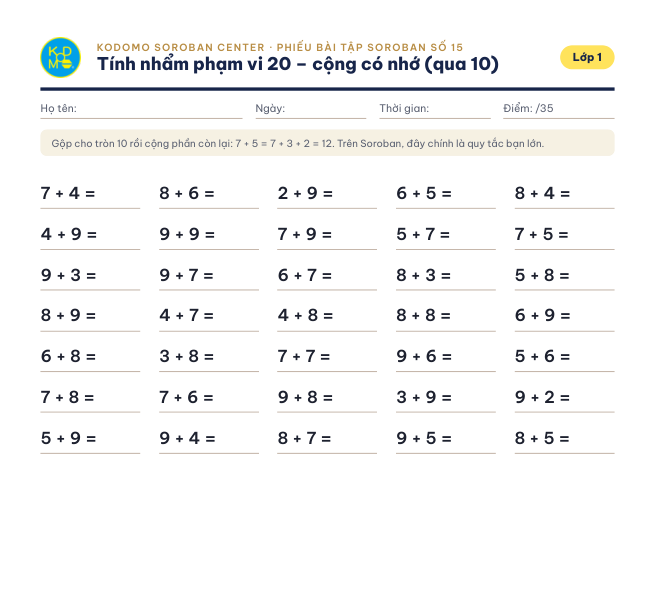
Mental math up to 20 – crossing 10
35 additions with carrying (7 + 5…). Make 10 first, then add the rest.
Register to download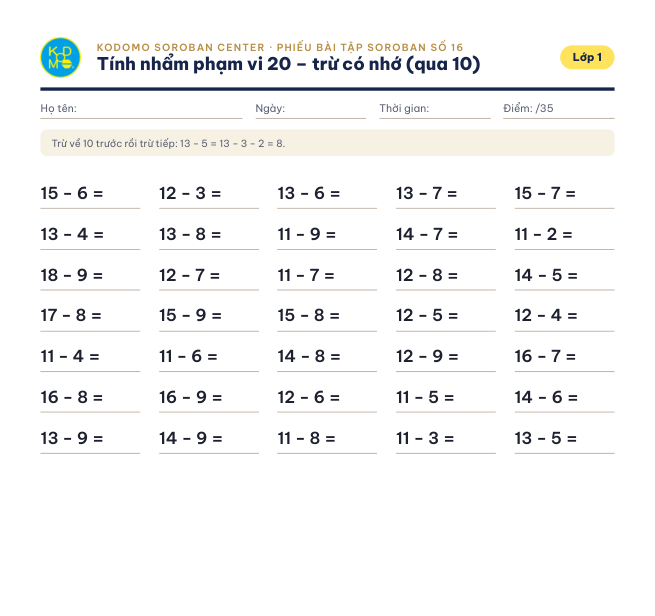
Mental math up to 20 – subtraction crossing 10
35 subtractions with borrowing (13 − 5…). Subtract down to 10 first, then the rest.
Register to download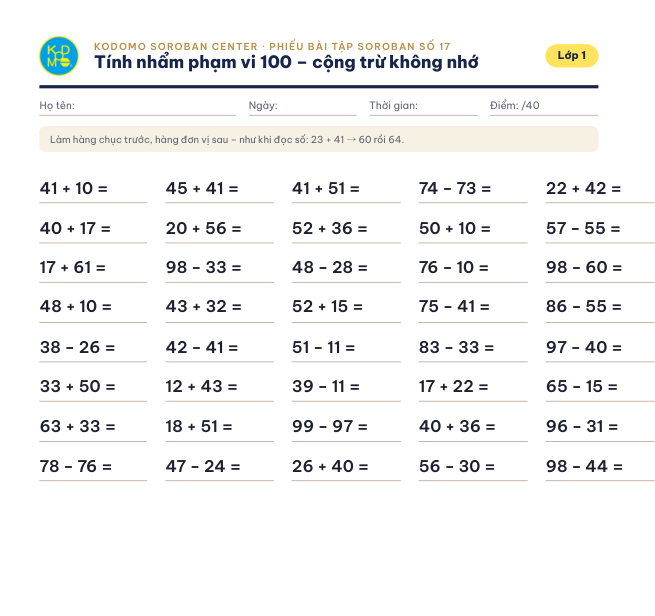
Mental math up to 100 – no carrying
40 two-digit additions and subtractions without carrying. Tens first.
Register to download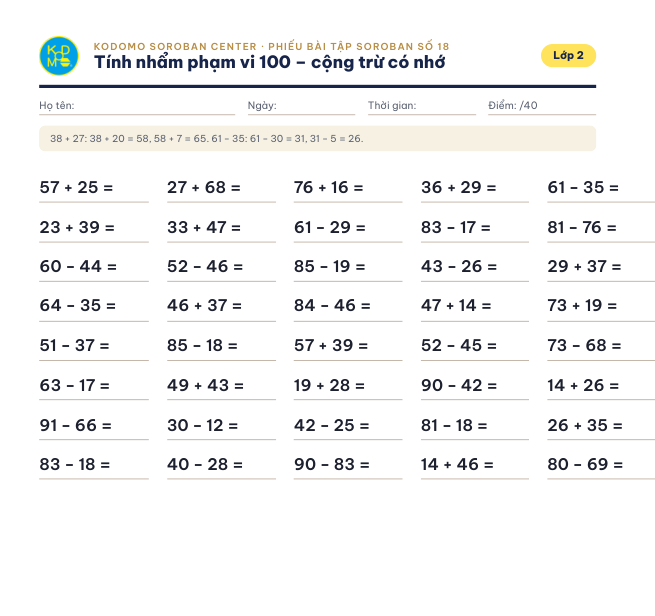
Mental math up to 100 – with carrying
40 additions and subtractions with carrying (38 + 27, 61 − 35). For grade 2.
Register to downloadGrade-1 thinking math
The problem types that appear in grade-1 thinking-math tests, with answers. Use together with What is “thinking math” in grade 1?.
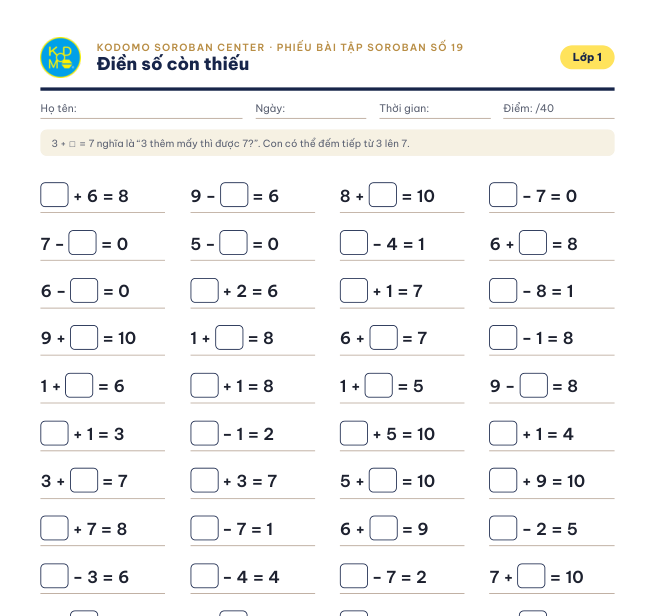
Fill in the missing number
40 problems like 3 + ☐ = 7 and ☐ − 2 = 5. Builds the “how many more” way of thinking.
Register to download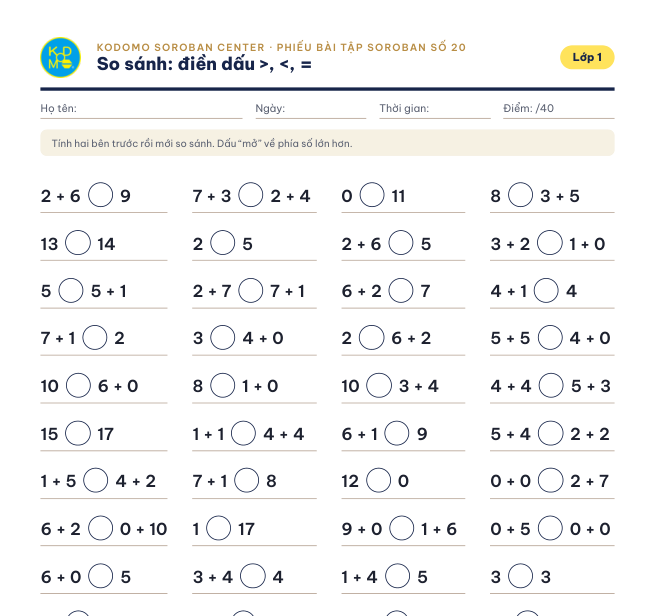
Compare: fill in >, <, =
40 comparisons with a calculation on each side. Work out both sides first, then compare.
Register to download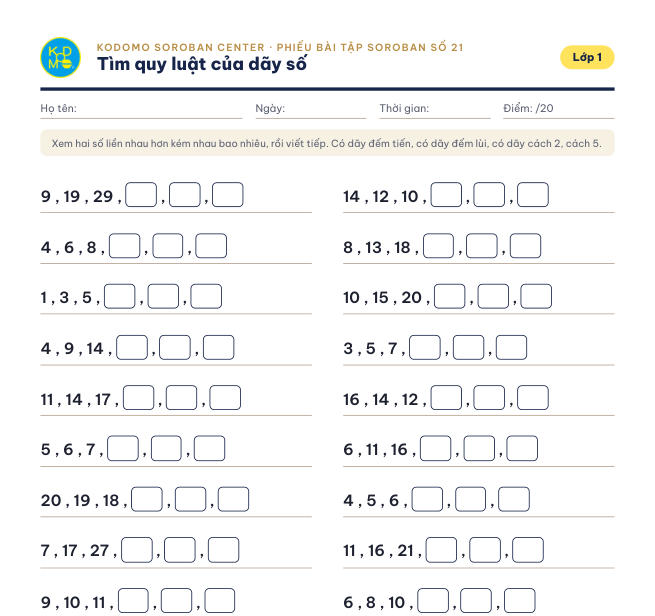
Find the pattern
20 sequences: counting up, counting down, in 2s, in 5s. Write the next 3 numbers.
Register to download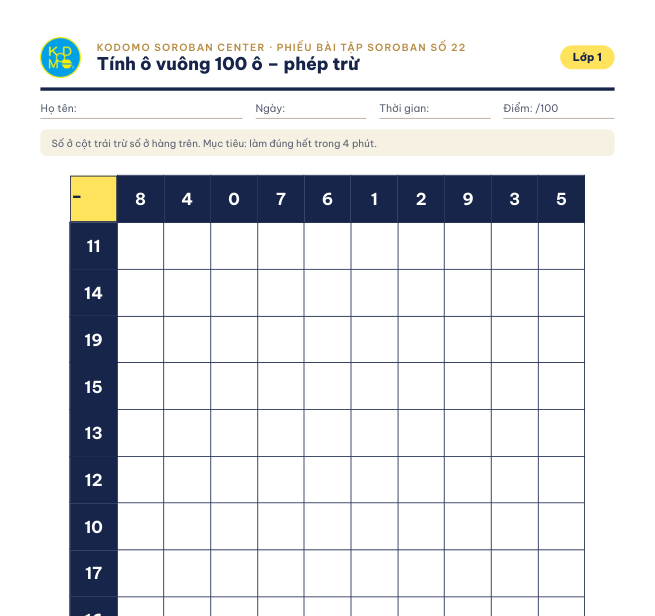
100-cell grid – subtraction
100 subtractions in one grid (10–19 minus 0–9). Goal: 4 minutes.
Register to downloadWhich sheet for my child?
| Where your child is | Sheets to use | Notes |
|---|---|---|
| Grade 1, no soroban yet, wants faster mental math | 13 → 14 → 15 → 16 → 17 | No abacus needed. Follow the 5 steps for teaching mental math. |
| Grade 1, practicing thinking math | 19 → 20 → 21 → 22 | One type a week, three times each. |
| No soroban yet, ages 5–7 | 01 → 02 → 04 | 1–2 weeks per sheet. Before the sheet, you read numbers and your child sets them on the abacus. |
| No soroban yet, age 8+ or adult | 01 → 03 → 05 → 06 → 08 | Read together with Learning soroban at home. |
| Learning Level 0 at KSC / school club | 01 – 04 | Review the week’s content; do not run ahead. |
| Learning Level 1A | 05 – 07 | Do 05 and 06 separately; do not mix yet. |
| Learning Level 1B | 08 – 10 | Sheets 09 and 10 are in test format. |
| Learning Level 2 | 11 – 12 | Add problems from the generator below. |
Out of sheets? Generate unlimited problems
Kodomo Soroban Center’s problem generator: choose the operation, digits, number of terms and number of problems, then print. For when your child has finished the sheets above.
The tool opens in the frame; if it does not appear, open it in a new window. See the other learning tools.
Frequently asked questions
Are the worksheets really free? Why register?
Completely free. Sheets 01 (soroban) and 13 (mental math) open with no registration. For the rest we ask for your name, phone number and your child’s grade – once only – so we can send new sheets via Zalo and, if you wish, suggest a suitable class. We do not send marketing messages. Parents, teachers and clubs are welcome to print and use them; please just keep the footer.
How are the problems generated?
With KSC’s own program: every problem is checked for which rule it needs (direct, 5-friend, 10-friend, combined), so a sheet only contains problems that match its level. That is why sheet 05 has no carrying at all, while every problem on sheet 06 carries.
How fast does my child need to be?
The KSC standard is 80% correct within the set time. At home, compare today’s time with yesterday’s; when your child gets 80% right and the time stops improving, move to the next sheet.
Is there a sheet for mental math (anzan)?
Mental math is best practiced with a parent reading numbers while the child “moves the beads” in their head, starting with the small problems on sheets 01–02 once they are solid on the abacus. Flash anzan needs software that shows numbers; at KSC children practice it every lesson from lesson 6 (you can also use our online trainer).
Practicing at home is good. Learning the right finger technique from the start is better.
Classes of 3–5 at Vinhomes Gardenia (Hanoi); the teacher watches every finger. Free trial lesson.