
The benefits of learning soroban
Soroban does more than teach children to calculate quickly. In every lesson, children practice concentration, picturing numbers, and the habit of sticking with a task. Below you’ll find the changes parents often notice, what scientific research tells us, and how you can support your child at home.
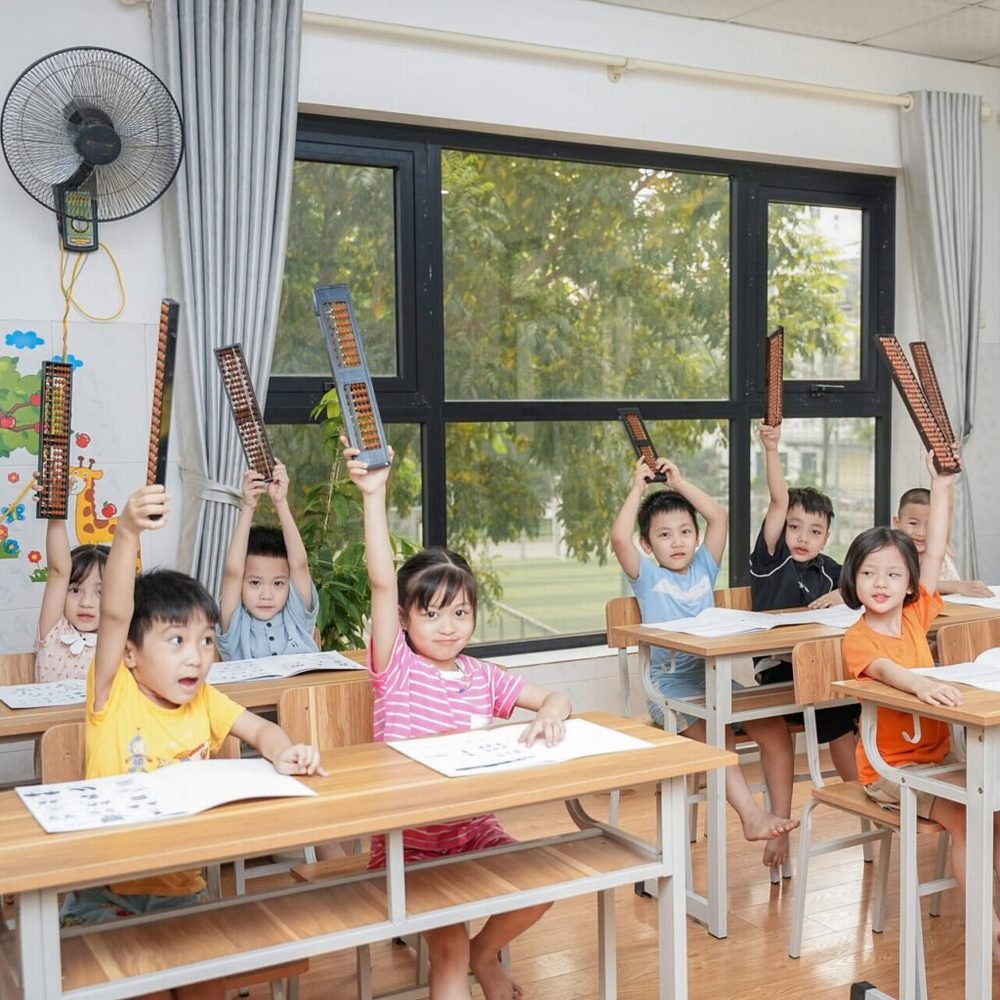
What does your child gain from soroban?
Each benefit comes with something parents can notice in their child’s everyday life.
Fast, accurate calculation
Timed practice helps children get a little faster after every lesson, and moving each bead carefully helps them get the right answer all the way to the end.
What parents may notice: your child adds up money, counts things and does math problems faster and with fewer mistakes.
Understanding numbers and place value
Each rod is a place, and each bead is a number. Children understand “tens, hundreds, thousands” with their own hands, not just by memorizing.
What parents may notice: your child reads and compares large numbers more easily.
Concentrating for longer
Eyes on the problem, fingers on the beads, mind holding the numbers – all at the same time. Short timed drills train children to keep their full attention.
What parents may notice: your child can sit and work for longer without getting distracted.
Remembering numbers as images
In mental calculation, children hold numbers as an image of the abacus in their head. This is how skilled soroban users remember long strings of numbers.
What parents may notice: your child remembers phone numbers, dates and prices better.
Perseverance and confidence
Each level is a little harder than the last. Children record their own times and scores and see their progress – the joy of “I did it!” grows into confidence.
What parents may notice: when something doesn’t work yet, your child wants to try again instead of giving up.
Japanese-style learning habits
Greetings at the start and end of class, sitting with good posture, getting out and putting away their own materials – small habits, done the Japanese way.
What parents may notice: your child keeps their study corner tidy and greets people more politely.
What does scientific research say?
Soroban and the “mental abacus” have been studied for many years. We summarize the findings honestly, including their limits.
Faster and more accurate
Children who learned the mental abacus calculated faster and more accurately than children who did not. (Stigler, 1984; Frank & Barner, 2012)
Numbers remembered as images
Skilled users remember much longer strings of digits than most people – but only for numbers. (Hatano & Osawa, 1983)
Effective when children truly master it
A three-year trial with children aged 5–7 found clearer gains in arithmetic and in understanding place value. (Barner et al., 2016)
The clearest benefits are in calculation and in understanding place value, and they appear when children practice regularly. For details and references, see our page Why learn soroban the Japanese way?
When will you see progress?
- First weeks
Posture and moving the beads
Your child learns how to sit, how to move the beads and how to read numbers on the abacus.
- Level 0
Adding and subtracting 1- to 3-digit numbers
Your child starts doing simple calculations mentally.
- 1A · 1B
Carrying and borrowing, mitorizan (column addition and subtraction)
Your child can do any addition or subtraction on the abacus, and mental calculation gets faster.
- Level 2
Multiplication and division
Your child learns multiplication and division on the abacus and takes graded exams in the Japanese kyu format.
Every child progresses at their own pace, depending on regular attendance and practice at home.
How parents can help at home
- Have your child practice a little every day with the home exercises in our textbook “Vui học Soroban”
- Praise your child’s own progress, without comparing them with other children
- Make sure your child comes to class regularly – steady practice matters more than cramming
- Ask your child to “teach” you a calculation on the abacus
- Read our free book “An introduction to soroban for adults” (in Vietnamese) to understand how your child learns
Let your child see for themselves in a trial lesson
Free trial lessons at our center in Vinhomes Gardenia, or ask about the in-school Soroban Club at your child’s school. Phone · Zalo 096.802.8484.