What is a soroban?
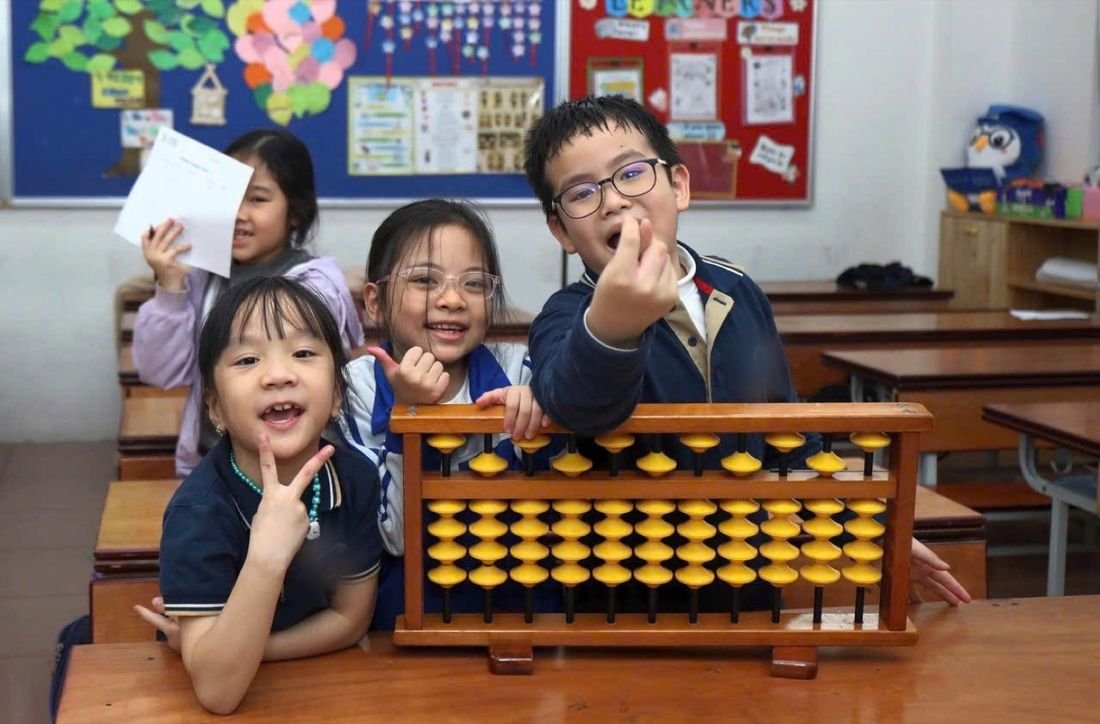
The soroban (そろばん) is the Japanese abacus. Each rod has 1 upper bead worth 5 and 4 lower beads worth 1 each. With this simple arrangement of beads, the soroban can show any number – and it helps children add, subtract, multiply and divide, and then calculate in their heads without the abacus at all.
Parts of the soroban
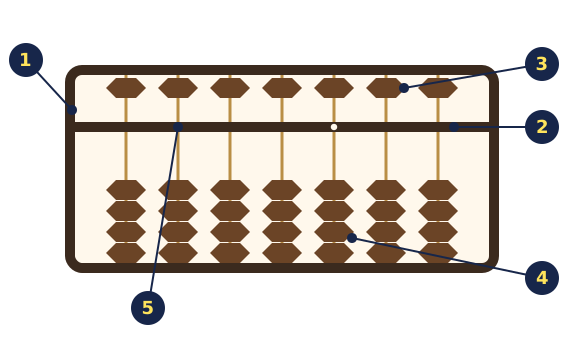
A soroban has many vertical rods. Each rod stands for one place value: ones, tens, hundreds, thousands…
- 1
Frame
Holds the rods and the beam in place.
- 2
Beam
Divides the abacus into an upper and a lower part. Beads moved against the beam are counted.
- 3
Five-bead (upper bead)
Each rod has 1 of these, worth 5.
- 4
One-beads (lower beads)
Each rod has 4 of these, each worth 1.
- 5
Marker dots
There is a dot every 3 rods, so it is quicker to find the ones place, the thousands place and so on.
Showing numbers on the soroban
The number on a rod = 5 × (five-beads against the beam) + (one-beads against the beam). Each number from 0 to 9 can be set in only one way.
Multi-digit numbers
Each digit goes on its own rod, from left to right, just as you write the number. The picture shows the number 2026: 2 in the thousands place, 0 in the hundreds, 2 in the tens and 6 in the ones.
Where does the soroban come from?
- 16th c.
From China to Japan
The abacus was brought to Japan from China, and the Japanese gradually improved it.
- Edo era
“Reading, writing and soroban”
In the temple schools for children (terakoya) of the Edo era, soroban was taught alongside reading and writing as a basic skill.
- 1930s
One upper bead, four lower beads
The compact soroban with one five-bead and four one-beads became the standard in Japan, making calculation faster and easier to picture.
- Today
In Japanese schools
Soroban is part of the primary school math curriculum in Japan (grades 3 and 4), and many children also attend soroban classes after school.
The soroban and the Chinese abacus
| Soroban (Japan) | Chinese abacus (suanpan) | |
| Upper beads | 1 bead (worth 5) | 2 beads |
| Lower beads | 4 beads (worth 1) | 5 beads |
| Setting numbers | Each number can be set in only one way | Some numbers can be set in more than one way |
| Features | Compact, with fewer beads; easy to picture in the mind for mental calculation | More beads; a traditional design |
How do children learn soroban?
Children start with a real abacus and, little by little, need only the “abacus in their head”.
Moving the beads by hand
Children learn how to sit, how to hold a pencil, and how to move the beads with the thumb and index finger. Each bead stands for a number, so children understand place value with their own hands.
Picturing the beads
Once they are comfortable, children look at a problem and imagine the beads moving. The abacus moves into the mind.
Mental calculation (anzan)
Children add and subtract multi-digit numbers quickly and accurately, without paper or an abacus.
Frequently asked questions
At what age can children start learning soroban?
Children can start from age 5. At the KSC center, there is a Kindergarten class for 5-year-olds and a Primary class for children up to age 12.
My child isn’t strong at math yet. Can they still learn?
Yes. Every new student starts at Level 0: getting to know the abacus, how to sit, how to move the beads and how to read numbers. Soroban helps children see numbers as pictures, so many children come to enjoy numbers more.
Is soroban the same as “math for developing thinking skills”?
Many places use “math for developing thinking skills” as a general name, but the teaching methods are very different. KSC teaches the same method that is used in Japan today. Learn more on our page Why learn soroban the Japanese way?
Would you like to learn how soroban calculation works yourself?
Read our free book “An introduction to soroban for adults” (in Vietnamese). It explains each bead movement step by step for all four operations.
Let your child try a soroban lesson
Free trial lessons at our center in Vinhomes Gardenia. Phone · Zalo 096.802.8484.