Why do Japanese students clean their own schools – and how to bring the habit home
In many Japanese primary schools, the whole school stops for a while almost every day to clean. Students pick up brooms and cloths and clean their classrooms, corridors and stairs themselves – in many schools, the toilets too. Why do Japanese schools do this, and what can parents in Hanoi take from it? We are Japanese and teach soroban to children in Hanoi. The short answer: cleaning time is part of learning, not a replacement for janitors.
In Japan, cleaning the school is part of the curriculum – a way for children to learn how to live in a group. During cleaning time, children learn:
- Shared spaces belong to me too
- Responsibility for the job you are given
- Working together – older pupils show younger ones
- Noticing and appreciating other people’s work
- Caring for things and making less mess
- At home: small, fixed jobs that fit the child’s age
What does cleaning time look like in Japanese schools?
In Japanese it is called sōji (掃除 – cleaning) or seisō (清掃). In many primary schools, cleaning time is on the timetable almost every school day, usually after lunch and the lunch break. Some schools do it in the morning.
Every school organizes it a little differently, but these points are common:
- Small groups (han), each with its own area, rotating weekly or each term
- Areas: classrooms, corridors, stairs, the shoe entrance, special classrooms, the gym; in many schools, the toilets too
- A teacher is in charge of each area, shows how to clean and often works alongside the children
- In mixed-grade groups, sixth-graders show younger pupils how to sweep and wipe
- Some schools practice “silent cleaning” (mokugon seisō) to stay focused on the task
At the end of each term there is also a bigger, more thorough cleaning (ōsōji). Where does cleaning time fit in the school day? See A day in the life of a Japanese elementary school student.
Where does cleaning time fit in Japanese education?
Besides academic subjects, the Japanese school curriculum includes “special activities” (tokubetsu katsudō, or tokkatsu for short): class meetings, duty roles, serving lunch and school events. Cleaning time belongs here.
The national curriculum from Japan’s Ministry of Education says that through duties such as cleaning, students come to understand why it matters to be aware of their own role and to work with others, as members of society. Guidance for teachers adds that children should feel they are contributing to their class and school – not just getting a job done.
In moral education, grades 1–2 cover “knowing the value of work and working for everyone,” and helping with housework to be useful to the family. In grades 5–6, home economics (katei-ka) teaches how to tidy and clean a home.
“Japanese schools make students clean to save money.”
The curriculum treats cleaning as an educational activity, with goals and teacher guidance: responsibility, cooperation and a spirit of working for the group.
“Japanese schools have no janitors.”
Schools still have staff; many hire cleaning companies for windows, periodic deep cleaning and, in some schools, the toilets. Daily cleaning around the classrooms is the students’ job.
5 things children learn from cleaning their own school
Classrooms and corridors belong to everyone – and that includes me.
Each child has an area and a specific task. Leave it unfinished, and the whole group notices.
One sweeps, one wipes, one takes out the trash. Older pupils show younger ones how.
After wiping a corridor yourself, you understand how much work keeping it clean takes – and you appreciate the people who do it.
When they have to clean up themselves, children tend to be more careful with desks, chairs and books.
These lessons can be taught at home too. Every home has small “areas” a child can take on as their own – the toy corner, the shoe rack, the dinner table after a meal.
From what age can children tidy up by themselves? Suggestions by age
These are general suggestions, not standards – every child is different. Start with what your child can almost fully do, then add more.
- Ages 3–4Putting things back in the right box
Toys into boxes with pictures on them, their own bowl to the sink, dirty clothes into the basket, wiping up water they spilled.
- Ages 5–6Looking after their own space
Tidying the bookshelf and shoe rack; packing and putting away their school bag; setting chopsticks and wiping the table after meals; folding towels and simple clothes.
- Ages 7–9Owning an “area” of the home
Sweeping or mopping one room, taking out the trash, watering plants, hanging and folding laundry; clearing their desk every evening.
Don’t let children use bleach or strong chemicals on their own, or climb up high to clean. If your child helps clean the toilet, start small – wiping the sink – with gloves and an adult nearby.
How to teach your child to tidy up the Japanese-school way: 5 steps
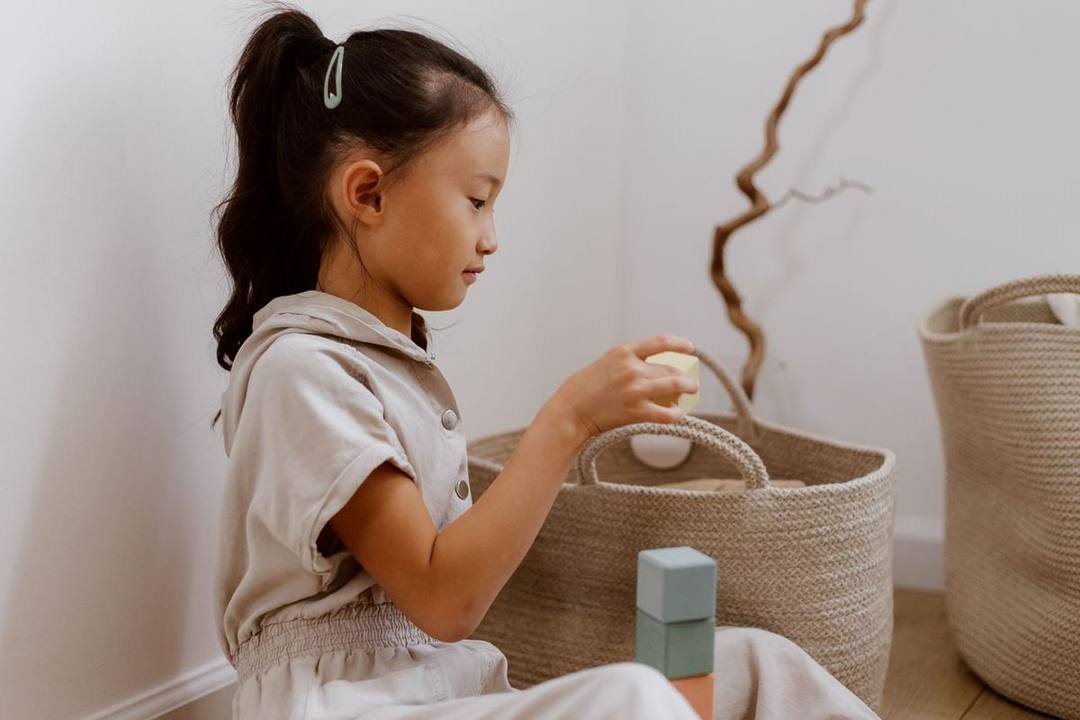
- Give everything an “address”
Children can’t tidy up if they don’t know where things go. Boxes with photos, labeled shelves, a fixed place for each kind of thing. With fewer things out at once, tidying is quicker too.
Start at homeTake a photo of the play corner when it’s tidy and stick it on the wall: “when we’re done, it should look like this photo.”
- A short, fixed “tidy-up time”
Like in Japanese schools: the same moment every day, short, with a clear end. For example, 5 minutes before dinner – set a timer or play one song, and when the song ends, you’re done.
- Do it together → watch → hand it over
In the first week, do it together and say each step out loud. The next week, stand nearby and help only when asked. When your child can do it without reminders, hand the job over completely.
Start at homeThe hardest part belongs to the parents: waiting instead of taking over. See also How do Japanese parents raise independent children?
- A picture checklist
Three to five boxes: toys in the box, books on the shelf, desk clear. Your child checks each one off when done. Some Japanese schools also use cards for students to look back on their work after cleaning time.
- Praise exactly what your child did
Instead of “good job,” describe what they did: “You lined up the shoes – the entrance looks so neat.” Specific praise tells your child what to do next time – and don’t forget to say thank you.
The goal isn’t a clean room today – it’s a child who can tidy up tomorrow.
What not to do when teaching children to tidy up
Some adult habits can make children hate tidying, even with the best intentions:
- Using cleaning as punishment (“Naughty? Go mop the floor!”) – your child learns that cleaning is something bad.
- Redoing it right in front of your child because it’s “not clean enough” – they learn their effort is pointless.
- Giving money or a treat every time – household jobs become something to trade for a reward.
- Expecting perfection from the start – a 5-year-old’s folded shirt is supposed to be wrinkly.
If you want to correct something, pick one point, for next time: “Next time, let’s try folding it in half first.” Japanese schools do the same: teachers show how to hold a broom and how to wipe, then let children carry on.
3 minutes of tidying at the end of every soroban lesson
A soroban lesson at Kodomo Soroban Center lasts 60 minutes and has 7 parts. Part 6 is 3 minutes of “tidying up and arranging”: children clear the abacus to 0, put their things back where they belong and check that the desk is neat before the closing greeting.
Three minutes sounds short, but repeated every lesson, every week, it is the same “use it, then put it away” habit Japanese schools teach – on the scale of one desk. Each lesson also starts with 3 minutes of “getting ready and arranging”: children take out their things and put them in the right place.
A tidy desk makes it easier to focus. At our center in Vinhomes Gardenia, each class has 3–5 children, so the teacher can see each child tidy their own space.
See how a lesson works and 8 ways to build focus. The trial lesson is free – sign up on our Contact page or call or message us on Zalo at 096.802.8484.
Frequently asked questions
Do Japanese students clean the toilets?
In many schools, yes – in groups, on a rotation. But not in every school; some leave this to staff or cleaning companies. In Japan, some people have also raised hygiene and safety concerns about children doing this job.
Why don’t Japanese schools hire janitors to clean classrooms?
In fact, Japanese schools do have staff, and many hire cleaning companies for jobs such as windows or periodic deep cleaning. Daily cleaning is left to students because it is an educational activity in the curriculum: it builds responsibility, cooperation and a spirit of working for the group.
At what age can children tidy up by themselves?
From about age 3, children can put toys back in a box with an adult helping; at 5–6 they can look after their own space (bookshelf, shoe rack, school bag); at 7–9 they can take on a fixed household job such as sweeping a room or taking out the trash. These are general suggestions – start with what your child can do.
How can I get my child to tidy up toys without being told?
Give each thing a clear place, keep a fixed 5-minute tidy-up time every day, do it together at first and then step back, and praise exactly what your child did. Don’t use tidying as a punishment.
What is 5S, and can it work for children?
5S is a way of keeping workplaces orderly that began in Japanese factories: Seiri (sort out what you don’t need), Seiton (set in order), Seisō (clean), Seiketsu (keep it clean), Shitsuke (make it a habit). For children, a light version works: fewer things you don’t use, a place for everything, put things away after use, and repeat every day until it becomes a habit.
Try a free soroban lesson
Classes of 3–5 children at Vinhomes Gardenia (Hanoi), 60 minutes each, taught exactly as in Japan. Phone · Zalo 096.802.8484.

Written by the teaching team of Kodomo Soroban Center, following the method and textbooks of Kodomo School (Japan, teaching soroban since 1976). The center is licensed by the Hanoi Department of Education and Training, and our project is a 2026 EDU-Port Nippon supported project of Japan’s Ministry of Education (MEXT).
About usEDU-Port NipponEducation licenseRelated articles
A day in the life of a Japanese elementary school student: what time school starts, how lunch works and when summer break is
What time do Japanese elementary students go to school, when do they start school and how long is summer break? A typical…
What should a 5-year-old learn? 6 activities and how to choose by your child’s temperament
What should a 5-year-old learn? 6 popular activities – swimming, martial arts, music and dance, art, English and thinking math: what each…
How to learn the times tables fast: 7 fun ways for kids, tips for the 7, 8 and 9 tables and a free worksheet
How to help your child learn the times tables fast: understand multiplication first, start with easy tables, only 36 facts to learn,…