Soroban or Finger Math? Comparing 4 popular kinds of “thinking math” for children
In Vietnam, “thinking math” is a common label for at least four very different things: Finger Math, Japanese soroban, franchised abacus programs, and logic math. Parents are often told that “they all develop thinking”, and end up choosing whichever center is nearest to home. This article puts the four side by side using the same yardstick – tool, number range, age, goal – so you can choose for your child, not by the advertising.
Finger Math suits children aged 3–6 for getting used to addition and subtraction up to 99 using their fingers, and it stops there. Japanese soroban suits children from age 5 who want to go further: adding, subtracting, multiplying and dividing numbers with many digits, then calculating mentally using the image of an abacus in their head. The two do not “connect” – a child who has finished Finger Math still starts soroban from the beginning. If your child is 5 or older and you want them to be able to do mental math, start straight away with soroban.
What are the four kinds of “thinking math”, really?
Finger Math
Finger Math uses 10 fingers to represent numbers from 0 to 99: one hand is the ones, the other hand is the tens, and the thumb is worth 5. Children learn addition and subtraction by folding and stretching their fingers according to rules. Its biggest strengths: no equipment is needed, 3–4-year-olds can learn it, and children can “see” small additions and subtractions. Its limits are just as clear: the number range stops at 99, there is no multiplication or division, and once children move up to primary school they stop using their fingers – the skill does not keep developing.
Japanese soroban
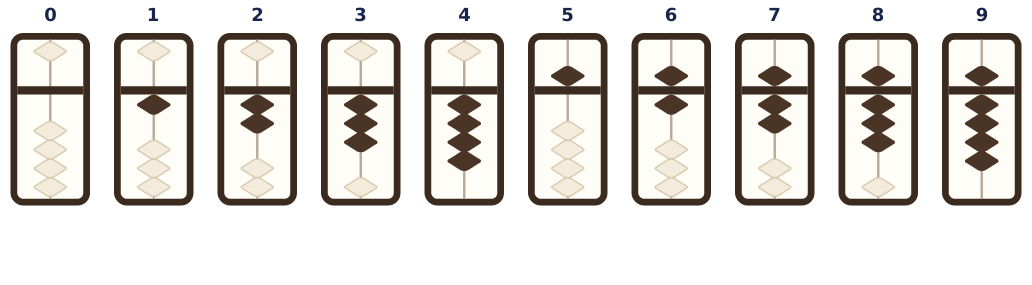
The soroban is the Japanese abacus, with one 5-bead and four 1-beads on each rod. Children start with a real abacus, learn the two exchange rules (the 5-friend rule – exchanging through 5, and the 10-friend rule – exchanging through 10), then gradually calculate with the “abacus in their head” (anzan). The Japanese method also links soroban with posture, learning habits and perseverance; soroban is still part of the grade 3–4 math curriculum in Japan and is one of the most popular extra-curricular activities there. The number range is unlimited, and it includes multiplication, division and decimals. See also What is soroban? and why choose Japanese soroban.
Franchised abacus programs
Some international programs – for example UCMAS, which started in Malaysia in 1993 – also use the abacus and aim for mental calculation, but they are packaged as franchise systems with their own materials, levels and competitions. In terms of the tool, these programs are close to soroban; the differences lie in how lessons are organized, the pace, the focus (often leaning towards speed and competitions) and the order in which operations are taught. When comparing, parents should ask specifically which rules the class teaches, when mental math begins and how many children are in a class, rather than looking at the program name.
Logic math / curriculum-based thinking math
This group uses neither an abacus nor fingers. Children learn to solve word problems, geometry, reasoning and patterns – close to Singapore math or thinking-math competitions. The goal is the way of thinking, not calculation speed. This group complements soroban well rather than replacing it, because soroban trains calculation and concentration, while logic math trains reasoning.
Comparison table: Japanese soroban and Finger Math
| Finger Math | Japanese soroban | Franchised abacus | Logic math | |
|---|---|---|---|---|
| Tool | 10 fingers | 1–4-bead abacus → abacus in the head | Abacus → mental math | Paper, pictures, games |
| Number range | 0–99 | Unlimited, including decimals | Unlimited | Depends on the curriculum |
| Operations | Addition, subtraction | Addition, subtraction, multiplication, division | Addition, subtraction, multiplication, division | All kinds of math |
| Suitable age | 3–6 | 5–12 (adults can learn too) | Usually 4–12 | From kindergarten to lower secondary |
| Final goal | Getting used to addition and subtraction | Visual mental math, concentration, learning habits | Mental math, competitions | Problem-solving thinking |
| Time to complete the course | A few months | About 3 school years (1 session/week) | 2–4 years depending on the program | Depends on the class |
| Link with school math | Stops at the end of grade 1 | Supports all through primary: place value, times tables, fast calculation | Similar to soroban | Supports the reasoning side |
4 important differences between soroban and Finger Math
1. The path: Finger Math stops at 99, soroban keeps going
With Finger Math, 99 is the physical limit of two hands. With soroban, one more rod means one more place; a 13-rod abacus can show numbers up to the trillions. More importantly, the way numbers are set on the soroban is exactly the same as the way they are written (left to right, one digit per rod), so what children learn within 10 still holds within 1,000,000.
2. The destination: fingers stay on the hands, the abacus moves into the head
The final goal of Japanese soroban is anzan – mental calculation using the image of the abacus. Children close their eyes, “see” the beads move and read off the answer. Brain imaging research in Japan has shown that skilled anzan users rely on the visual–spatial processing areas rather than the language areas when they calculate. Finger Math has no such step; once children stop using their fingers, the skill stops too.
3. Soroban’s two exchange rules are grade 1–2 math
To add 3 + 4 on the soroban, children add 5 and then take away 1 (the 5-friend rule). To add 7 + 5, they take away 5 and then add 10 (the 10-friend rule). These two rules are exactly the “splitting and combining numbers” taught in grade 1–2 math textbooks. A child learning soroban understands that 4 is “5 take away 1” not because the teacher said so, but because their hands have done it hundreds of times. Finger Math also has the thumb = 5 rule, but it does not go on to exchanging through 10 in a way that connects with place value.
4. What a comparison table cannot show: learning habits
A Japanese soroban lesson begins with standing up to greet, placing the abacus in the right spot and sitting up straight, and ends with resetting the abacus to 0, putting things away and saying thank you. Many Japanese families send their children to soroban for this part first, and for fast calculation second. This is something parents should observe for themselves during a trial lesson, at any class.
My child has already learned Finger Math – should they switch to soroban?
Yes, and there is nothing to regret. Finger Math is not “wrong”; it is a good bridge for 3–5-year-olds getting used to addition and subtraction. But the two systems represent numbers in different ways, so your child will still start soroban at Level 0 like everyone else: posture, how to move the beads, setting numbers, and only then the rules. Your child’s advantage is being used to the idea that “5 is a group” – they usually settle in faster in the first week.
Something to watch for in the first 2–3 weeks: out of habit, your child may hold up their fingers when doing mental math. The teacher will gently bring their hands back to the abacus; at home, parents only need to avoid asking their child to “calculate fast” during this period.
Choose by your child, not by the program name: 3 questions
- How old is your child, and how long can they sit and concentrate?
Under 5 and not yet able to sit for 15 minutes: counting games or Finger Math at home are enough. From 5: soroban in a slower-paced class (the Kindergarten class at KSC). From 6: soroban is the clear choice.
- What does your family want after 1 year?
If you want your child to “know how to add and subtract before grade 1”: Finger Math can do that. If you want your child to do mental math with 2–3-digit numbers, understand place value and have the habit of sitting down to learn: soroban. If you want your child to solve reasoning problems: logic math (which can be learned alongside soroban).
- When does that class start teaching mental math?
This question separates a good soroban class from one that only teaches moving beads. The Japanese method brings in mental math from the 4th lesson, with small numbers. If the class answers “after 1 year”, think carefully.
Frequently asked questions
How are Finger Math and soroban different?
Finger Math uses 10 fingers, can show numbers up to 99 and covers only addition and subtraction; it suits children aged 3–6. Soroban uses a 1–4-bead abacus, has no limit on the number range, includes multiplication and division, and its destination is mental calculation using the image of an abacus in the head; it suits children from age 5.
Should my child learn Finger Math first and then soroban?
It is not necessary. The two do not follow on from each other; a child who has finished Finger Math still starts soroban at Level 0. If your child is already 5 or older, they can start straight away with soroban.
Are soroban and UCMAS the same?
Both use the abacus and aim for mental calculation. The differences lie in how lessons are organized, the pace, the focus (competitions or learning habits) and the order in which operations are taught. Ask the specific class which rules they teach, when mental math begins and how many children are in a class.
After learning soroban, does my child still need logic math?
The two complement each other: soroban trains calculation, place value and concentration; logic math trains reasoning and problem solving. Many children learn both at the same time, as long as their weekly schedule is not too full.
Try a free soroban lesson
Classes of 3–5 children at Vinhomes Gardenia (Hanoi), 70 minutes each, taught exactly as in Japan. Phone · Zalo 096.802.8484.
Written by the teaching team of Kodomo Soroban Center, following the method and textbooks of Kodomo School (Japan, teaching soroban since 1976). The center is licensed by the Hanoi Department of Education and Training, and our project is a 2026 EDU-Port Nippon supported project of Japan’s Ministry of Education (MEXT).
About usEDU-Port NipponEducation licenseRelated articles
How do Japanese parents raise independent children? 7 habits from Japanese schools that parents can start today
How do Japanese parents raise independent children? Not with iron discipline, but with 7 habits repeated every day at school and at…
What is Japanese “thinking math”? Soroban, Kumon, Gakken and how Japan teaches children math
What is Japanese “thinking math”? The Japanese don’t call it “thinking math” – they have 3 popular ways of teaching math: soroban…
My child can’t focus when studying – what can I do? 8 ways Japanese classrooms build concentration (for ages 5–8)
Your child can’t focus when studying – what can you do? A realistic view of attention spans at ages 5–8, 5 common…