Is learning soroban good for children? Are there any downsides? A frank answer from 50 years of teaching soroban
“Is learning soroban good?” and “Does soroban have any downsides?” are the two questions parents search on Google most often before booking a trial lesson. We have taught soroban in Japan since 1976 and in Hanoi since 2022, so let us answer plainly: soroban is very good if it is learned the right way – and there are also cases where it is better not to start yet. This article covers both sides.
Yes, soroban is good for children aged 5–12: they calculate faster and more accurately, understand place value with their own hands, concentrate for longer and feel more confident with numbers. Soroban does no “harm” as long as the class uses the right method, follows each child’s pace and does not chase results. The common worries – confusion with school math, dependence on the abacus, rote learning – can all be avoided, and we explain each of them below.
What is “good” about soroban? 5 things parents can see
The soroban (そろばん) is the Japanese abacus: each rod has 1 bead worth 5 and 4 beads worth 1. Children start by moving real beads, and gradually need only the “abacus in their head” to calculate mentally. If you are not yet sure how the soroban works, read What is soroban? first. Below are the changes parents most often tell us about after a few months.
Fast and accurate calculation
Every lesson includes a short timed exercise. Children work out 27 + 45 in their head faster and, more importantly, make fewer mistakes, because each bead is moved carefully.
Understanding “tens, hundreds, thousands” by hand
Each rod is one place. Children understand place value not by memorizing it, but by putting beads in the right place hundreds of times.
Longer concentration
Eyes on the problem, fingers on the beads, the number held in mind – all at once. It is a workout in full attention that is hard to get from other activities.
Remembering numbers as pictures
In mental math, children hold numbers as images of beads. Parents often notice their child remembers phone numbers, dates and prices much better.
Perseverance and confidence
Each level is a little harder, and children record their own times and scores and see themselves improve. This feeling of “I can do it” matters more than any number.
Japanese learning habits
Greeting at the start, sitting properly, preparing and putting away their own things. This is what schools and parents notice first – even before calculation speed.
Scientific research also supports these observations, within limits: children who learn the “abacus in the head” calculate faster and more accurately than those who do not (Stigler, 1984; Frank & Barner, 2012); skilled users remember much longer strings of digits (Hatano & Osawa, 1983); a 3-year trial with children aged 5–7 showed clear gains in arithmetic and place value (Barner et al., 2016). The clearest benefits lie in calculation and number sense – and they only appear when children practice regularly. We summarize this in more detail in Benefits of soroban.
Does soroban have any downsides? 7 common worries and the facts
Each worry below has its reasons. Many of them come from classes that teach it the wrong way, not from the abacus itself.
1. “My child will get confused with the way they calculate at school”
This is the question we hear most. The truth: soroban and school math train two different abilities that reinforce each other. School math builds logical thinking and how to set out working; soroban trains handling numbers visually and quickly. A child who is good at soroban still sets out sums and writes solutions like everyone else – they just reach the answer faster and more surely.
Confusion only happens when a soroban class teaches a “special method” with fingers or strange rules that is not connected to real numbers. With the Japanese method, numbers are set on the abacus from left to right exactly as they are written, so children do not have to learn two systems.
2. “My child will become dependent on the abacus”
Quite the opposite: the aim of Japanese soroban is to let go of the abacus. At KSC, children start mental math (anzan) from the 4th lesson and Flash Anzan from the 6th. The real abacus is only a stepping stone that lets the image of the beads move into the head. After Level 1, many children can already add and subtract 2-digit numbers with their eyes closed and nothing in their hands.
If a class has children moving beads month after month with no mental math, that is a sign the program is not right.
3. “Speed practice puts pressure on children and makes them afraid of learning”
This worry is well founded. Timed exercises are part of soroban, but how the clock is used decides everything. In Japan, the clock is used for children to compare themselves with themselves from the week before, not to rank them in front of the class. In every lesson, children record their own time and score on a progress sheet; the teacher looks at each child’s progress.
Signs of a class teaching it wrong: constant competitions, criticizing children for being slow, or praising only the fastest. Signs of a class teaching it right: children want to try again when they have not reached the target, and tell their parents about their own “record”.
4. “Soroban is rote learning, not thinking”
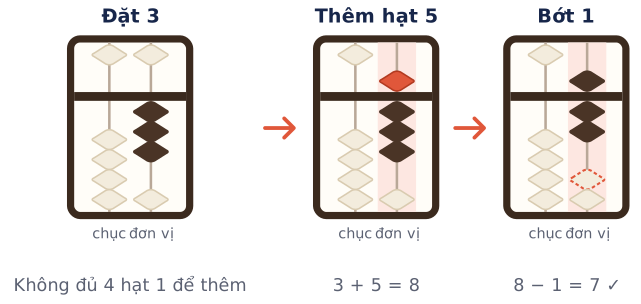
Addition and subtraction on the soroban rest on two very “thinking” rules: the 5-friend rule (exchanging through 5: 3 + 4 = 3 + 5 − 1) and the 10-friend rule (exchanging through 10: 7 + 5 = 7 − 5 + 10). To calculate, children have to understand that 4 is “5 take away 1” and 5 is “10 take away 5”. That is exactly the splitting and combining of numbers that the grade 1–2 math curriculum wants children to master. The difference is that children “see” and “touch” the splitting, instead of only hearing it explained.
What soroban cannot replace: word problems, geometry, reasoning. That is why we always say soroban supports math – it does not replace it.
5. “Sitting and moving beads for a long time is bad for eyes and posture”
A 60–70-minute soroban lesson involves no screens, and the first part of every lesson is… sitting with good posture. In the Japanese method, posture (姿勢) is taught from the very first lesson: a straight back, the abacus in the right place, using the thumb and index finger. Compared with an hour on a phone, an hour of soroban is far better for the eyes and the back.
6. “It costs time and money, and the results are not certain”
The full course at KSC is 80 sessions, divided into 5 modules of 16 sessions each, with tests in every module. With 1 session a week in an in-school club, children complete the course in about 3 school years. Results come from regularity, not intensity: 10 minutes of practice at home every day is better than 2 hours at the weekend. If your family cannot keep up at least 1 session a week, think carefully before starting.
7. “Is it harmful to start too early?”
There is a right age. Children under 5 usually do not yet have nimble enough fingers and cannot sit for 20 minutes, so starting too early easily leads to boredom. From age 5, children can begin in the slower-paced Kindergarten class; 6–8 is the “golden age”; 9–12-year-olds learn faster and still benefit a great deal. We have written a separate article on the best age to start soroban.
When is soroban not the right fit for your child?
We turn down some trial lessons, because learning at the wrong time is worse than not learning at all. Soroban is not yet right when:
- Your child cannot yet count to 10 or tell the digits apart. This is the foundation for setting numbers on the abacus. Give your child a few more months of counting games first.
- Your child cannot yet sit and concentrate for about 15–20 minutes. The Kindergarten class at KSC has a slow pace and includes games, but children still need to sit at the table.
- The family expects “2 months of lessons and super-fast mental math”. Mental math with 2-digit numbers usually needs the whole of Level 0 (16 sessions) plus practice at home. Wrong expectations turn every lesson into pressure for both child and parents.
- Your child’s schedule of extra classes is already too full. Soroban needs a slot in the week when your child still has energy. Adding one more class on a Friday evening rarely works.
On the other hand, soroban suits especially well children who are “afraid of numbers”, children who get math right but slowly, and children who need to build the habit of sitting down to learn. These three groups make the clearest progress in our classes.
How can your child learn soroban “the right way”? 6 questions to ask when choosing a class
The benefits – or “downsides” – of soroban depend largely on how it is taught. When you go to a trial lesson at any soroban class, ask these 6 questions:
- Which method and which textbook do you teach with?
“Soroban” is not the name of a method; there is the Japanese way, the Malaysian way, and many variations. Ask specifically: how are the 5-friend and 10-friend rules taught, how are multiplication and division taught, and what is the textbook? At KSC, the textbook Vui học Soroban is written to follow exactly how soroban is taught in Kodomo School classes in Japan.
- When does my child start mental math?
If the answer is “after mastering the abacus”, ask next: “how long is that?”. The Japanese method brings in mental math very early (lesson 4) with small numbers, because the image of the beads has to be built alongside the hand movements.
- How many children are in a class?
Moving beads with the wrong finger is a mistake that has to be corrected from the first week. In a class of 3–5, the teacher can watch every finger. In a class of 15, they cannot.
- Are there tests and a progress sheet?
Tests are not for ranking, but so that children and parents can see where the child is. KSC has 3 tests in each module, and the pass mark is 80% correct within the set time.
- Does the lesson include time for building learning habits?
Greetings, setting out and putting away materials, resetting the abacus to 0 – these small things are the reason many Japanese families send their children to soroban, not only for fast calculation.
- What does my child practice at home, and who guides it?
A good class gives short homework worksheets (10 minutes) and guidance so that parents can do them together with their child. We also have free worksheets and the book Introduction to Soroban for Adults (in Vietnamese) so that parents can understand for themselves how their child calculates.
How is Japanese soroban different from other kinds of “thinking math”?
In Vietnam, “thinking math” is a common label for many very different things: Finger Math, franchised abacus programs, Singapore-style logic math… Each has its own goals, and not all of them lead to visual mental calculation. The table below gives a quick summary; the article Soroban or Finger Math? compares them in more detail.
| Japanese soroban (KSC) | Finger Math | Logic / thinking math | |
|---|---|---|---|
| Tool | Abacus with 1 bead above and 4 below, then the abacus in the head | 10 fingers | Problems, pictures, games |
| Number range | Unlimited; includes multiplication, division, decimals | Usually up to 99, addition and subtraction | Depends on the curriculum |
| Goal | Visual mental math, concentration, learning habits | Getting young children used to addition and subtraction | Reasoning, problem solving |
| Suitable age | 5–12 (adults can learn too) | 3–6 | All ages |
Conclusion: good – with conditions
Learning soroban is good for most children aged 5–12, and we have not seen any “harm” coming from the abacus when the class uses the right method. The things parents worry about – confusion with school math, dependence on the abacus, speed pressure – are all the result of how it is taught, and can all be avoided by choosing a class carefully. The surest way to find out whether soroban suits your child is a trial lesson: see whether your child enjoys moving the beads, whether they can sit through it, and whether the teacher watches every one of your child’s fingers.
Frequently asked questions
Does learning soroban have any downsides?
Soroban itself does no harm. The problems parents worry about (confusion with school math, dependence on the abacus, pressure) all come from teaching it the wrong way: no mental math, classes that are too large, or using the clock to rank children instead of letting them compare themselves with themselves.
Will learning soroban make my child slower at school math?
No. Your child still sets out sums and presents their working as the teacher asks; soroban just helps them reach the answer faster and more surely. Numbers on the soroban are set from left to right just as they are written, so children do not have to learn two systems.
How long before my child can do mental math?
At KSC, children do mental math with 1-digit numbers from the 4th lesson and Flash Anzan from the 6th. The goal after Level 0 (16 sessions) is to add and subtract 2-digit numbers with eyes closed. Progress depends a lot on 10 minutes of practice at home every day.
Should a 4-year-old start soroban?
Usually not yet. Under 5, fingers are not nimble enough and it is hard to sit and concentrate for 15–20 minutes. Let your child play counting games and learn to recognize the digits, then start the Kindergarten class from age 5.
Will soroban help my child do better at math?
Soroban helps with calculation and understanding place value – the foundation of primary math – and trains concentration. It does not replace learning to solve word problems or geometry. Think of soroban as a supporting activity, like swimming for fitness.
Try a free soroban lesson
Classes of 3–5 children at Vinhomes Gardenia (Hanoi), 70 minutes each, taught exactly as in Japan. Phone · Zalo 096.802.8484.
Written by the teaching team of Kodomo Soroban Center, following the method and textbooks of Kodomo School (Japan, teaching soroban since 1976). The center is licensed by the Hanoi Department of Education and Training, and our project is a 2026 EDU-Port Nippon supported project of Japan’s Ministry of Education (MEXT).
About usEDU-Port NipponEducation licenseRelated articles
How do Japanese parents raise independent children? 7 habits from Japanese schools that parents can start today
How do Japanese parents raise independent children? Not with iron discipline, but with 7 habits repeated every day at school and at…
What is Japanese “thinking math”? Soroban, Kumon, Gakken and how Japan teaches children math
What is Japanese “thinking math”? The Japanese don’t call it “thinking math” – they have 3 popular ways of teaching math: soroban…
My child can’t focus when studying – what can I do? 8 ways Japanese classrooms build concentration (for ages 5–8)
Your child can’t focus when studying – what can you do? A realistic view of attention spans at ages 5–8, 5 common…