 Thị trấn WakumaStudent login
Japanese Alphabet for Kids: Hiragana Chart, Reading, Stroke Order and Free Printable PDF Worksheets
Many children in Vietnam fall in love with Japanese through cartoons, manga or a family trip. To get started, they need just one thing: the Japanese hiragana chart – the 46 letters Japanese children learn first. We are Japanese and teach soroban to children in Hanoi. This article has the full chart with romaji, dakuten and combined sounds, how to write the letters the way Japanese schools teach, 10 greetings and two sets of PDF worksheets to print at home.
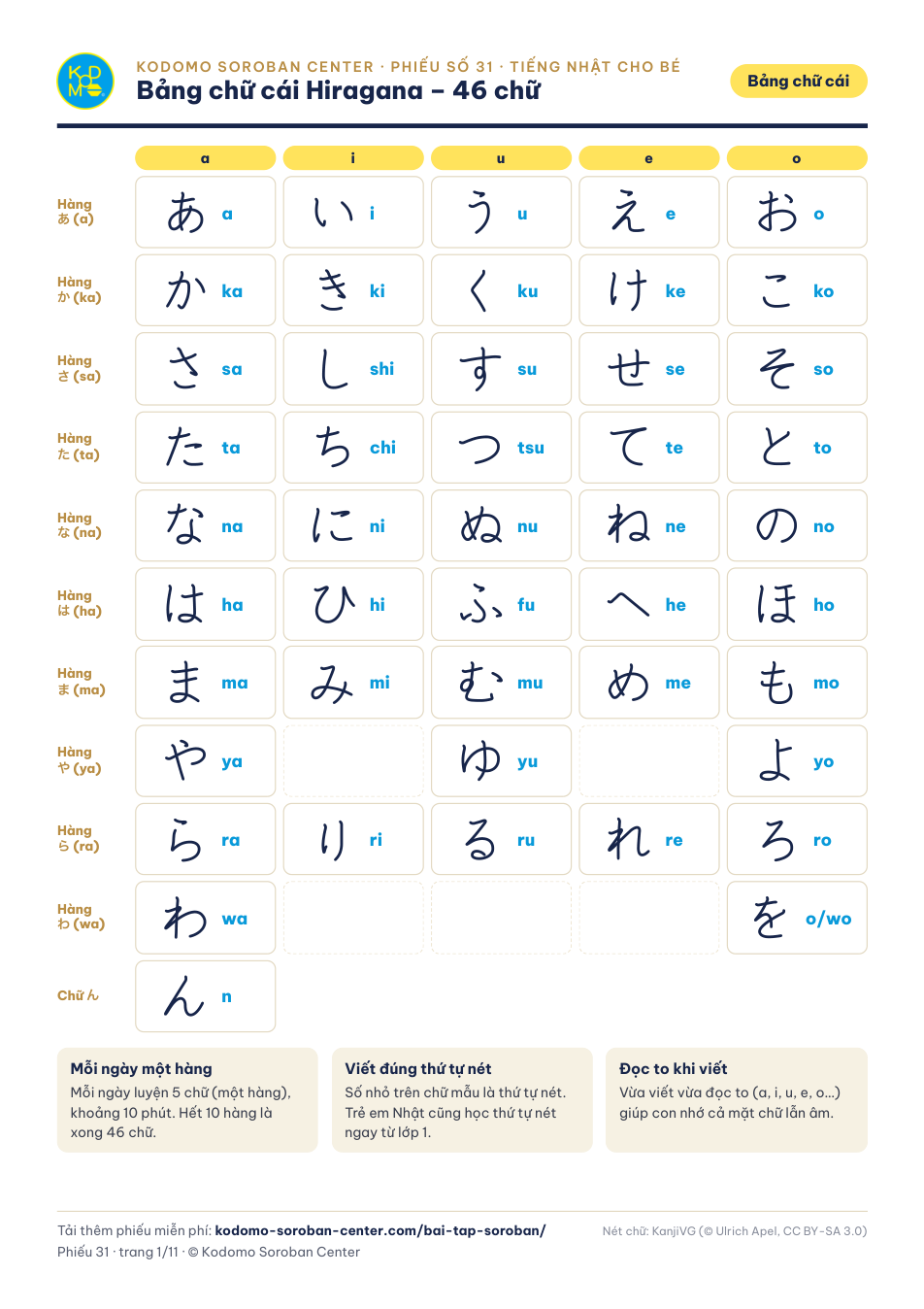
Hiragana is the most basic Japanese alphabet: 46 letters in 10 rows. Children should learn one row a day, write in the correct stroke order and read aloud as they write.
- 46 letters, 10 rows: a, ka, sa, ta, na, ha, ma, ya, ra, wa, plus n
- Add “ten ten” or “maru” marks for 25 voiced letters; combine with small ya, yu, yo for 33 combined sounds
- One row a day, about 10 minutes – the whole chart in 10 days
- Correct stroke order, in boxes with a dotted cross guide
- Add a few greetings to use at home straight away
- Free PDF worksheets, no registration needed: 11 pages of hiragana and 2 pages of greetings
What is hiragana? How many Japanese alphabets are there?
Japanese uses three scripts at once. Hiragana is used for native Japanese words and grammar endings; katakana for words borrowed from other languages; and kanji (Chinese characters) for the core meaning of words. An ordinary sentence usually contains all three.
In Japan, children first learn to write hiragana in grade-1 Japanese class, then katakana, then kanji. That makes hiragana the most natural way in for a child.
The full hiragana chart and how to read it
The chart is read row by row: each row starts with a consonant and goes through the five vowels a, i, u, e, o. For example, the ka row: か き く け こ (ka, ki, ku, ke, ko). The ya row has only 3 letters, the wa row has わ and を, and the chart ends with ん (n).
Most letters are read just as the romaji shows. Only a few need extra attention:
Four letters whose romaji breaks the row pattern (not si, ti, tu, hu).
The Japanese “r” sits between English “r” and “l”: the tongue taps lightly once.
As particles, は is read “wa” (as in こんにちは) and を is read “o”.
ん (n) always follows another letter, as in ほん (hon – book).
Hiragana with dakuten and combined sounds
Once the 46 letters are familiar, there are two more groups. No new shapes to learn – just a mark or a combination:
Voiced sounds (dakuten, handakuten): two small dots, “ten ten” (゛), turn the ka, sa, ta and ha rows into ga, za, da and ba; a small circle, “maru” (゜), turns the ha row into pa. 25 letters in all:
ぢ (ji) and づ (zu) sound like じ and ず and are rarely used; most words are written with じ and ず.
Combined sounds (yōon): a letter from the i column (き, し, ち…) followed by a small ゃ, ゅ or ょ. The two letters are read as one sound. There are 33:
Two more things children meet when reading words: the small っ (a small tsu) makes a short pause and doubles the next consonant, as in きって (kitte – stamp) and がっこう (gakkō – school); and long vowels stretch a vowel, as in おかあさん (okāsan – mother) and おとうさん (otōsan – father). When writing, the small ゃ, ゅ, ょ and っ sit in the lower-left part of the box.
How to write hiragana in the right stroke order, like Japanese children
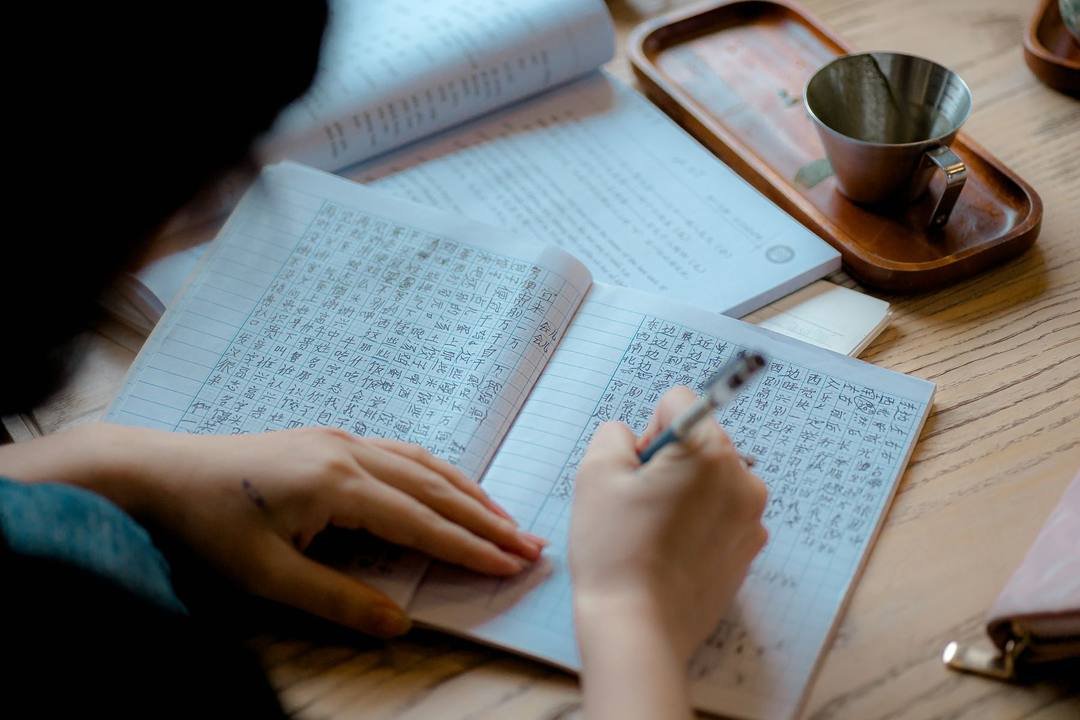
In Japanese primary schools, grade-1 writing notebooks have large squares with a dotted cross in the middle. The cross helps children place each letter evenly in the box. Teachers pay close attention to stroke order and the three ways a stroke ends: stop, flick and sweep. A lesson usually goes through these steps:
- Look at the model and the stroke numbers
Each stroke has a small number. The child counts silently: stroke 1, stroke 2, stroke 3.
- Write in the air
The whole class writes the letter big in the air with a finger, counting the strokes. At home, a child can write on a parent’s palm.
- Trace the faint letters
Trace 2–3 times so the hand learns the path of each stroke.
- Write alone in boxes with a cross guide
Write slowly, using the dotted lines so the letter isn’t off-center, too big or too small.
- Read the letter aloud
Reading aloud links the shape to the sound and sticks better than silent copying.
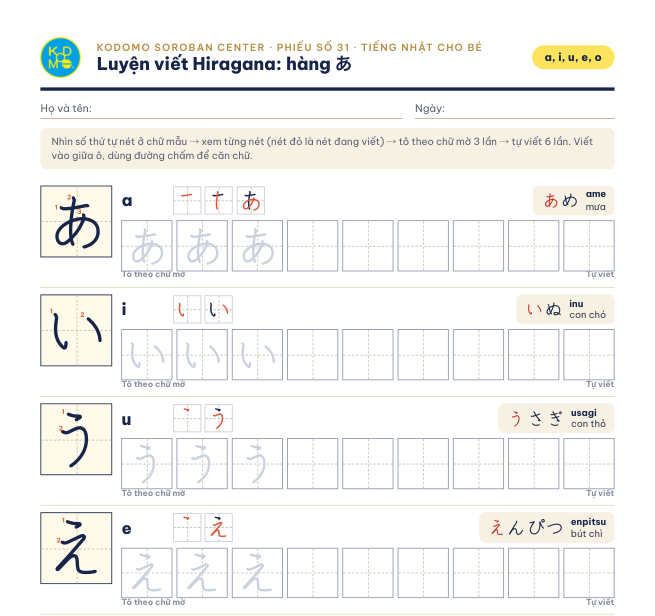
Worksheet 31 follows exactly these steps: a model with stroke numbers, each stroke drawn separately (red is the stroke being written), 3 boxes to trace, 6 boxes to write alone and an example word with its meaning.
Hiragana letters children often mix up
Some letters look very alike. Let your child write two of them side by side and find the difference:
| What is different? | |
|---|---|
| あ and お | お has an extra small dot on the right; the curve of あ is more closed. |
| ぬ and め | ぬ has a small loop at the end of the stroke; め does not. |
| る and ろ | る has a small loop at the end; ろ does not. |
| わ, れ, ね | Same first stroke. After that: わ curves round, れ kicks outward, ね ends in a small loop. |
| は and ほ | ほ has an extra horizontal stroke at the top. |
| き and さ | き has two horizontal strokes; さ has only one. |
| さ and ち | The curves at the bottom face opposite ways. |
How long does it take to learn the Japanese alphabet? A 10-day plan
At one row a day, a child covers all 46 letters in 10 days. That is only the first pass: reading and writing them confidently takes repeated review. Short, regular practice beats one long session.
| Rows | Tips | |
|---|---|---|
| Days 1–2 | あ (a) and か (ka) | Get used to the cross guide and stroke order |
| Days 3–4 | さ (sa) and た (ta) | Watch し shi, ち chi, つ tsu |
| Days 5–6 | な (na) and は (ha) | Watch ぬ–め, は–ほ, ふ fu |
| Days 7–8 | ま (ma) and や (ya) | The ya row has only 3 letters |
| Days 9–10 | ら (ra) and わ (wa), ん (n) | Watch る–ろ, わ–れ–ね |
| After that | Review the chart, then dakuten and combined sounds | Read the chart daily; rewrite the letters still wrong |
10 basic Japanese greetings for kids
Letters are more fun when a child can use them right away. The ten greetings below are all written in hiragana – practice the letters and say them with your family every day.
| Reading | Meaning | When? | |
|---|---|---|---|
| おはよう | ohayō | Good morning | In the morning; to adults: おはようございます |
| こんにちは | konnichiwa | Hello | During the day |
| こんばんは | konbanwa | Good evening | In the evening |
| さようなら | sayōnara | Goodbye | When parting |
| ありがとう | arigatō | Thank you | More polite: ありがとうございます |
| ごめんなさい | gomen nasai | I’m sorry | When you did something wrong |
| いただきます | itadakimasu | (thanks for the food) | Before eating |
| ごちそうさま | gochisōsama | (thanks for the meal) | After eating |
| はじめまして | hajimemashite | Nice to meet you | When meeting someone for the first time |
| おやすみなさい | oyasuminasai | Good night | Before going to bed |
In こんにちは and こんばんは, the final は is read “wa”.
Download free hiragana writing worksheets (PDF)
Both sets print on A4 and download right away – no registration needed. They suit children from about 5–6 years old as well as adult beginners (the worksheets are in Vietnamese):
- Worksheet 31 – Hiragana writing (11 pages, PDF): page 1 is the hiragana chart with romaji; pages 2–11 cover one row each, with stroke numbers, each stroke, an example word with its meaning, boxes to trace and boxes to write alone.
- Worksheet 32 – Japanese greetings (2 pages, PDF): 10 greetings with romaji, meaning and when to use them, a row to trace and a row to write alone.
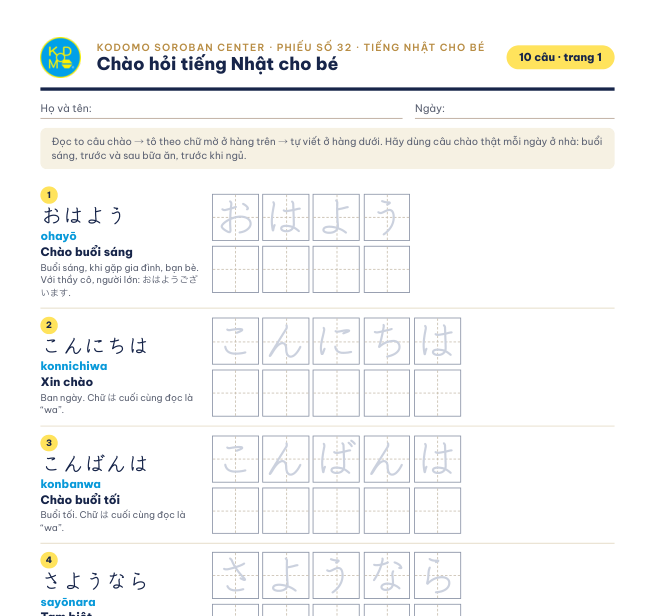
Download right away, no registration needed: the hiragana worksheets (11 pages) and the greetings worksheets (2 pages). More sheets are on the free worksheets page. Print one page a day, stick the chart by the study desk, and have the whole family say いただきます before dinner.
Can children learn Japanese at home with an app?
Yes, as long as they still write with a pencil every day. Kodomo Soroban Center online members also get Japanese with Wakuma (trial version): listen to the sounds, see how each letter is written, trace it and then write hiragana and katakana alone. The app helps with the sounds; paper helps the hand learn the strokes – the two work best together.
Writing in the right order, neatly inside the box, is also a habit of a Japanese-style soroban class: children write their numbers neatly in the answer boxes and record their own results. See a 60-minute lesson.
Frequently asked questions
How many letters are in the Japanese alphabet?
Hiragana has 46 basic letters, and katakana has 46 matching ones. From the 46 hiragana come 25 voiced letters (with marks) and 33 combined sounds (with a small ゃ, ゅ or ょ). Kanji are far more numerous: in grade 1 alone, Japanese children learn 80.
At what age can a child learn hiragana?
In Japan, children formally learn to write hiragana in grade 1 (around age 6), and many get familiar with it in kindergarten. A child in Vietnam can start once they hold a pencil steadily and are used to writing Vietnamese letters. Don’t push: 10 minutes a day is enough.
Should children learn hiragana or katakana first?
Hiragana first, just like Japanese children. Hiragana appears in almost every sentence, while katakana is mainly for borrowed foreign words. Once a child reads hiragana confidently, katakana becomes much easier.
What are dakuten and combined sounds in hiragana?
Dakuten are marks added to a letter to change its sound: two dots (“ten ten”) or a small circle (“maru”), for example か (ka) becomes が (ga) and は (ha) becomes ぱ (pa). A combined sound is a letter from the i column followed by a small ゃ, ゅ or ょ, read as one sound, for example き and ゃ make きゃ (kya).
How long does it take to learn the Japanese alphabet?
At one row a day, a child goes through all 46 hiragana in about 10 days for the first time. Reading and writing them confidently takes repeated review over a few weeks. Short daily practice works better than cramming.
Does stroke order matter?
Yes. The correct stroke order makes letters balanced, easier to read and faster to write later on. Japanese children learn stroke order from grade 1, and the habit helps a lot when they move on to kanji.
Where can I download hiragana writing worksheets as PDF?
Worksheet 31 (the chart plus writing practice for all 46 hiragana, 11 pages) and worksheet 32 (10 greetings, 2 pages) can be downloaded free right in this article or on Kodomo Soroban Center’s free worksheets page – no registration needed.
Try a free soroban lesson
Classes of 3–5 children at Vinhomes Gardenia (Hanoi), 60 minutes each, taught exactly as in Japan. Phone · Zalo 096.802.8484.
Written by the teaching team of Kodomo Soroban Center, following the method and textbooks of Kodomo School (Japan, teaching soroban since 1976). The center is licensed by the Hanoi Department of Education and Training, and our project is a 2026 EDU-Port Nippon supported project of Japan’s Ministry of Education (MEXT).
About usEDU-Port NipponEducation licenseRelated articles
Let Them Fail (a Little): How Natural Consequences Raise Independent Kids
Doing too much for your child? Small, safe failures – oversleeping, a forgotten notebook, spilled milk – teach independence, Japanese style. 8…
How to teach your child to study on their own: 6 small habits from Japanese families
Help your child study without reminders: 6 Japanese-style habits – a set time and spot, a to-do list, a timer, packing the…
My child learns slowly – what should I do? 7 ways to help them keep up without pressure
Is your child slow to learn and understand? 5 common reasons, 7 ways to help at home, 4 things to avoid, and…