How to learn the times tables fast: 7 fun ways for kids, tips for the 7, 8 and 9 tables and a free worksheet
“My child can rattle off the 7 times table, but ask 7 × 8 on its own and they freeze.” Many parents run into this. We are Japanese and teach soroban to children in Hanoi; in Japan, children learn the times tables by heart in grade 2. The short answer: children learn the tables fast not by sitting for hours, but by understanding first, learning in the right order and reviewing briefly every day.
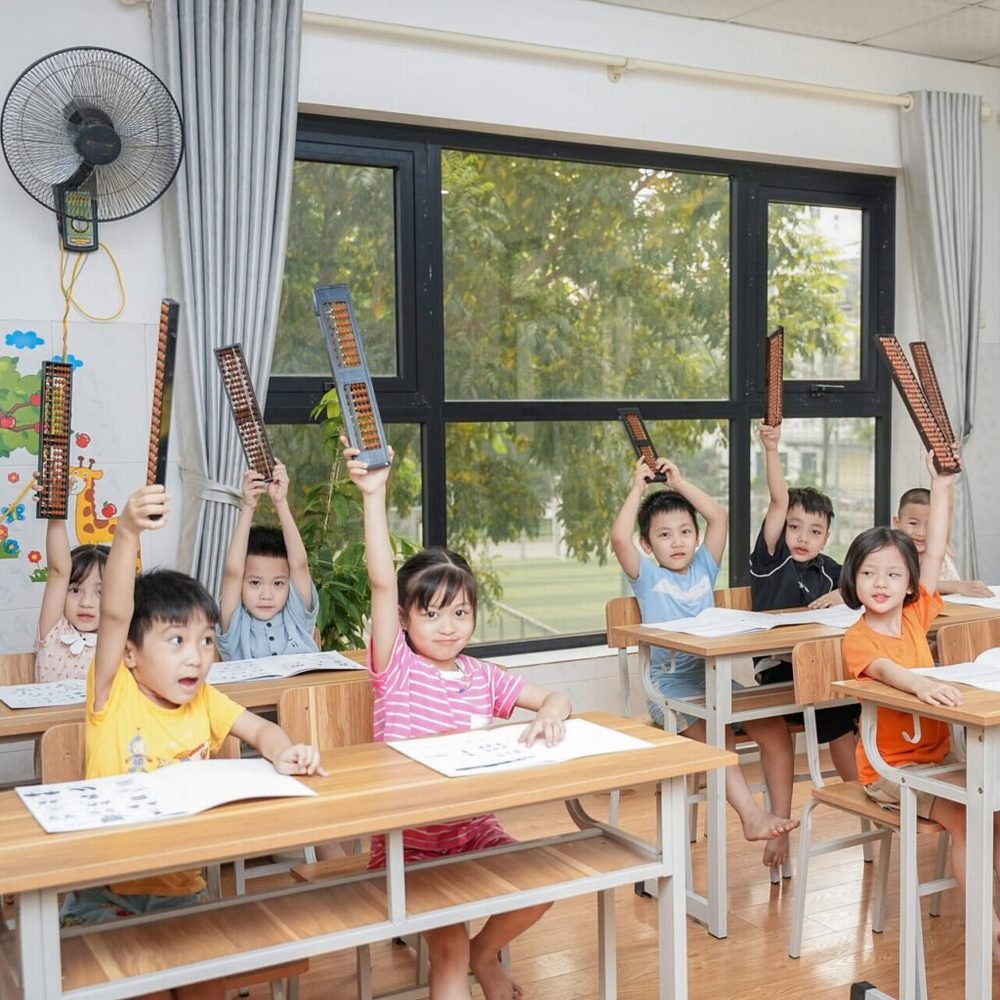
Help your child understand multiplication first, then learn a little every day.
- Understand multiplication with objects before memorizing
- Easy tables first: 2 and 5, then 3 and 4, finally 6 to 9
- Order doesn’t matter: tables 2–9 have only 36 facts to learn
- Use each table’s own trick: doubling, the clock, folding fingers
- Say them out loud in a rhythm, 5–10 minutes a day
- Ask in random order and fill-in-the-blank, not just in sequence
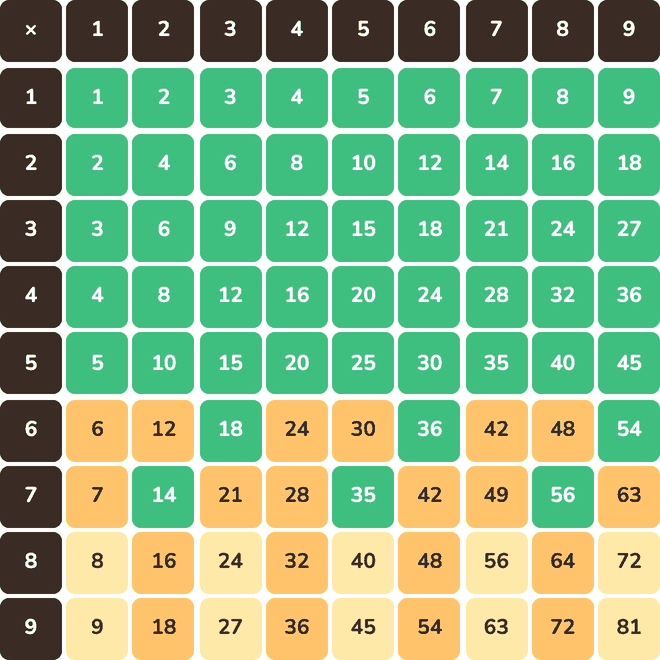
- Color in the facts they know; practice only what’s left
When do children learn the times tables?
Under Vietnam’s 2018 general education curriculum and current textbooks, the times tables are split over two years:
- Grade 2: the 2 and 5 times tables, plus dividing by 2 and by 5
- Grade 3: a review of 2 and 5, then multiplying and dividing with 3, 4, 6, 7, 8 and 9
In Japan, children learn all 81 facts, from 1 × 1 to 9 × 9 (called kuku, “nine-nine”), in grade 2. The way they learn is distinctive: they chant each table aloud in a rhythm, like a nursery rhyme – “ni-ichi ga ni, ni-nin ga shi, ni-san ga roku…” (2 × 1 = 2, 2 × 2 = 4, 2 × 3 = 6). They say it forward and backward, then answer when asked in random order.
Before memorizing: help your child understand what multiplication means
A child who can recite “three times seven is twenty-one” doesn’t necessarily know what 3 × 7 means – and when they forget, they have no way to find it again. So start with the meaning.
For children, multiplication means putting together several equal groups. In Vietnamese textbooks, 2 × 3 means “2 taken 3 times”: 3 plates with 2 candies on each make 2 + 2 + 2 = 6 in all.
Set out objects in groups: 4 plates with 3 beans on each. Ask “how many groups, and how many in each?” before writing 3 × 4. Once your child understands, they can work out 6 × 4 even if they forget it: 6 × 3 = 18, plus one more group of 6 makes 24.
7 fun ways to learn the times tables fast
The seven ways follow an order: understand, learn, then check.
- Understand with objects first
For each new table, have your child lay out objects or draw dots for the first few facts. Once they can say “the 3 times table goes up by 3 each time”, move on to memorizing.
- Easy tables first
The 2 and 5 tables, then 3 and 4, and finally 6, 7, 8 and 9 – close to the textbook order. The 1 times table and multiplying by 10 are easy; a quick look at the end is enough.
- Order doesn’t matter
3 groups of 2 or 2 groups of 3 both make 6: 2 × 3 = 3 × 2. Tables 2 to 9, leaving out × 1 and × 10, have 64 facts – but your child really only needs to learn 36 of them.
- Use each table’s “shortcut”
Many tables can be worked out from ones already learned: the 4s from the 2s, the 6s from the 5s. See the six tips in the next section.
- Say them out loud in a rhythm
Just as Japanese children chant kuku: “three times one is three, three times two is six…”. Saying it aloud keeps the rhythm, and you can hear where your child stumbles.
- 5–10 minutes a day, spaced out
Short and regular beats one long session on the weekend. Review an old table the next day, a few days later and a week later.
Start at homeTie the tables to a fixed daily routine – for example, one table after brushing teeth. Stop while your child still wants to keep going.
- Games and a coloring chart
Ask in random order (7 × 6?), ask fill-in-the-blank questions (8 × □ = 72), or flip two number cards and multiply. Each fact your child answers right away gets colored in on a 9 × 9 chart; the blank cells show what still needs practice.
Our worksheet has all of these: page 1 is a color times table chart (2–9) to put on the wall; page 2 has 40 random questions, fill-in-the-blank problems and a 9 × 9 chart to color in; the answers are on page 3. Download the times tables worksheet (free PDF, in Vietnamese).
Quick tips for each table
These “shortcuts” help your child find the answer again when they forget. The final goal is still to remember each answer directly.
2 × 7 = 7 + 7 = 14.
4 × 7: double 7 to get 14, then double again to get 28.
8 × 7: 7 → 14 → 28 → 56.
When the minute hand points to 7, it is 35 minutes past, so 5 × 7 = 35. The answer always ends in 0 or 5.
Hold up all 10 fingers. For 9 × 4, fold down the 4th finger from the left: 3 fingers on the left (3 tens), 6 on the right – that’s 36.
Each group of 6 is a group of 5 plus 1: 6 × 7 = 5 × 7 + 7 = 35 + 7 = 42.
Struggling with the 7s and 8s? Practice only what’s left
Many children get stuck on the 7 and 8 tables: they come last, so they get the least review, and the answers are big and close together (48, 49, 54, 56, 63, 64). The good news is that very little is truly new:
Once your child knows the 2, 3, 4, 5, 6 and 9 tables, only three new facts remain: 7 × 7 = 49, 7 × 8 = 56 and 8 × 8 = 64. Instead of reciting whole tables again, practice only the cells that are not colored yet.
Remember 56 = 7 × 8 with the sequence “5, 6, 7, 8”. For the 7s, split 7 into 5 + 2: 7 × 6 = 5 × 6 + 2 × 6 = 30 + 12 = 42 – just as 7 on a soroban is one 5-bead and two 1-beads.
The 9 × 9 coloring chart is on page 2 of the worksheet: Download the times tables worksheet (free PDF, in Vietnamese).
What not to do when your child is learning the times tables
- Moving on to a new table while your child can only recite it from the top
- Timing them and racing for speed from the very first days
- Comparing your child with siblings or classmates
- Scolding wrong answers – your child gets scared and stops answering
- One very long session to “get the whole table done”
Reciting in order is only the first step. If you ask 6 × 7 and your child has to start again from “six times one is six”, stay on that table a few more days; speed will come later. If your child is starting to dislike math, see My child is struggling with math – what should I do?.
The times tables and soroban
In Japan, multiplication on the soroban uses these same times tables. For 23 × 4, your child uses 2 × 4 = 8 and 3 × 4 = 12, placing each result in the right column to get 92. So soroban doesn’t replace learning the times tables – it needs your child to know them well.
At Kodomo Soroban Center (Vinhomes Gardenia), each class has 3–5 children and each lesson lasts 60 minutes, following the teaching of Japan’s Kodomo School. At home, students use their member code to enter the Soroban Practice Room (in Vietnamese), which includes the coloring times table chart shown above. See how a lesson works; the trial lesson is free – sign up on our Contact page or call or message us on Zalo at 096.802.8484.
Frequently asked questions
What age should children learn the times tables?
Under the current curriculum in Vietnam, children learn the 2 and 5 tables in grade 2 and the rest in grade 3 – around age 7–8. More important than age is being comfortable adding equal numbers, like 3 + 3 + 3.
How long does it take to learn the times tables?
Every child is different. With 5–10 minutes a day, the easy tables usually take a few weeks, and answering every fact confidently in random order takes a few more weeks to a few months. At school the tables are split across grades 2 and 3, so there is no need to rush.
Should my child learn the times tables in order?
Yes, at first: saying them in order helps your child see the pattern and keep the rhythm. Once they can say a table forward, have them say it backward, then ask in random order and with fill-in-the-blank questions like 8 × □ = 72. Truly knowing a fact means answering right away, without starting the table from the top.
The 7 and 8 times tables are hard to remember – any tips?
Yes. Once your child knows the 2–6 and 9 tables, the 7s and 8s have only 3 new facts: 7 × 7 = 49, 7 × 8 = 56 and 8 × 8 = 64. For the 8s, double three times (8 × 6: 6 → 12 → 24 → 48). For the 7s, split 7 into 5 + 2 (7 × 6 = 30 + 12 = 42).
What is the easiest way to learn division facts?
Division is multiplication “read backward”. If your child knows 4 × 6 = 24, they also know 24 ÷ 4 = 6 and 24 ÷ 6 = 4. In grade 3, multiplying and dividing by the same number are usually taught in the same lesson. Practice fill-in-the-blank questions (4 × □ = 24) – they are the bridge to division.
Try a free soroban lesson
Classes of 3–5 children at Vinhomes Gardenia (Hanoi), 60 minutes each, taught exactly as in Japan. Phone · Zalo 096.802.8484.

Written by the teaching team of Kodomo Soroban Center, following the method and textbooks of Kodomo School (Japan, teaching soroban since 1976). The center is licensed by the Hanoi Department of Education and Training, and our project is a 2026 EDU-Port Nippon supported project of Japan’s Ministry of Education (MEXT).
About usEDU-Port NipponEducation licenseRelated articles
Why do Japanese students clean their own schools – and how to bring the habit home
Why do Japanese students clean their schools every day? What cleaning time looks like, what children learn from it, and how to…
A day in the life of a Japanese elementary school student: what time school starts, how lunch works and when summer break is
What time do Japanese elementary students go to school, when do they start school and how long is summer break? A typical…
What should a 5-year-old learn? 6 activities and how to choose by your child’s temperament
What should a 5-year-old learn? 6 popular activities – swimming, martial arts, music and dance, art, English and thinking math: what each…