My child is struggling with math – what should I do? Find where they are stuck, then help 10 minutes a day at home
Your child is slow at math, makes lots of mistakes, frowns whenever math time comes – and sometimes ends up in tears. You worry, give extra exercises, and the whole family gets worn out. We are Japanese soroban teachers working with children in Hanoi, and what we see most often is this: “bad at math” is usually one missing step in the foundation, not a child who “just isn’t a math person”.
Don’t rush to add more exercises. Find exactly where your child is stuck, then practice that one thing for 10 minutes a day:
- Do a 5-minute check at home to see where they are stuck
- Many children are stuck on the basics: number sense and the “friends of 10”
- Understanding first, speed later
- No comparing, no scolding, no doing it for them
- Keep an eye on eyesight, hearing and sleep
- See a specialist if your child stays far behind despite steady help
First: where exactly is your child struggling? A 5-minute check at home
“Bad at math” covers a lot. Two children with the same low score can be stuck in completely different places – and need different kinds of help.
Pick a moment when your child is in a good mood, don’t call it a “test”, and treat it as a game. Just watch – don’t correct or give hints:
- Can they see a number at a glance? Quickly show 3 fingers, then 5, then 5 and 2. Does your child say “three”, “five”, “seven” right away, or count finger by finger?
- Can they make 10? Ask “7 and what make 10?”, “What about 4?”. Do they answer straight away, or think for a long time and count?
- Still counting on fingers? Give 4 + 3 and 8 + 5. Do they count one by one on their fingers, even for very small sums?
- Stuck on word problems? “You have 5 candies and give 2 to your sister. How many are left?” Can they work out 5 − 2 but not tell which operation the problem needs?
- Flustered when rushed? Give 10 easy sums: the first time untimed, the second time timed. With the clock running, do they make many more mistakes, get tense or give up?
Whichever question trips your child up is where you start. One specific sticking point is much easier to fix than a vague feeling that your child is “bad at math”. Below, each question is linked to a cause.
6 common reasons children struggle with math
These are the causes we see most often in free trial lessons. One child can have two or three of them at the same time.
Your child still counts one by one and doesn’t “see” 7 as 5 and 2. (Questions 1 and 3)
They don’t know the pairs that make 10, so every sum across 10 has to be counted. (Question 2)
They can solve problems like the example, but stop when the question is asked differently – common with word problems. (Question 4)
When children are afraid of mistakes, they calculate below their real ability. Over time that fear becomes “I hate math”. (Question 5)
They understand the lesson but make mistakes by copying numbers wrong, skipping items or forgetting a step halfway.
Not seeing the board clearly, not hearing all of the teacher’s explanation, not sleeping enough – any of these can look like being “bad at math”.
The first three are about the foundation; the last three are about the conditions for learning. If the foundation has a gap, more exercises won’t help – you need to go back to the exact step that is missing.
Help for each cause: 10 minutes a day at home
Choose 1–2 activities that match where your child is stuck. Ten minutes a day, at the same time, in the same place. Keep going for at least 2 weeks before judging the results.
- Number sense: “quick look” games in groups of 5
Line up beans or bottle caps in rows of 5, cover some, and ask “how many?”. The goal is for your child to say the number without counting.
Start at home2 minutes before homework: you hold up fingers, your child says the number right away. Once they get it right without counting, move on to numbers up to 10.
- Group of 10: quick-fire “friends of 10”
You say “7!”, your child says “3!”; “4!” – “6!”, for 1 minute a day. Once they answer without thinking, sums across 10 like 7 + 5 = 7 + 3 + 2 become much easier. The full sequence is in our article on teaching fast mental math in grade 1.
- Understanding first: use real objects and let your child explain out loud
For word problems, put real candies or chopsticks on the table and act out the story. Then let your child explain how they solved it. Two good questions work better than five minutes of explaining.
Start at homeInstead of “wrong, do it again”, ask “how did you do it?”. While explaining, children often spot their own mistake.
- Less fear: accuracy first, speed later
Put the clock away for a while. Choose problems easy enough that your child gets almost all of them right, then make them harder step by step. Only compare your child with themselves yesterday.
- Focus: short blocks, a clear desk
Split the 10 minutes into two 5-minute blocks, with just one worksheet and one pencil on the desk. See also 8 ways to build a child’s focus.
- The body: eyesight, hearing, sleep
Have your child’s eyes and hearing checked if they often squint, lean very close to their notebook or keep asking you to repeat things. Keep a regular bedtime and avoid screens right before study time.
Need practice material? Our free worksheets have a box for your child to record their own time. Once your child is confident, try online mental math practice with 1-digit numbers.
4 things not to do when your child struggles with math
All of these come from love and worry – but they usually make things harder.
- Adding more exercises and longer study time. If the foundation still has a gap, more exercises just mean more mistakes. A few problems, aimed at the right spot, every day work better.
- Comparing your child with siblings or friends. “They can do it, so why can’t you?” doesn’t teach your child how to do it – it only teaches them that they are not good enough.
- Scolding or punishing mistakes. A frightened child finds it hard to think, and will look for ways to avoid math time instead of trying.
- Giving the answer or doing it for them to save time. The homework gets finished, but your child learns nothing. Ask one hint question, then wait.
For a child who is afraid of math, getting back the feeling “I can do this” matters more than any score.
When should you see a specialist?
Most children who “struggle with math” improve once they get help in the right place. But there are cases where parents shouldn’t try to handle it alone.
your child is clearly far behind classmates and has made little progress despite months of steady help; still finds it hard to say which of two small numbers is bigger (such as 5 and 8) after a long period of practice; also struggles with reading, remembering or focusing; or is so anxious that they get stomachaches or cry every time math comes up. See a pediatrician or a child psychologist or educational specialist for a proper assessment.
These signs do not mean something is definitely wrong. Only a qualified professional who meets your child in person can make an assessment – this article and soroban teachers cannot replace that.
Which children is soroban right for – and not right for yet?
As soroban teachers, we’ll be honest: the abacus is not a cure for every math difficulty.
Soroban fits when
- Your child still counts on fingers and doesn’t “see” numbers
- Your child gets answers right but slowly
- Your child is afraid of numbers and needs to see step-by-step progress
- Your child needs good study habits
Not yet when
- Your child can’t count to 10 or tell digits apart yet
- The main difficulty is understanding word problems
- Your child shows the signs above – see a specialist first
- Your child’s schedule of extra classes is already full
The abacus gives children a concrete picture of groups of 5 and 10 – exactly the foundation many children who “struggle with math” are missing. But it takes time: 2-digit mental math usually comes by the end of Level 0 (16 lessons), together with practice at home. Read more: is learning soroban good for children?
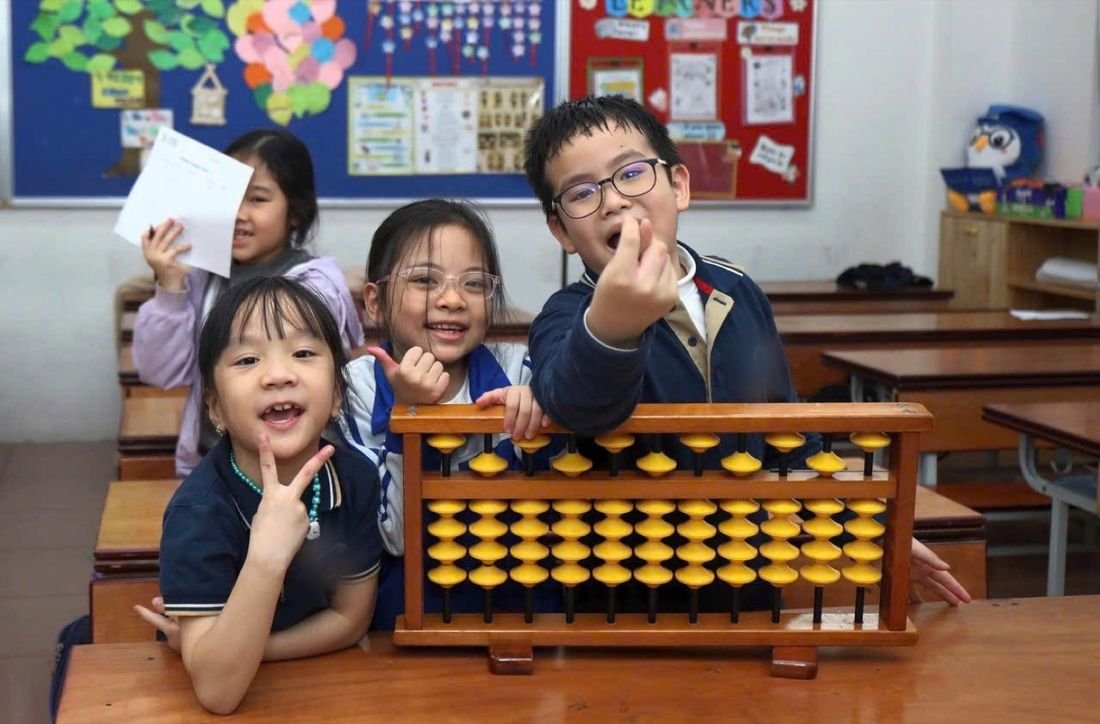
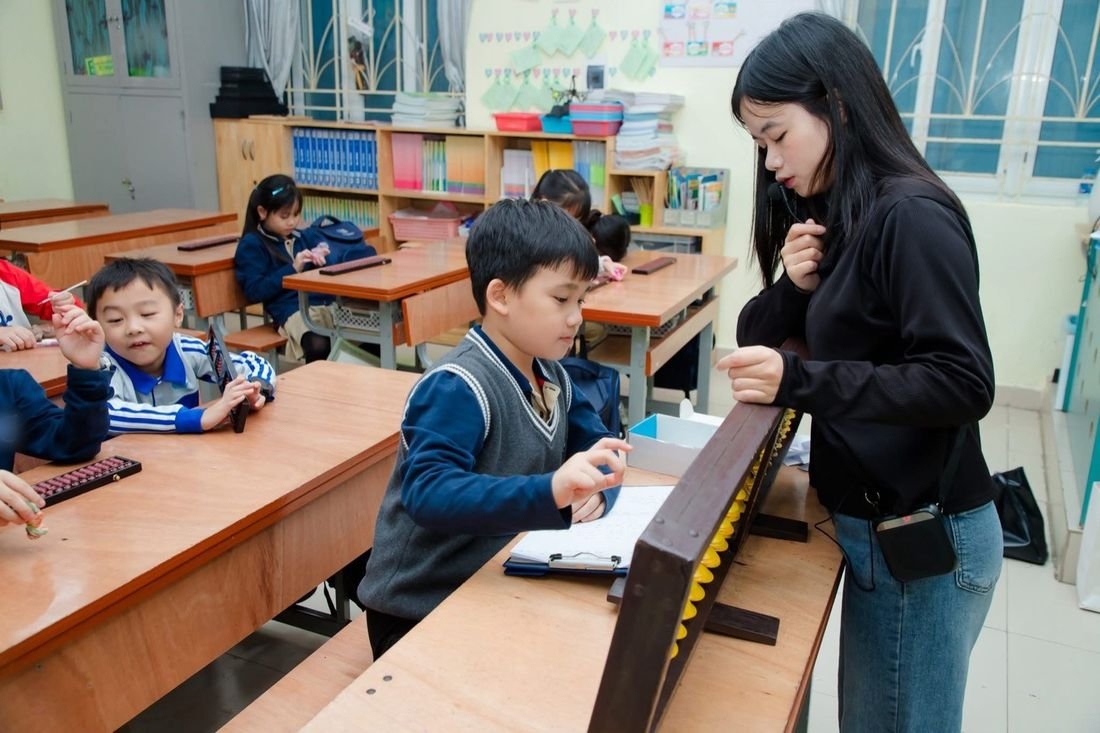
At Kodomo Soroban Center in Vinhomes Gardenia, each class has only 3–5 children, so the teacher can catch every small mistake. Each 60-minute lesson follows a fixed rhythm – greeting, grid calculations, soroban, mental math, Flash Anzan, tidying up – and mental math starts in the 4th lesson with small numbers.
See what a lesson looks like, or call/Zalo 096.802.8484 to book a free trial lesson.
Frequently asked questions
What should I do if my child is bad at math?
First find exactly where your child is stuck: number sense, the “friends of 10” pairs, word problems, or anxiety when rushed. Then practice that one thing for 10 minutes a day for at least 2 weeks – without comparing, scolding or doing it for them.
Why is my child slow at mental math?
Usually because they still count one by one instead of seeing numbers in groups of 5, don’t know the “friends of 10” pairs yet, or calculate by reciting in their head instead of using images. All three can be practiced at home if you follow the right order and practice a little every day.
What can I do if my child is afraid of math?
Take away the clock and the pressure for speed for a while, choose problems easy enough that your child gets almost all of them right, and then make them harder step by step. Don’t compare your child with others or scold mistakes. Once they get back the feeling “I can do this”, the fear usually fades. If your child gets stomachaches or cries every time they study, talk to a specialist.
Is a child who is slow at math less intelligent?
Usually not. Many children are slow at math simply because one step in the foundation is missing, because they are afraid of mistakes, because they find it hard to focus, or because of eyesight, hearing or sleep. If your child stays far behind and doesn’t improve despite months of steady help, see a pediatrician or a child psychologist or educational specialist for a proper assessment.
Does learning soroban help children do better in math?
Soroban helps most when a child still counts on fingers, gets answers right but slowly, or is afraid of numbers, because the abacus gives a concrete picture of groups of 5 and 10. It does not replace practice in understanding word problems, and it takes time, together with practice at home.
Try a free soroban lesson
Classes of 3–5 children at Vinhomes Gardenia (Hanoi), 60 minutes each, taught exactly as in Japan. Phone · Zalo 096.802.8484.

Written by the teaching team of Kodomo Soroban Center, following the method and textbooks of Kodomo School (Japan, teaching soroban since 1976). The center is licensed by the Hanoi Department of Education and Training, and our project is a 2026 EDU-Port Nippon supported project of Japan’s Ministry of Education (MEXT).
About usEDU-Port NipponEducation licenseRelated articles
Getting your child ready for grade 1 math: what should they know? 5 skill areas, 5-minute daily games and a free checklist
How to prepare your child for grade 1 math: what grade 1 covers in Vietnam, what a 5-year-old should know, 5 skill…
What is Japanese mental math (anzan)? How Japanese children calculate with an abacus in the head
Japanese mental math (anzan) means calculating with an abacus pictured in the head. How it differs, the 3 stages, Flash Anzan and…

How do Japanese parents raise independent children? 7 habits from Japanese schools that parents can start today
How do Japanese parents raise independent children? Not with iron discipline, but with 7 habits repeated every day at school and at…