 Thị trấn WakumaStudent login
Converting units in grade 3: a length, weight and capacity chart and how to avoid mistakes – with a free worksheet
The test asks “2 m = … cm”, and your child writes 20. Asked “45 mm or 5 cm – which is longer?”, they pick 45 mm because 45 is bigger than 5. We are Japanese and teach soroban to children in Hanoi. Converting units is where many grade 3 children slip up, but with one staircase and two rules, your child can convert correctly without rote memorizing.
Converting units in grade 3 means writing the same length, weight or capacity in a different unit: multiply when going from a bigger unit to a smaller one, and divide when going from a smaller unit to a bigger one.
- New in grade 3: millimeters (mm), grams (g), milliliters (ml)
- Length: km → m → dm → cm → mm; from m down, each step is ×10
- 1 km = 1000 m, 1 kg = 1000 g, 1 l = 1000 ml
- Converting to a smaller unit should give a bigger number
- To compare two measurements, convert them to the same unit first
- Let your child measure, weigh and pour real things at home
Which units of measurement do grade 3 children learn?
In the Vietnamese grade 3 math book Kết nối tri thức với cuộc sống, the first semester has a unit called “Some units of length, weight, capacity and temperature”, with three lessons on new units: Lesson 30: Millimeters, Lesson 31: Grams and Lesson 32: Milliliters.
Your child already knows the other units: centimeters from grade 1; decimeters, meters, kilometers, kilograms and liters from grade 2. Grade 3 links the new units to the old ones, and the numbers grow: 10, 100, then 1000. Lesson names may differ by textbook (Chân trời sáng tạo, Cánh diều…), but the relationships between units are the same.
Grade 3 unit conversion chart: length, weight, capacity
The relationships to know in grade 3:
| Quantity | Relationship | Memory tip |
|---|---|---|
| Length | 1 cm = 10 mm | Each small mark on a ruler is 1 mm. |
| Length | 1 dm = 10 cm | Ten 1 cm pieces joined end to end. |
| Length | 1 m = 10 dm = 100 cm = 1000 mm | Three steps, each ×10. |
| Length | 1 km = 1000 m | This step is ×1000, not ×10. |
| Weight | 1 kg = 1000 g | A 1 kg bag of sugar weighs as much as 1000 packets of 1 g. |
| Capacity | 1 l = 1000 ml | A 1 l bottle fills 4 cups of 250 ml. |
For length, draw your child a staircase: km → m → dm → cm → mm. From m down, each step is ×10; only the step from km to m is ×1000. The number of steps down tells you how many times to multiply by 10: m to cm is two steps, so multiply by 10 × 10 = 100.
Weight and capacity are simpler: just one step, ×1000 (kg and g, l and ml).
How to convert units in grade 3: when to multiply, when to divide?
There are only two rules. Before calculating, your child checks: am I going from a bigger unit to a smaller one, or the other way around?
Big → small: multiply
- 2 m = 2 × 100 = 200 cm
- 3 kg = 3 × 1000 = 3000 g
- The new number is bigger
Small → big: divide
- 60 mm = 60 ÷ 10 = 6 cm
- 5000 ml = 5000 ÷ 1000 = 5 l
- The new number is smaller
Why multiply? 1 m is 100 cm, so 2 m is two groups of 100 cm. Why divide? Every 10 mm makes 1 cm, so 60 mm makes 6 cm. Ask your child to explain the reason in their own words.
Multiplying by 10, 100 or 1000 just means adding one, two or three zeros; dividing a round number of tens, hundreds or thousands takes away that many zeros. See also Mental math tricks for kids.
Measurements with two units: 1 m 25 cm and 205 cm
For a measurement with two units, convert the bigger-unit part first, then add the rest.
- 1 m 25 cm = 100 cm + 25 cm = 125 cm
- 205 cm = 200 cm + 5 cm = 2 m 5 cm
Watch the zero: 2 m 5 cm is 205 cm, not 25 cm.
Why do children make mistakes converting units?
In our experience, most mistakes fall into these four types.
“1 m = 10 cm.”
Your child is mixing up 10, 100 and 1000. 1 m = 100 cm: from m to cm is two steps, so multiply by 100.
“45 mm is longer than 5 cm, because 45 is bigger than 5.”
Convert to the same unit before comparing: 5 cm = 50 mm, and 45 mm is less than 50 mm. So 45 mm < 5 cm.
“60 mm in cm is 600 cm.”
Your child multiplied instead of dividing. Converting to a bigger unit should make the number smaller: 60 mm = 6 cm.
“Memorizing the chart is enough.”
A child who has never lifted 1 kg finds it hard to spot an absurd answer, like a pencil weighing 5 kg.
After each problem, your child checks: the smaller the unit, the bigger the number – and the other way around. Writing 200 cm = 2000 m is clearly wrong – the answer is 2 m. If your child is stuck on multiplication and division themselves, see My child is struggling with math – what should I do?.
How can my child get a feel for 1 m, 1 kg and 1 l?
Children convert more accurately once they have held, seen and measured these units themselves – at the study desk and in the kitchen.
Four activities, 5–10 minutes each:
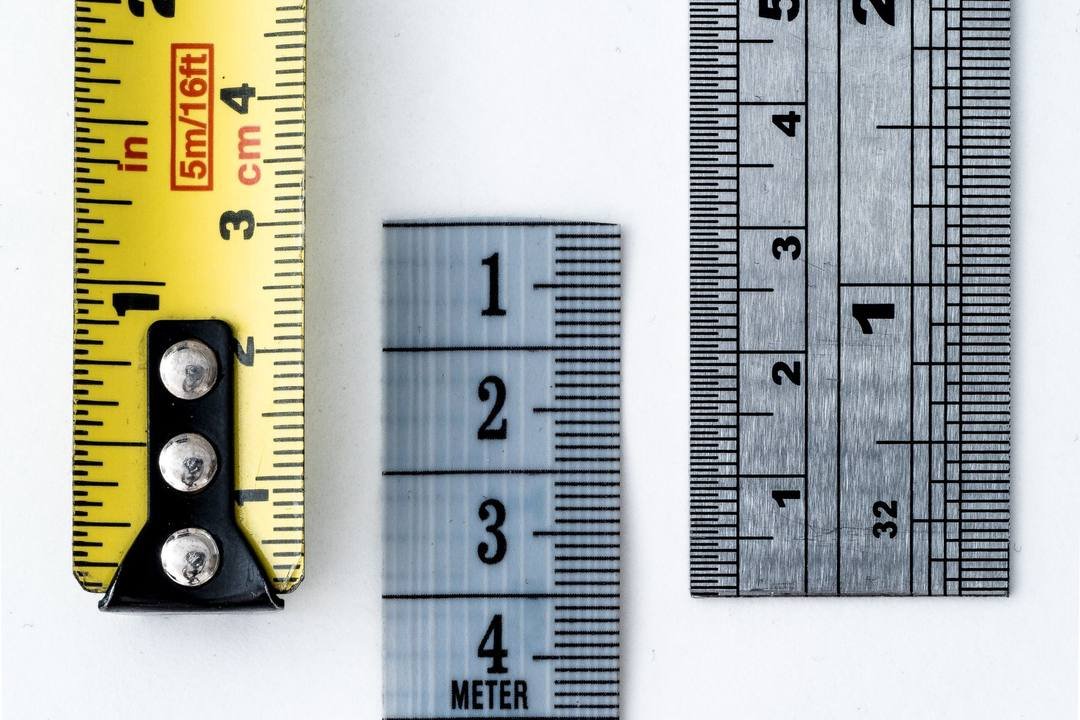
Measure a pencil or a notebook. Ten small marks make 1 cm – your child sees for themselves why 1 cm = 10 mm.
Mark 1 m on the floor with tape. Your child stretches out their arms to compare, then guesses whether the table is longer or shorter than 1 m.
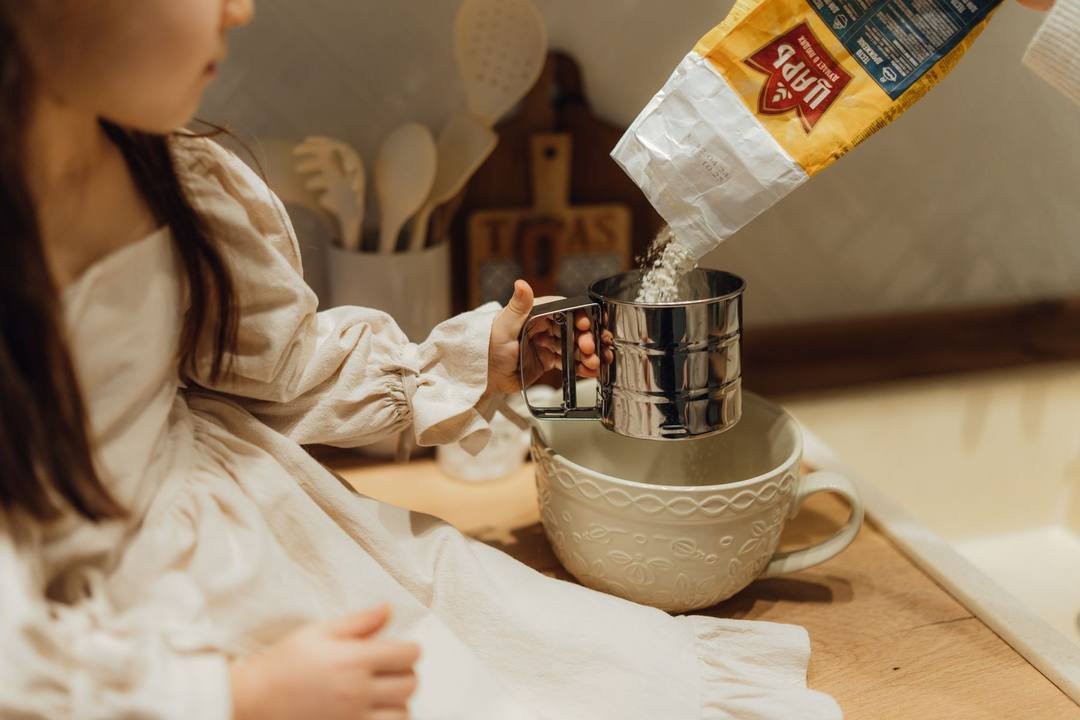
Your child lifts a 1 kg bag of sugar, then puts it on the scale. With a measuring cup marked in ml, pour a 1 l bottle out into 4 portions of 250 ml.
Look for “ml” on a water bottle and “g” on a snack bag. Which bag is heavier? How many bottles make 1 l?
In Japan, too, the primary school math curriculum values estimating and then actually measuring everyday objects, so children get a feel for how big each unit is. Guess first, measure next, then compare the two numbers – and units stop being strange letters. See also What is Japanese “thinking math”?.
Grade 3 unit conversion worksheet: free to print
Our 3-page worksheet follows the staircase and the two rules above. Page 1 is the conversion chart: the staircase of length units, three boxes for length, weight and capacity, the two rules “big → small: multiply, small → big: divide” and 12 fill-in-the-blank problems. Download the grade 3 unit conversion worksheet (free PDF, in Vietnamese).
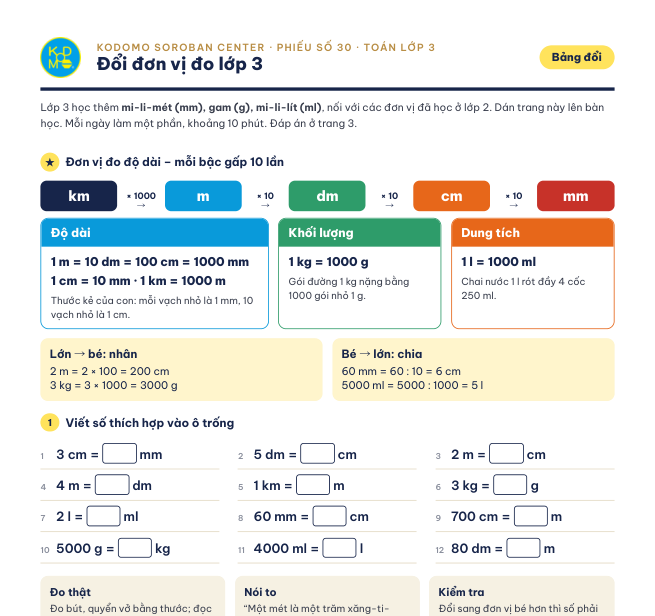
Page 2 has 20 conversion problems (problems 11–20 use two units, such as 1 m 25 cm or 205 cm), 8 problems filling in >, < or =, and 4 everyday word problems. For example: “A rope is 2 m long. Dad cuts off 35 cm. How many centimeters of rope are left?” – convert 2 m = 200 cm, then 200 − 35 = 165 (cm). The answers are on page 3.
One part a day, about 10 minutes. Units go in parentheses after the calculation, as in Word problems in grades 1 and 2; if your child is still slow at subtracting with borrowing, see Grade 2 mental math: adding and subtracting with carrying.
How does soroban help with converting units?
On the soroban, each rod is worth 10 times the rod to its right: ones, tens, hundreds, thousands – just like the staircase mm → cm → dm → m. Multiplying by 10 means moving the number one rod to the left.
Your child can see why 2 m = 200 cm: the digit 2 simply moves two rods to the left. Soroban also helps your child do calculations like 1000 − 350 quickly, but it can’t replace holding a ruler or lifting a bag of sugar at home.
At Kodomo Soroban Center (Vinhomes Gardenia, Hanoi), each class has 3–5 children and each lesson lasts 60 minutes, with classes for 5-year-olds and for primary school children. The teaching follows Kodomo School – a Japanese school network since 1976.
Set 2, then 200, on our free online soroban, or see how a lesson works. The trial lesson is free – sign up on our Contact page or call or message us on Zalo at 096.802.8484.
Frequently asked questions
Which units of measurement do grade 3 children learn?
In the Vietnamese textbook Kết nối tri thức với cuộc sống, grade 3 children learn three new units in the first semester: millimeters (mm), grams (g) and milliliters (ml). They use them together with units they already know: centimeters from grade 1; decimeters, meters, kilometers, kilograms and liters from grade 2. Lesson names and order may differ by textbook.
How many mm are in 1 m?
1 m = 1000 mm. Since 1 m = 10 dm, 1 dm = 10 cm and 1 cm = 10 mm, going from meters to millimeters is three steps, each ×10: 10 × 10 × 10 = 1000. In the same way, 1 m = 100 cm.
How can my child avoid mistakes when converting units?
Teach two rules: bigger to smaller, multiply; smaller to bigger, divide. For length, count the steps m – dm – cm – mm, each ×10. After each problem, your child checks that converting to a smaller unit gave a bigger number, and always converts to the same unit before comparing.
How do you convert 1 m 25 cm to centimeters?
Convert the meters first: 1 m = 100 cm. Then add the rest: 100 cm + 25 cm = 125 cm. The other way works the same: 205 cm = 200 cm + 5 cm = 2 m 5 cm.
Is there a printable grade 3 unit conversion worksheet?
Yes. Our free worksheet has 3 pages: the conversion chart and 12 fill-in problems; 20 conversions, 8 comparisons and 4 everyday word problems; and the answers. Download it from our free worksheets page.
Try a free soroban lesson
Classes of 3–5 children at Vinhomes Gardenia (Hanoi), 60 minutes each, taught exactly as in Japan. Phone · Zalo 096.802.8484.

Written by the teaching team of Kodomo Soroban Center, following the method and textbooks of Kodomo School (Japan, teaching soroban since 1976). The center is licensed by the Hanoi Department of Education and Training, and our project is a 2026 EDU-Port Nippon supported project of Japan’s Ministry of Education (MEXT).
About usEDU-Port NipponEducation licenseRelated articles
Let Them Fail (a Little): How Natural Consequences Raise Independent Kids
Doing too much for your child? Small, safe failures – oversleeping, a forgotten notebook, spilled milk – teach independence, Japanese style. 8…
How to teach your child to study on their own: 6 small habits from Japanese families
Help your child study without reminders: 6 Japanese-style habits – a set time and spot, a to-do list, a timer, packing the…
My child learns slowly – what should I do? 7 ways to help them keep up without pressure
Is your child slow to learn and understand? 5 common reasons, 7 ways to help at home, 4 things to avoid, and…