 Thị trấn WakumaStudent login
Word problems in grades 1 and 2: 4 steps to help your child understand and solve them – with a free worksheet
“Mom, is this one plus or minus?” Your child works out 15 + 6 in a flash, but freezes at a problem full of words – or adds the two numbers right away. We are Japanese and teach soroban to children in Hanoi. What we want to tell parents first: word problems are hard not because of the math, but because your child has to understand the story before calculating.
Children solve word problems correctly when they understand the problem first and calculate second – and 4 simple steps help them do that.
- Read the problem twice: first for the story, then slowly
- Underline the numbers and the question
- Draw: dots in grade 1, a line diagram in grade 2
- Calculate, then write an answer sentence that matches the question
- Don’t pick the operation just because of “more than” or “fewer than”
- 2–3 problems a day is enough
Why are word problems hard for grade 1 and 2 children?
The calculations are usually easy: 4 + 3, 15 + 6. The hard part is four things that come before the calculation:
Grade 1 children are still learning to read; by the end of a sentence they forget how it began.
Add, take away, put together, left over, more than, fewer than – each word is a situation.
Many children see two numbers and calculate right away, before reading the question.
Even with the right calculation, your child still has to write an answer sentence that matches the question.
So when your child gets it wrong, it is often not because they are bad at math. They haven’t pictured the story yet, so they don’t know what to calculate. If the calculations themselves are still slow, see How to teach your grade 1 child fast mental math.
How far do grades 1 and 2 go with word problems?
In Vietnam’s 2018 general education curriculum, word problems are no longer a separate strand; they come up along the way as children learn addition and subtraction.
- Grade 1: children look at a picture or read the problem, say the right calculation, work it out correctly, and gradually add an answer sentence. Many grade 1 teaching guidelines do not yet ask for a full written solution in the “Bài giải – Đáp số” (solution – answer) format.
- Grade 2: children learn one-step problems and how to set them out: a solution sentence, the calculation with its unit, and the answer. The grade 2 textbook Kết nối tri thức với cuộc sống already has “problems about adding or taking away a number of units” and “problems about more than or fewer than by a number of units” in volume 1.
Each textbook series and each school may ask for a slightly different layout. At school, your child can simply set out their work the way the teacher shows; at home, focus on helping them understand the problem.
4 steps to solve word problems in grades 1 and 2
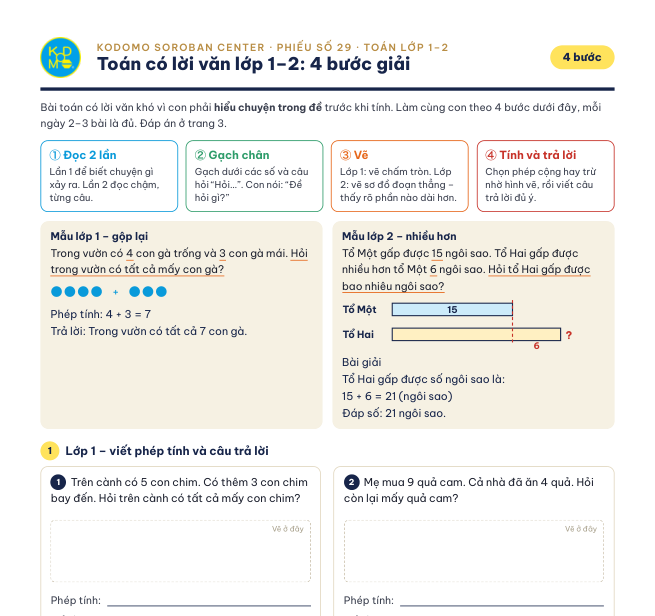
These are the same 4 steps printed on the worksheet. Do all 4 steps with every problem, even easy ones.
- Read twice
The first time to find out what happens. The second time slowly, sentence by sentence; then your child retells the problem in their own words.
Start at homeNot reading fluently yet? You read it the first time; your child reads it the second time or repeats each sentence after you.
- Underline
Underline the numbers and the question. Before calculating, your child says out loud: “What is the question asking?”
- Draw
In grade 1, draw dots: 4 roosters are 4 dots. In grade 2, draw a line diagram to see clearly which part is longer.
- Calculate and answer
Choose addition or subtraction from the drawing, then write a complete answer sentence. Grade 2: the solution sentence comes from the question: “How many students are in class 2B?” → “The number of students in class 2B is:”. Finally, reread the problem with the answer: does it make sense?
The two examples on the worksheet:
- Grade 1 – putting together: “In the garden there are 4 roosters and 3 hens. How many chickens are there in the garden in all?” Calculation: 4 + 3 = 7. Answer: There are 7 chickens in the garden in all.
- Grade 2 – more than: “Group 1 folded 15 paper stars. Group 2 folded 6 more stars than Group 1. How many stars did Group 2 fold?” Solution: The number of stars Group 2 folded is: 15 + 6 = 21 (stars). Answer: 21 stars.
The unit goes in parentheses after the calculation; the answer doesn’t need parentheses. Page 1 of the worksheet also has 4 grade 1 problems with a box for drawing. Download the word problems worksheet (free PDF, in Vietnamese).
The “more than” trap: don’t solve by keywords
Many children are told: “more than means add, fewer than means subtract.” This trick is not always right.
“If it says ‘more than’, add.”
Problem 10 on the worksheet: “Mai has 16 flowers. Mai has 5 more flowers than Lan. How many flowers does Lan have?” Lan has 5 fewer than Mai: 16 − 5 = 11.
“If it says ‘fewer than’, subtract.”
“Hung has 28 marbles. Hung has 7 fewer marbles than Dung. How many marbles does Dung have?” Dung has more, so add: 28 + 7 = 35.
“Learn lots of keywords and you can solve anything.”
Keywords are only hints. Your child needs to know which number is bigger and which number the question asks for – a drawing shows that.
Choose the operation from the drawing, not from one word in the problem. Page 3 of the worksheet has a drawing that explains why problem 10 is a subtraction.
Line diagrams: how to draw “more than, fewer than” problems
A line diagram uses two lines to compare two amounts: the longer line is the larger amount, and the extra part is the difference. At school, your child may learn to write a short summary of the problem; a line diagram is a summary in picture form.
In Japan, primary school math textbooks also often use tape diagrams and line diagrams so that children can see how the numbers relate.
For problem 10: draw Mai’s line and write 16. Lan’s line is shorter; write 5 on the missing part and “?” on Lan’s line. You are looking for the shorter line, so subtract: 16 − 5 = 11. To find the longer line, add.
No ruler or exact lengths needed – the longer line just has to look longer.
Page 2 has 6 grade 2 problems where your child draws the diagram themselves. Download the word problems worksheet (free PDF, in Vietnamese).
Practice at home: 2–3 problems a day, with you as the listener
A little every day. 2–3 problems done with all 4 steps help more than a whole page done in a hurry.
Four easy ways to practice:
“There are 8 cookies on the plate and the family eats 3. How many are left?”
Your child makes up a problem about their own toys for you to solve.
You only ask “What is the question asking?” and don’t solve it for them.
“Which line is longer? Which line are you looking for?” – don’t correct it right away.
Things to avoid:
- Reading the problem and then solving it for your child
- Forgetting the unit: 15 + 6 = 21 (stars)
- An answer sentence that doesn’t match the question: it asks about Group 2, but your child writes about Group 1
- Giving dozens of problems at once
- Scolding or comparing your child with classmates
If your child is starting to dislike math, see My child is struggling with math – what should I do?.
How does soroban help with word problems?
To be honest: soroban does not teach children how to read and understand word problems – as we wrote in What is grade 1 “thinking math”?.
Soroban helps with
- Fast, accurate calculation, so your child has energy left to think about the problem
- Splitting and combining 5 and 10 (the 5-friend and 10-friend rules): seeing a number as parts
- Concentration and the habit of sitting down to study
Soroban doesn’t teach
- Reading and understanding the problem
- Choosing the operation from the story
- Setting out the solution
Soroban helps with the calculating; understanding the problem still needs its own practice.
Splitting and combining numbers is another link: problem 4 on the worksheet (10 marbles, 7 blue, the rest red) is exactly “10 is 7 and 3”. See Splitting and combining numbers in grade 1 and the splitting and combining worksheet.
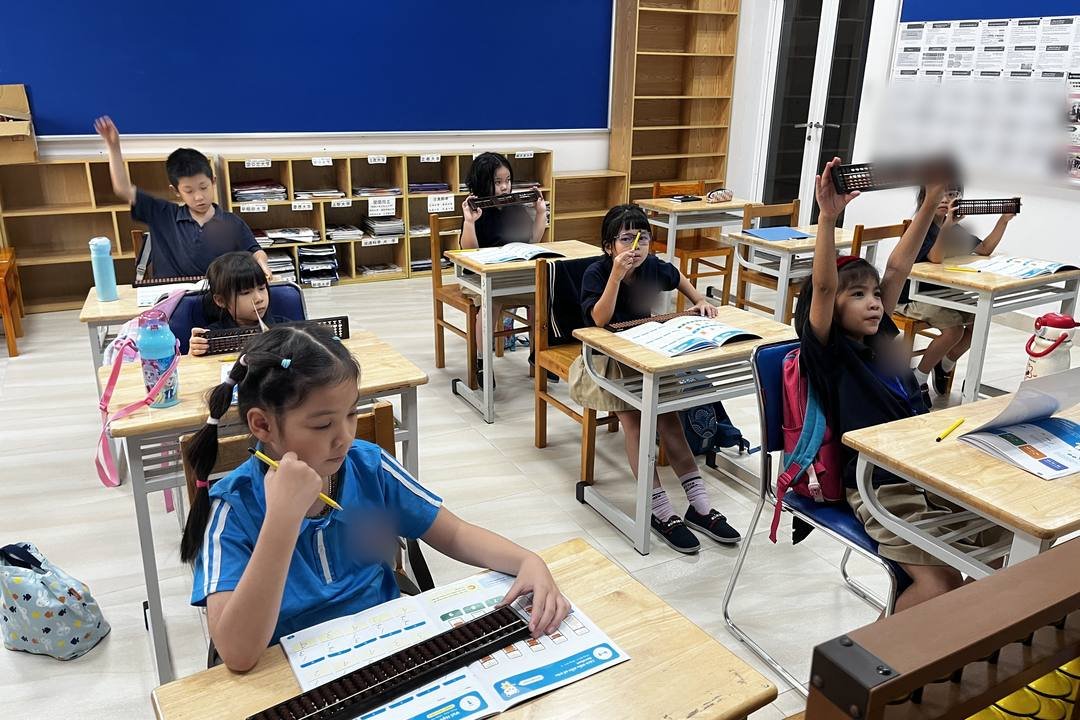
At Kodomo Soroban Center (Vinhomes Gardenia, Hanoi), each class has 3–5 children and each lesson lasts 60 minutes, with classes for 5-year-olds and for primary school children. We also run soroban clubs at schools, like the class in the photo at the top.
See how a lesson works. The trial lesson is free – sign up on our Contact page or call or message us on Zalo at 096.802.8484.
Frequently asked questions
Do grade 1 children have to write a full solution and answer (“Bài giải” and “Đáp số”)?
Usually not yet. Many grade 1 teaching guidelines only ask children to give the right calculation and answer the question; the “Bài giải – Đáp số” layout is learned in grade 2. Follow the teacher’s instructions.
My child can’t read fluently yet – how can they do word problems?
Don’t wait for fluent reading. You read the problem the first time, your child repeats each sentence, then draws dots. Understanding the story is enough; reading speed will come.
How do we know when to add and when to subtract?
Draw it; don’t guess from one word in the problem. Looking for the whole (putting together, adding more) means add; looking for a part (what is left, what was taken away) means subtract. In comparison problems, finding the longer line means add, and finding the shorter line or the difference means subtract.
What is a line diagram, and how do you draw one?
It is a picture that uses two lines to compare two amounts. Draw the line for the known number first, then draw the second line longer or shorter as the problem says, write the difference on the extra part, and put a “?” where the unknown is.
Is there a printable word problems worksheet for grades 1–2?
Yes. Our free worksheet has 3 pages: the 4 steps, two examples and 4 grade 1 problems; 6 grade 2 problems (adding more, taking away, more than, lighter than, how many more, and one that says “more than” but needs subtraction); and the answers. Download it on our free worksheets page.
Try a free soroban lesson
Classes of 3–5 children at Vinhomes Gardenia (Hanoi), 60 minutes each, taught exactly as in Japan. Phone · Zalo 096.802.8484.

Written by the teaching team of Kodomo Soroban Center, following the method and textbooks of Kodomo School (Japan, teaching soroban since 1976). The center is licensed by the Hanoi Department of Education and Training, and our project is a 2026 EDU-Port Nippon supported project of Japan’s Ministry of Education (MEXT).
About usEDU-Port NipponEducation licenseRelated articles
10 math games for kids aged 3–5 at home – no need to buy toys
10 math games for kids aged 3–5 at home using everyday things: number hopscotch, sorting, patterns, hide-under-a-bowl, dice dots, measuring with hands…
Splitting and combining numbers in grade 1: how to teach number bonds up to 10 – with a free worksheet
How to teach grade 1 number bonds – splitting and combining numbers up to 10: 5 steps from objects to mental math,…
Japanese-style parenting for ages 3–6: 10 small habits many Japanese families keep every day
Japanese-style parenting for ages 3–6 at home: greetings, meals, small chores, waiting while kids try, praise and scolding, early bedtime, picture books…