Grade 2 mental math: adding and subtracting with carrying up to 100 – 3 easy methods and a free worksheet
In grade 2, children meet problems like 36 + 27 and 72 − 45. With the column method they manage, but asked out loud they get stuck – or they write 53 because they forgot to “carry the 1”. We are Japanese and teach soroban to children in Hanoi. What we want to tell parents first: once your child understands that the carried 1 is really one ten, adding and subtracting with carrying becomes much easier.
Children add and subtract with carrying faster in their heads once they see the carried 1 as one ten and have a few simple methods ready.
- Foundation: fast addition and subtraction across 10, up to 20
- Split tens and ones: 36 + 27 = 50 + 13 = 63
- Round to a ten, then adjust: 58 + 29 = 58 + 30 − 1 = 87
- Subtraction: add on, or subtract a round ten and give back
- Use the column method for schoolwork, mental math to check
- 10 minutes a day: say it → write it → do it in your head
How far does grade 2 go with carrying?
Under Vietnam’s 2018 general education curriculum, grade 2 children should add and subtract mentally up to 20 and with round tens and hundreds; addition and subtraction with carrying gradually extend up to 1,000.
All three grade 2 math textbook series (Ket noi tri thuc voi cuoc song, Canh dieu and Chan troi sang tao) follow the same order: first adding and subtracting across 10 up to 20, then adding and subtracting with carrying up to 100.
With two-digit numbers, textbooks mainly teach the column method. Working out 36 + 27 entirely in your head is one step further – but well worth practicing, because a child who can do it mentally can check their own work.
Why is “carrying the 1” hard for grade 2 children?
When doing 36 + 27 in columns, Vietnamese children say: “6 plus 7 is 13, write 3, carry 1; 3 plus 2 is 5, plus 1 is 6, write 6.” Many children can say it fluently without knowing what the carried 1 actually is.
That 1 is one ten. 13 is 1 ten and 3 ones: the 3 ones stay, and the 1 ten moves to the tens column. Once your child understands this, they forget to carry less often, because they know where the 10 is going.
Use counting sticks: 10 sticks make 1 bundle. Lay out 36 sticks (3 bundles and 6 loose) and 27 sticks (2 bundles and 7 loose). There are 13 loose sticks: your child ties 10 of them into a new bundle, leaving 3. That makes 6 bundles and 3 sticks – 63. The carried 1 is that new bundle.
The second foundation is adding and subtracting across 10, up to 20. Quickly ask a few, like 6 + 8, 9 + 4, 12 − 5 and 15 − 8: if your child answers right away, they are ready; if they still count on their fingers, go back to How to teach a grade 1 child fast mental math.
3 ways to add and subtract with carrying up to 100 in your head
All three share one idea: turn the problem into one with round tens. For each method, have your child say every step out loud before doing it in their head.
- Split tens and ones
Add tens to tens and ones to ones, then put them together: 30 + 20 = 50, 6 + 7 = 13, so 36 + 27 = 50 + 13 = 63. Likewise: 45 + 37 = 70 + 12 = 82. It is close to the column method, but the tens come first.
- Round to a ten, then adjust
When a number ends in 8 or 9, add the round ten instead, then take away the extra: 58 + 29 = 58 + 30 − 1 = 88 − 1 = 87. Likewise: 46 + 28 = 46 + 30 − 2 = 76 − 2 = 74.
NoteIf you added too much, take it back. Have your child say “1 too many, take away 1” before doing it mentally.
- Subtraction: add on, or subtract a round ten and give back
For 72 − 45, add on from the number being subtracted: 45 + 5 = 50, 50 + 22 = 72, so the answer is 5 + 22 = 27. Or subtract a round ten: 72 − 50 = 22; that took away 5 too many, so give 5 back: 22 + 5 = 27.
Your child doesn’t need all three methods for every problem. Let them pick the one they find easiest – as long as they can explain why it works. Our article Mental math tricks for kids has more tricks.
Page 1 of the worksheet shows examples of all three methods and 12 fill-in-the-blank problems, like 45 + 38 = 70 + □ = □. Download the grade 2 mental math worksheet (free PDF, in Vietnamese).
Column method or mental math? Your child needs both
At school, your child still uses the column method and sets out their work the way the teacher shows. Mental math doesn’t replace it; it helps your child look back at the answer.
Mental math
- Tens come first, so you know right away “about how much”
- Works anytime, no paper or pencil needed
- Helps catch answers that don’t make sense
Column method
- The way to set out work at school
- Right to left, one column at a time; steady as numbers grow
- Easy to forget the carry if done by habit without understanding
Say your child works out 36 + 27 in columns and gets 53. A quick mental check: 36 + 20 is already 56, so 53 is wrong. Or they get 37 for 72 − 45 because they forgot the borrow in the tens column: 72 − 40 = 32, so the answer must be less than 32. Check by adding: 27 + 45 = 72.
Use the column method to set out the work, and mental math to see whether the answer makes sense.
Daily mental math practice for grade 2: 10 minutes is enough
Practice each type of problem for 3 days in a row, in this order: say it, write it, then do it in your head.
- Day 1Say each step out loud
“45 + 37: 40 plus 30 is 70, 5 plus 7 is 12, 70 plus 12 is 82.” Do 5–6 problems; if there are mistakes, slow down.
- Day 2Write the steps on paper
Write the middle step too: 45 + 37 = 70 + 12 = 82. You can see where your child gets stuck.
- Day 3In the head only
You read the problem, your child says the answer. If they still need to write, add one more day of writing.
Go from easy to hard: adding a one-digit number (68 + 7 = 68 + 2 + 5 = 75), then two two-digit numbers; subtraction in the same order (53 − 8 = 53 − 3 − 5 = 45, then 72 − 45).
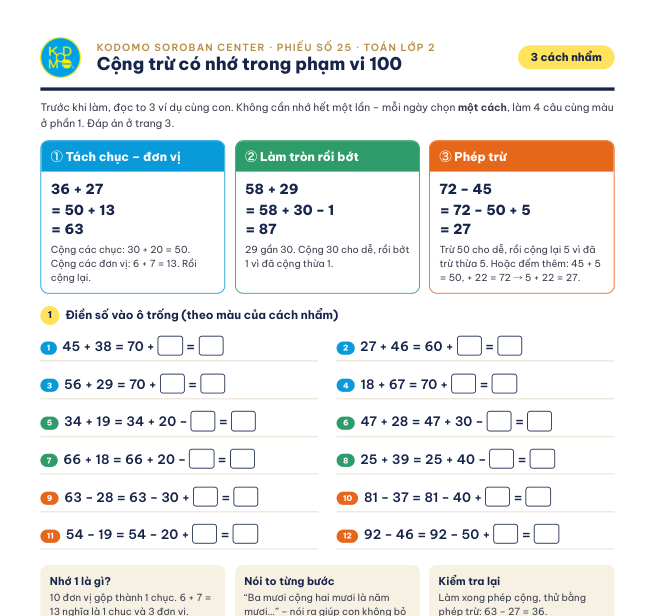
Once your child is comfortable with all three methods, they practice a mix with the 40 problems with carrying up to 100 on page 2; the answers are on page 3. Download the grade 2 mental math worksheet (free PDF, in Vietnamese). For more practice, see Sheet 18 in the mental math worksheets.
Things to avoid:
- Timing your child while they still make mistakes – right first, fast later
- Asking for mental math before your child sees the carried 1 as one ten
- Teaching all three methods on the same day
- Telling your child to drop the column method taught at school
- Scolding mistakes or comparing your child with classmates
If your child is starting to dislike math, see My child is struggling with math – what should I do?.
How does soroban help with carrying?
On a soroban, carrying the 1 is a movement of the hand. For 36 + 27, your child sets 36 and adds 2 in the tens column to get 56. The ones column shows 6, so there is no room to add 7 – your child takes away 3 (7 and 3 are “friends of 10”) and adds 1 bead in the tens column. The soroban now shows 63.
Like method 1, your child works on the tens first, and adds the 1 ten to the column on the left with their own hand. Your child can see the carried 1, so it is harder to forget. In our experience, many children who learn soroban become faster and more accurate at carrying. Once their hands are used to it, they gradually move on to picturing the soroban in their head: see What is Japanese mental math (anzan)?.
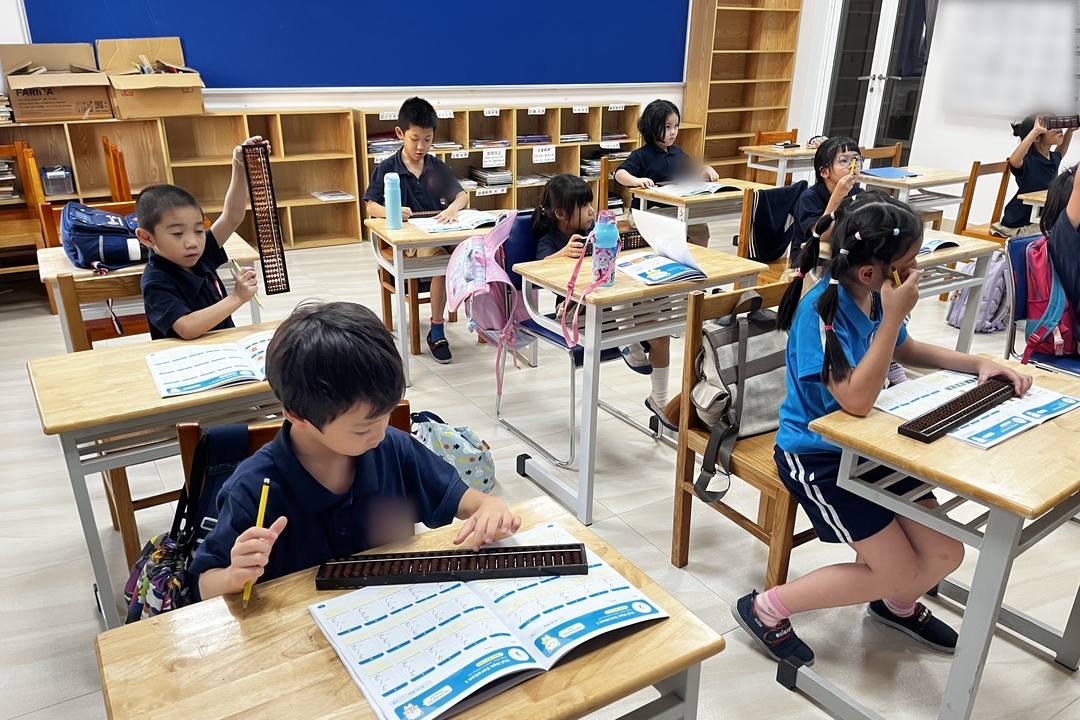
In our program, the 10-friend rule for addition is learned at Level 1A. At Kodomo Soroban Center (Vinhomes Gardenia), each class has 3–5 children and each lesson lasts 60 minutes, with classes for primary school children. We also run soroban clubs at schools, like the class in the photo at the top.
See how a lesson works. The trial lesson is free – sign up on our Contact page or call or message us on Zalo at 096.802.8484.
Frequently asked questions
Up to what number do grade 2 children add and subtract with carrying?
They first learn adding and subtracting across 10 up to 20, then with carrying up to 100, usually in the first semester. By the end of grade 2, they add and subtract with carrying (no more than once per problem) up to 1,000. The mental math required is up to 20 and with round tens and hundreds.
My child keeps forgetting to carry the 1 – what can I do?
Don’t just remind them to “carry the 1!”. Show them that the 1 is one ten, with counting sticks: tie 10 loose sticks into a new bundle. In the column method, have your child say “13 is 1 ten and 3 ones”, then check the answer mentally.
Should my child use mental math or the column method?
Both. At school, your child uses the column method the way the teacher shows. Mental math tells them “about how much” the answer is and helps them catch mistakes. Children who are good at mental math are often more accurate in columns too, because they understand each step.
How long should my child practice mental math each day?
About 10 minutes. Practice each type for 3 days: say it, write the steps, then do it in the head only. A little every day beats one long session on the weekend; stop while your child still wants more.
Is there a printable grade 2 mental math worksheet?
Yes. Our grade 2 mental math worksheet has 3 pages: examples of the 3 methods and 12 fill-in-the-blank problems, 40 problems with carrying, and the answers. To review the foundation up to 20, also use Sheets 15 and 16 on our free worksheets page.
Try a free soroban lesson
Classes of 3–5 children at Vinhomes Gardenia (Hanoi), 60 minutes each, taught exactly as in Japan. Phone · Zalo 096.802.8484.

Written by the teaching team of Kodomo Soroban Center, following the method and textbooks of Kodomo School (Japan, teaching soroban since 1976). The center is licensed by the Hanoi Department of Education and Training, and our project is a 2026 EDU-Port Nippon supported project of Japan’s Ministry of Education (MEXT).
About usEDU-Port NipponEducation licenseRelated articles
Japanese-style parenting for ages 3–6: 10 small habits many Japanese families keep every day
Japanese-style parenting for ages 3–6 at home: greetings, meals, small chores, waiting while kids try, praise and scolding, early bedtime, picture books…
What is Flash Anzan? How to practice Flash Anzan mental math at home with your child
Flash Anzan is a mental math drill: numbers flash on a screen one by one and your child adds them on an…
How to teach kids to tell time: 5 easy steps from o’clock to every minute – with a free printable worksheet
How to teach your child to read an analog clock in 5 steps: hour and minute hands, o’clock, half past, 15 and…