 Thị trấn WakumaStudent login
Splitting and combining numbers in grade 1: how to teach number bonds up to 10 – with a free worksheet
The teacher asks, “7 is how many and how many?” Your child stares at their fingers for a long time before answering – or says “5 and 2” right away without knowing why. We are Japanese and teach soroban to children in Hanoi. Splitting and combining numbers looks simple, but it is the foundation of addition, subtraction and, later on, mental math.
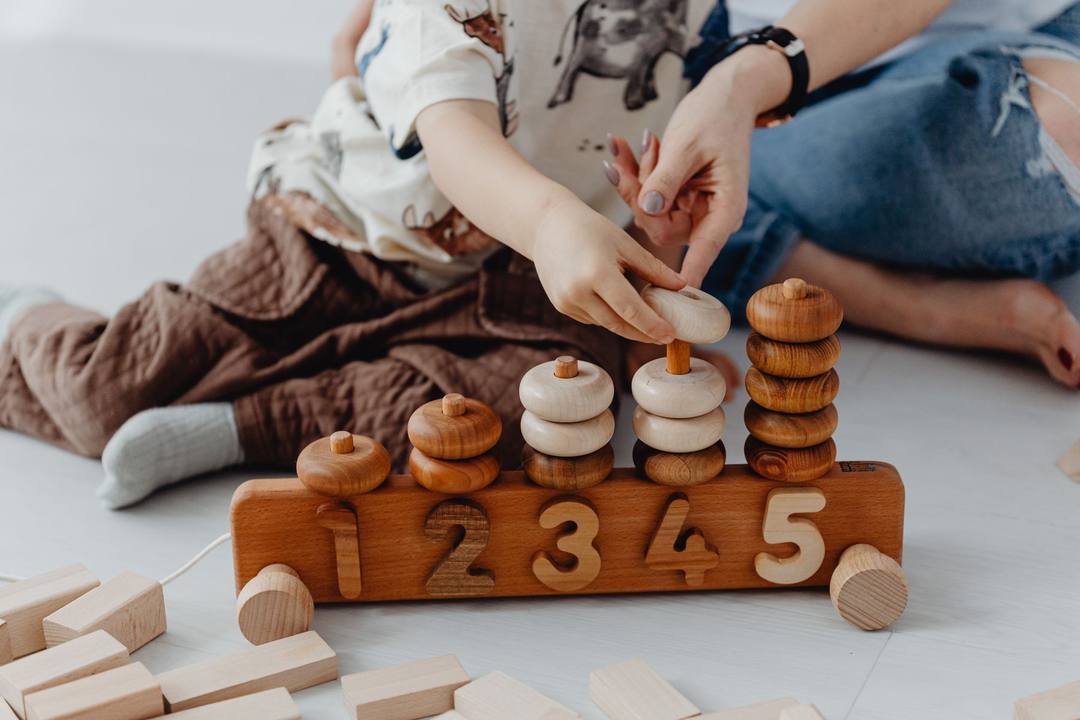
Splitting and combining numbers (number bonds) means understanding that each number is made of two parts: 7 is 5 and 2, and 5 and 2 together make 7.
- Grade 1 covers numbers up to 10, early in the first semester
- The lesson name depends on the textbook: “Tách – gộp số” or “Mấy và mấy”
- The foundation for addition, subtraction and adding across 10
- Teach in order: objects → dots → diagram → digits → saying it fast
- Split 5 first, then 10, and 6–9 last
- 5–10 minutes a day, through games
What are number bonds (“how many and how many”) in grade 1?
Combining means putting two small groups together into one big group: “3 and 2 together make 5”. Splitting means dividing one group into two parts: “7 splits into 5 and 2”, or in short, “7 is 5 and 2”.
At school, your child often sees a number bond diagram: the number on top is the whole, the two numbers below are the parts, joined by two lines. Read from top to bottom, it shows splitting; from bottom to top, combining – the same three numbers, seen from opposite directions.
The lesson name differs by textbook. The Vietnamese grade 1 math book Chân trời sáng tạo has a lesson called “Tách – gộp số” (splitting and combining numbers); Kết nối tri thức với cuộc sống has “Mấy và mấy” (how many and how many) in the unit “Numbers from 0 to 10”. Both come early in the book, in the first semester, as groundwork for addition.
Why does splitting numbers matter in grade 1?
Once your child knows that 7 is 5 and 2, they don’t need to count from the start to work out 5 + 2 or 7 − 2. Compare two ways of working:
Seeing numbers as two parts
- 5 + 2: 7 right away, because 7 is 5 and 2
- 7 − 2: 5 right away – it’s the same pair
- 7 + 5: split 5 into 3 and 2, making 10 + 2 = 12
Counting one by one
- 5 + 2: counting “six, seven” on fingers
- 7 − 2: counting back, easy to be off by one
- 7 + 5: counting on five times – slow and error-prone
The last one, 7 + 5 = 7 + 3 + 2, is the way of adding across 10 that your child will use a lot in grade 2. Seeing “the whole and two parts” also helps your child understand word problems in grades 1 and 2.
In our experience, children who keep counting on their fingers are often still unsure about this. At that point, piling on more sums won’t help; going back to splitting and combining will. See also How to teach your grade 1 child fast mental math and My child is struggling with math – what should I do?.
In Japan, too, first graders spend time on a unit called “ikutsu to ikutsu” (meaning “how many and how many”) before learning addition – exactly the soroban’s “friends of 5, friends of 10”. See What is Japanese “thinking math”?.
How to teach number bonds in grade 1: 5 steps from objects to mental math
Move from things your child can hold to things they only think about. Go on to the next step only after your child gets the current one right for a few days in a row.
- Real objects: split and combine
Give your child 7 beans or 7 blocks. They split them into two piles, count each pile, then put them back together and count them all. Say it out loud: “7 is 4 and 3.”
- Dots in rows of 5
Draw dots, 5 to a row. Looking at 7 dots, your child sees a row of 5 and 2 extra right away – no need to count each dot.
- Number bond diagram
Draw the whole on top and the two parts below, leaving one circle blank for your child to fill in.
- Digits only
“8 is 6 and how many?” Your child answers out loud or writes in the box, with no objects in front of them.
- Say it out loud, then faster
You say “10 is 7 and…”, and your child answers “3!”. Think about speed only once your child gets almost everything right.
The order of the numbers: split 5 first (1 and 4, 2 and 3 – the “friends of 5”), then 10 (1 and 9, 2 and 8, 3 and 7, 4 and 6, 5 and 5 – the “friends of 10”). Leave 6, 7, 8 and 9 for last, when your child already has 5 and 10 as two landmarks.
Our number bonds worksheet follows these exact steps. Page 1 has three examples (combining, splitting, on the soroban) and 12 number bond diagrams; in problems 1–4, your child counts the dots first. Download the number bonds worksheet (free PDF, in Vietnamese).
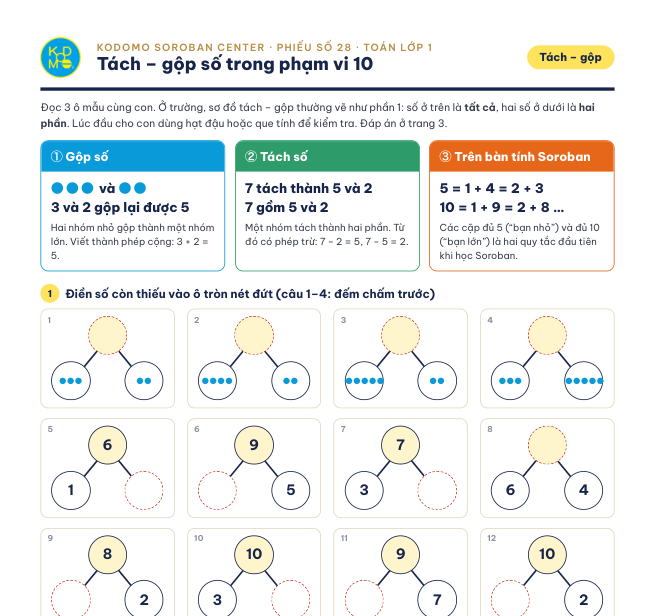
Page 2 has 12 “… is … and □” problems, friends of 5 (4 problems) and friends of 10 (9 problems), then finding every way to split 6 and 8. The answers are on page 3. Once your child knows the friends of 10, move on to Sheet 15 – adding across 10 – in the mental math worksheets.
Number bond games at home
Practice with hands and voice – no desk needed. 5–10 minutes at a time is enough.
Hide some of 10 beans under a bowl. Your child looks at the beans left outside, guesses how many are under the bowl, then lifts it to check.
Your child holds up 7 fingers: one full hand of 5 and 2 on the other – 7 is 5 and 2 at a glance. Try 6, 8 and 9 next.
Give your child 6 blocks: how many ways can they make two groups? 1 and 5, 2 and 4, 3 and 3, 4 and 2, 5 and 1. Start from 1 so nothing is missed.
Draw a number card; your child finds the card that makes 10 with it. How to make the cards is in Getting your child ready for grade 1 math.
Once your child has found every way to split 6, ask: “What do you notice?” When the first part goes up by 1, the second goes down by 1. A pattern children discover for themselves stays with them much longer than one they are told. For younger children, see 10 math games for kids aged 3–5.
Common mistakes when teaching number bonds
Most of them come from a very natural wish: wanting your child to learn it fast.
“If they can recite ‘7 is 5 and 2’, that’s enough.”
Memorizing without understanding leaves your child stuck as soon as the numbers change. Let them check with beans: split 7 beans into 5 and 2, then put them back together.
“They got it right – put the objects away to save time.”
Put objects away too early and your child goes back to counting on fingers. Keep the beans and dots until your child answers correctly without looking.
“If they can combine, they can split.”
Combining leads to addition, splitting leads to subtraction: 7 is 5 and 2, so 7 − 2 = 5. Practice both directions on the same diagram.
“A good student answers fast.”
When rushed, children guess and start to fear math. Right first, fast later – speed comes on its own once they understand.
Number bonds on the soroban
Each rod of the soroban has one 5-bead above and four 1-beads below, so your child sees 6 to 9 as “5 and some more”: 7 is the 5-bead plus two 1-beads.
The first two soroban rules are number bonds too: the 5-friend rule uses pairs that make 5, and the 10-friend rule uses pairs that make 10. For example, 3 + 4: your child sets 3, but only one free 1-bead is left – not enough to add 4. They add the 5-bead (making 8), then take away 1 (leaving 7) – because 4 and 1 are friends of 5. The soroban shows 7: 3 + 4 = 3 + 5 − 1.
Your child isn’t memorizing “3 + 4 = 7” – they are doing that split and combine with their own hands. In our experience, many children who learn soroban answer “how many and how many” faster and more surely – but at home, beans and fingers can do the same job. Read more: Is learning soroban good for children?.
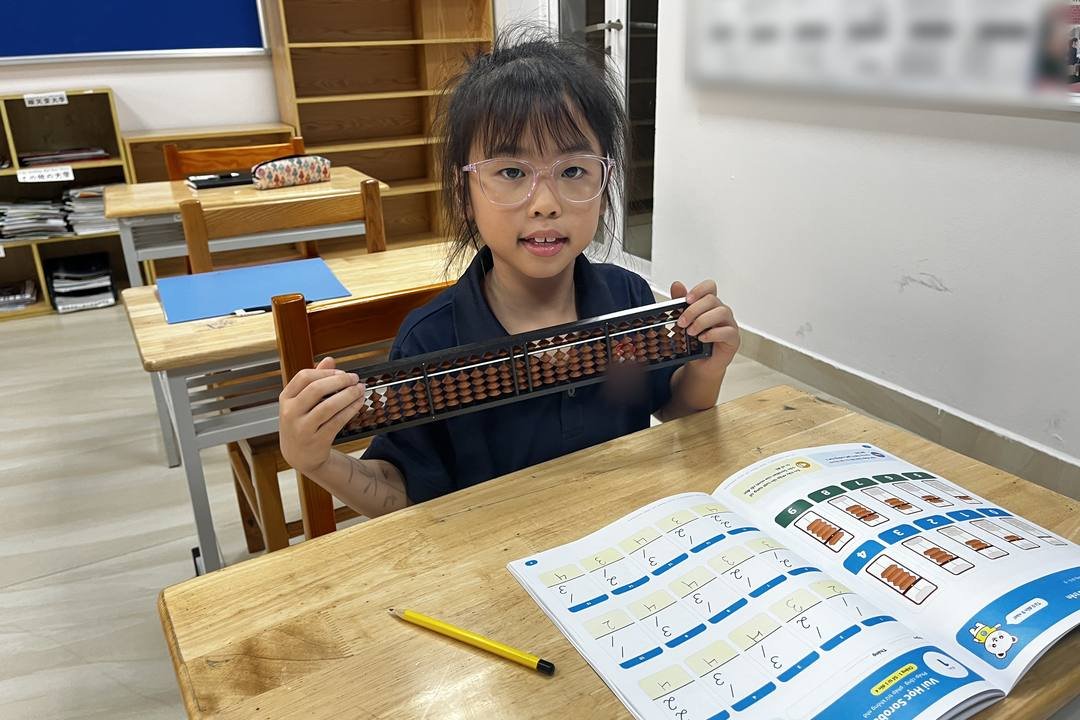
At Kodomo Soroban Center (Vinhomes Gardenia), each class has 3–5 children and each lesson lasts 60 minutes, with classes for 5-year-olds and for primary school children. We also run soroban clubs at schools, like the class in the photo.
Try 3 + 4 on our free online soroban, or see how a lesson works. The trial lesson is free – sign up on our Contact page or call or message us on Zalo at 096.802.8484.
Frequently asked questions
What are number bonds (splitting and combining numbers)?
It means understanding that a number is made of two parts: 7 is 5 and 2 (splitting), and 5 and 2 together make 7 (combining). At school, children use a number bond diagram: the whole on top, the two parts below. It is the foundation of addition and subtraction.
When do grade 1 children learn number bonds?
Early in grade 1, in the first semester, with numbers up to 10. The lesson name depends on the textbook: Chân trời sáng tạo calls it “Tách – gộp số”; Kết nối tri thức với cuộc sống has “Mấy và mấy” (how many and how many) in the unit “Numbers from 0 to 10”.
My child still counts on their fingers – is that a problem?
Not in the first semester: fingers are a good tool when starting out. Show your child that one hand is 5, so they see 7 as 5 and 2 instead of counting each finger. If they have been doing addition for a while and still count one by one, go back to practicing number bonds.
Should I teach friends of 5 or friends of 10 first?
Friends of 5 first: there are only two pairs (1 and 4, 2 and 3), easy to see on one hand. Then friends of 10, and only then splitting 6, 7, 8 and 9. In our soroban classes, we also teach the 5-friend rule before the 10-friend rule.
Is there a printable grade 1 number bonds worksheet?
Yes. Our free number bonds worksheet has 3 pages: number bond diagrams; “… is … and □” problems with friends of 5 and friends of 10; and the answers. Download it from our free worksheets page.
Try a free soroban lesson
Classes of 3–5 children at Vinhomes Gardenia (Hanoi), 60 minutes each, taught exactly as in Japan. Phone · Zalo 096.802.8484.

Written by the teaching team of Kodomo Soroban Center, following the method and textbooks of Kodomo School (Japan, teaching soroban since 1976). The center is licensed by the Hanoi Department of Education and Training, and our project is a 2026 EDU-Port Nippon supported project of Japan’s Ministry of Education (MEXT).
About usEDU-Port NipponEducation licenseRelated articles
10 math games for kids aged 3–5 at home – no need to buy toys
10 math games for kids aged 3–5 at home using everyday things: number hopscotch, sorting, patterns, hide-under-a-bowl, dice dots, measuring with hands…
Word problems in grades 1 and 2: 4 steps to help your child understand and solve them – with a free worksheet
Why grade 1 and 2 word problems are hard, 4 steps (read, underline, draw, solve), the “more than” trap, how to draw…
Japanese-style parenting for ages 3–6: 10 small habits many Japanese families keep every day
Japanese-style parenting for ages 3–6 at home: greetings, meals, small chores, waiting while kids try, praise and scolding, early bedtime, picture books…