How to teach your grade 1 child fast mental math the Japanese way: 5 steps, 10 minutes a day
Your child has started grade 1 but still counts on their fingers, adds slowly, or often makes mistakes when a sum “goes past 10”? This is a guide for parents on teaching fast mental math in grade 1, in the same order Japanese children are taught – from counting, to splitting and combining numbers, to adding and subtracting across 10, to mental math with images – with a 10-minute daily practice plan and free worksheets. We are soroban teachers, so this article also says clearly when the abacus helps and when it is not needed yet.
Fast mental math in grade 1 does not come from doing lots of exercises, but from 5 steps in the right order: (1) count fluently and recognize numbers up to 20; (2) learn the “friends of 5” and “friends of 10” (pairs of numbers that add up to 5 and to 10); (3) add and subtract within 10 without fingers; (4) add and subtract across 10 by splitting numbers (7 + 5 = 7 + 3 + 2); (5) calculate with images – on a soroban or with dot patterns – instead of reciting in your head. Ten minutes a day, and within 4–6 weeks your child will change noticeably. Below is how to do each step.
Why is my child slow at mental math? 3 common causes
Before you teach, look at where your child is getting stuck. In free trial lessons at Kodomo Soroban Center, we see three causes again and again:
- Your child counts rather than “sees” numbers. To work out 4 + 3, they count “five, six, seven” on their fingers. Counting is right in kindergarten, but in grade 1 children need to see 4 + 3 as “4 and 1 more is 5, plus 2 is 7” – that is, to see numbers in groups of 5.
- Your child hasn’t learned the “friends of 10” pairs yet. 7 goes with 3, 6 with 4, 8 with 2… Without this foundation, every sum across 10 has to be counted, and your child slows down exactly where grade 1 math spends the most time (numbers up to 20).
- Your child calculates in words, not in pictures. They silently recite “seven plus five equals…” and then search their memory. Fast mental calculators – and Japanese children who learn the soroban – don’t do this: they see numbers as images and “move” them. This is the biggest difference, and it can be trained.
The good news: all three can be fixed at home, even by parents who aren’t good at math, as long as you follow the right order and practice regularly.
Step 1 · Count fluently and “see” numbers up to 20 (week 1)
Don’t rush into addition and subtraction. First make sure your child can do these three things without thinking:
- Count forwards and backwards from 1 to 20 and from 20 back to 1, and count in twos (2, 4, 6…).
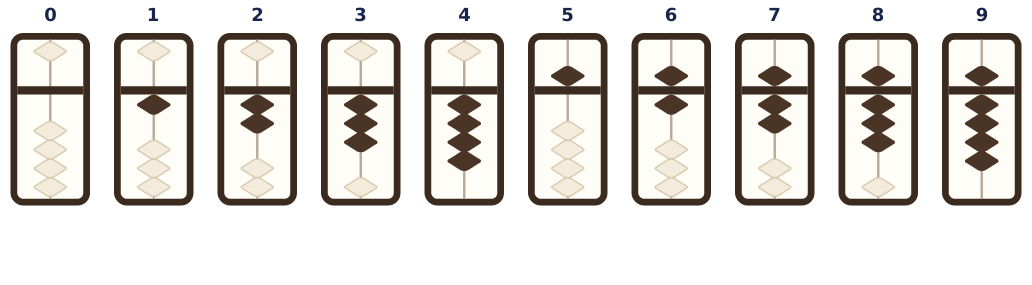
- Recognize amounts without counting: you quickly hold up 3 fingers, 5 fingers, then 5 fingers and 2 – your child says “three”, “five”, “seven” straight away. This is the first lesson of the soroban: 7 is one 5-bead and two 1-beads, not seven separate things.
- Say the number before and after: “What comes before 12? What comes after 15?”
A good game: lay out beans or bottle caps in rows of 5 and ask “how many?” while covering some of them. At our center we use the abacus itself for this: when a child sets 7 on the abacus, they automatically see that 7 = 5 + 2. The article What is the soroban? has pictures of the numbers 0–9 for parents to refer to.
Step 2 · Learn the “friends of 5” and “friends of 10” (weeks 1–2)
This is the most important step, and the one most often skipped. Japanese fast mental math is built on two very small tables:
| Friends of 5 | 1 ↔ 4 · 2 ↔ 3 | Used when adding or subtracting within 10 and there is “not enough”: 3 + 4 = 3 + 5 − 1 |
|---|---|---|
| Friends of 10 | 1 ↔ 9 · 2 ↔ 8 · 3 ↔ 7 · 4 ↔ 6 · 5 ↔ 5 | Used when adding or subtracting across 10: 7 + 5 = 7 + 3 + 2 = 12 |
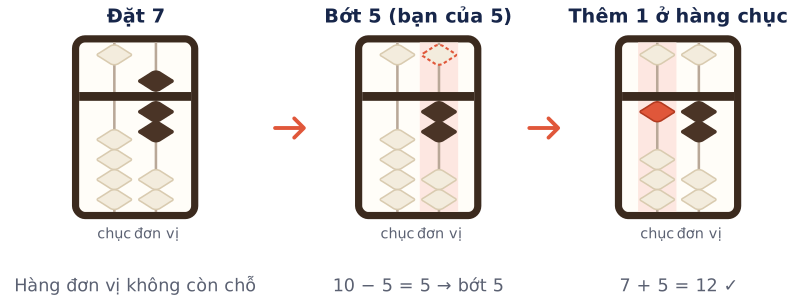
How to teach it: play a one-minute “quick question – quick answer” game every day. You say “7!”, your child says “3!”; “4!” – “6!”. When your child answers without thinking (in under 1 second), they are ready for step 4. On the soroban, these two tables don’t need to be memorized in words – your child’s hands do them hundreds of times: if there aren’t enough 1-beads, use the 5-bead (friends of 5); if there is no room left in the ones column, borrow from the tens column (friends of 10). We call these the 5-friend rule and the 10-friend rule.
Step 3 · Add and subtract within 10 without fingers (weeks 2–3)
Goal: 50 additions and subtractions within 10 in 3 minutes, with no mistakes. Three small rules help your child let go of their fingers:
- Adding 1 or 2: count on from the bigger number. 2 + 7 → start from 7: “eight, nine”. This is the only time counting is allowed.
- Adding 5: a group of 5 you can see. 3 + 5 is “3 and one group of 5” = 8. If your child has an abacus, this means bringing one 5-bead down.
- Adding 3 or 4: go via 5. 3 + 4 = 3 + 5 − 1 (friends of 5). At first it feels like a detour; after a week your child does it in their head without thinking.
Subtraction works the other way round, plus one more idea: subtraction is finding the missing number. 9 − 6: “6 plus what makes 9?” – your child uses exactly the friends-of-10 and friends-of-5 tables they have just learned. Mental math worksheets 13 and 14 (within 10) at the end of this article are for this step.
Step 4 · Add and subtract across 10 by splitting numbers (weeks 3–4)
This is the hardest part for children in grades 1–2, and it is where most “slow” children get stuck. In the Vietnamese curriculum, addition and subtraction with carrying within 20 are formally taught at the start of grade 2, but most children meet them earlier, and they are the foundation of every calculation that comes later – so starting practice in the second term of grade 1 is just right. The Japanese way of teaching has only one rule: make 10 first, then add the rest.
13 − 5 = ? Subtract down to 10 first: 13 − 3 = 10. You still need to subtract 2 more: 10 − 2 = 8.
How to teach it at home: write the sum in large numbers and ask “What does 7 need to make 10?” – your child answers using the friends-of-10 table. Then ask “5 splits into 3 and what?”. Two questions, no long explanations. After 20–30 exercises, your child does those two steps in their head on their own. At this stage, don’t ask for speed; ask for accuracy and for them to say the method out loud. Speed comes in step 5.
If your child is learning the soroban: this is exactly Level 1A (the 10-friend rule). Once their hands are used to it, they don’t need to think “split 5 into 3 and 2” – they see there is no room left in the ones column, take away 5 and add 1 ten. It is faster, and they never get it wrong because they have the picture.
Step 5 · From accurate to fast: mental math with images (week 4 onwards)
Once your child is accurate, speed comes from switching from “calculating in words” to “calculating in pictures”. There are two ways, depending on whether your child learns the soroban or not:
Option A – your child doesn’t learn the soroban: mental math with “5-dot patterns”
Teach your child to imagine each number as dots arranged in rows of 5 (like on dice or dot cards). 7 is one row of 5 and 2 dots; adding 5 means adding one row; 12 is two rows and 2 dots. You read the sum slowly, your child closes their eyes, “arranges the dots” and says the answer. This works quite well up to 20, but it is hard to extend to 2- or 3-digit numbers.
Option B – your child learns the soroban: mental math on an abacus in the head (anzan)
This is how Japanese children do fast mental math. Once they are used to a real abacus, they place their hands on the abacus but don’t move the beads, only imagining them moving; then they put the abacus away, close their eyes, and “move the beads” in their head. The image of the abacus has ones, tens and hundreds columns, so this method can go on to numbers with many digits and even multiplication and division. At Kodomo Soroban Center, children do mental math from the 4th lesson and Flash Anzan (numbers flashing quickly on a screen) from the 6th. Parents can let their child try our online mental math practice tool – start with 1 digit, 3 numbers, 1 second.
A 10-minute daily practice plan (6 weeks)
| Week | Main practice (7 minutes) | To finish (3 minutes) | Worksheet |
|---|---|---|---|
| 1 | Count forwards and backwards to 20; hold up fingers – your child says the number straight away; friends-of-5 quick questions | “Number before – number after” game | – |
| 2 | Friends-of-10 quick questions (1 minute); adding within 10 without fingers | You read out 5 sums, your child says the answers | 13 |
| 3 | Subtracting within 10 (“find the missing number”) | Friends-of-10 quick questions, as fast as possible | 14 |
| 4 | Adding across 10 by splitting numbers, saying the method out loud | 3 mental sums with images (5-dot patterns or abacus) | 15 |
| 5 | Subtracting across 10 (subtract down to 10 first) | Flash Anzan 1 digit · 3 numbers · 1.5 seconds | 16 |
| 6 | Mixed addition and subtraction within 20, timed, with the time written down | Flash Anzan 1 digit · 4 numbers · 1 second | 15 + 16 |
Regular beats a lot: 10 minutes every day is better than 1 hour at the weekend. Use a clock so your child compares themselves with themselves yesterday, not with siblings or friends – this is a principle we keep in every class.
5 mistakes parents often make when teaching mental math
- Pushing for speed before your child is accurate.
Speed is the result of a clear picture, not of being hurried. When your child makes a lot of mistakes, go back a step rather than adding more practice time.
- Banning fingers too early.
Fingers are fine in week 1. They should only disappear once your child has the friends-of-5 and friends-of-10 tables and the “group of 5” in their head – usually in weeks 2–3.
- Teaching tricks instead of structure.
“To add 9, add 10 and take away 1” is a good trick, but only after your child understands splitting and combining numbers. Tricks without a foundation fall away in grade 2.
- A different type of exercise every day.
Six-year-olds need repetition. One type of exercise per week, the same for 5 days, is what moves a child from “knowing” to “doing without thinking”.
- Parents explaining too much.
Asking two questions (“What does 7 need to make 10?”, “5 splits into 3 and what?”) works better than five minutes of explanation. What children find out for themselves, they remember for longer.
When does the soroban help – and when is it not needed yet?
To be honest: for numbers up to 20 in grades 1–2 alone, if parents stick with the plan above for 6 weeks, children improve clearly without an abacus. The soroban becomes worthwhile when:
- Your child has tried but still counts on their fingers after 1–2 months – the abacus gives them a concrete picture of a “group of 5” and a “group of 10” that words cannot.
- You want your child to do mental math with 2- and 3-digit numbers and go on to multiplication and division – “5-dot patterns” can’t go that far, but an abacus in the head can.
- Your child needs to build concentration and study habits at the same time – a Japanese-style soroban lesson is 60–70 minutes with no screens, with greetings, posture and tidying up.
If you’d like to understand the abacus before deciding, the article How to learn the soroban at home walks you through the first 7 steps with illustrations, and the article on age helps you see whether your child is ready.
Grade 1 mental math worksheets (free PDF)
The worksheets for this article are on the Free worksheets page: worksheets 13–14 (within 10, addition and subtraction), 15–16 (across 10), 17 (within 100 without carrying), 18 (within 100 with carrying, for grade 2). Each worksheet has 2 pages: exercises and answers, with a box for writing down the time so your child can track their own progress. There are also worksheets 19–22 for grade 1 “thinking math” (fill in the missing number, comparing, finding patterns, grid sums).
Frequently asked questions
How can I teach my grade 1 child fast mental math?
Follow the 5 steps in order: count fluently and recognize numbers up to 20; learn the “friends of 5” and “friends of 10” pairs; add and subtract within 10 without fingers; add and subtract across 10 by splitting numbers (7 + 5 = 7 + 3 + 2); then calculate with images instead of reciting in your head. Ten minutes a day, for 4–6 weeks.
Should grade 1 children use counting sticks or fingers?
Yes, at the beginning. Counting sticks and fingers help children understand amounts. But from weeks 2–3, replace them with a “group of 5” (dot cards, an abacus) so your child moves on to seeing numbers in groups, and then gradually stops using tools.
Is my grade 1 child behind if they still count on their fingers?
No, not in the first term. Finger counting becomes a problem when your child has already learned to go past 10 but still counts one by one. At that point, go back to the friends-of-10 table and splitting numbers, rather than pushing for speed.
What is Japanese-style mental math?
It is calculating with the image of a soroban in the head (anzan). Learners picture the beads moving instead of reciting the calculation in their head, so they can calculate numbers with many digits very quickly. Japanese children learn on a real abacus first, then move gradually to mental math.
Does my child need to learn the soroban to do fast mental math?
For numbers up to 20 in grades 1–2, it isn’t essential – 6 weeks following the plan in this article is enough. The soroban is worthwhile when your child still counts on their fingers after 1–2 months, when you want them to do mental math with 2- and 3-digit numbers and multiplication and division, or when you want them to build concentration and study habits at the same time.
Try a free soroban lesson
Classes of 3–5 children at Vinhomes Gardenia (Hanoi), 70 minutes each, taught exactly as in Japan. Phone · Zalo 096.802.8484.

Written by the teaching team of Kodomo Soroban Center, following the method and textbooks of Kodomo School (Japan, teaching soroban since 1976). The center is licensed by the Hanoi Department of Education and Training, and our project is a 2026 EDU-Port Nippon supported project of Japan’s Ministry of Education (MEXT).
About usEDU-Port NipponEducation licenseRelated articles
How do Japanese parents raise independent children? 7 habits from Japanese schools that parents can start today
How do Japanese parents raise independent children? Not with iron discipline, but with 7 habits repeated every day at school and at…
What is Japanese “thinking math”? Soroban, Kumon, Gakken and how Japan teaches children math
What is Japanese “thinking math”? The Japanese don’t call it “thinking math” – they have 3 popular ways of teaching math: soroban…
My child can’t focus when studying – what can I do? 8 ways Japanese classrooms build concentration (for ages 5–8)
Your child can’t focus when studying – what can you do? A realistic view of attention spans at ages 5–8, 5 common…