 MembersLog in

 あ



Soroban or Kumon? How the two Japanese ways of learning math differ, and which suits your child
Kumon and soroban are the two “Japanese math” names Hanoi parents come across most – and both can be found around My Dinh. We teach soroban, so this article describes Kumon accurately, the way Kumon describes itself, including the cases where Kumon is the better fit.
Two Japanese methods, two different goals – choose by your child.
- Kumon: self-study with worksheets, small daily steps → calculation skills, independent study, getting ahead
- Soroban: learning with the abacus, led by a teacher → mental math with images (anzan), concentration, study habits
- Likes quiet, working alone, fine with daily repetition → Kumon suits them very well
- Learns with their hands, needs a class rhythm, multi-digit mental math → soroban
- Both: soroban first (ages 5–8), Kumon later
Two methods, two Japanese philosophies
Kumon: small steps, self-study every day
In 1954, a teacher, Toru Kumon, wrote worksheets for his son, each a little harder than the one before. Today Kumon is one of the largest after-school learning networks in the world (math and English).
- Starts from a “comfortable starting point” (usually a little below the current level)
- Works through worksheets alone every day – at the center and at home
- The instructor observes, grades and adjusts the pace; the student reads the instructions and works out the method
- Math: from counting all the way to calculus, with an emphasis on speed and accuracy in written calculation
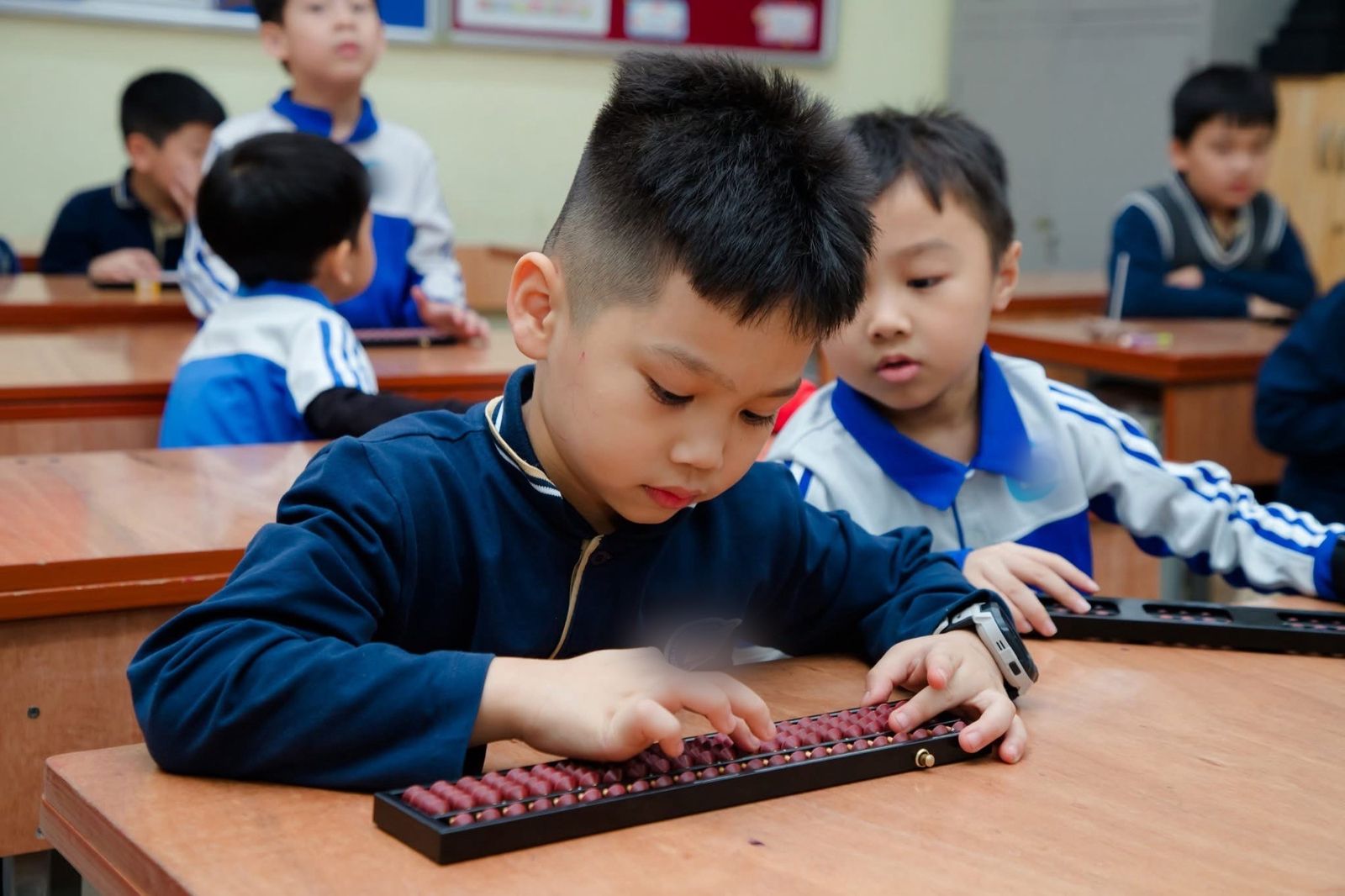
Soroban: a real abacus, then the abacus in the head
The soroban is the Japanese abacus (one 5-bead and four 1-beads on each rod), taught in Japan since the 17th century and still part of Japan’s grade 3–4 math curriculum.
- Move real beads; learn the 5-friend rule (exchanging through 5) and the 10-friend rule (exchanging through 10)
- Gradually calculate with the image of an abacus in the head (anzan)
- A teacher leads a steady rhythm: greeting, timed grid calculation, abacus, mental math, Flash Anzan, tidying up
- Not only fast calculation, but concentration, posture and study habits – see why we chose Japanese-style soroban
Soroban and Kumon compared
| Kumon (Math) | Japanese-style soroban (KSC) | |
|---|---|---|
| Tools | Paper worksheets, pencil | Abacus → the abacus in the head |
| Main goals | Fast, accurate written calculation; independent study habits; getting ahead of the curriculum | Mental math with images; place value; concentration; Japanese-style study habits |
| Way of learning | Self-study with worksheets; the instructor observes and adjusts | Small classes of 3–5 children, led by a teacher in a steady rhythm; hands first, head later |
| Frequency | 2 sessions a week at the center + worksheets at home every day (20–30 minutes) | 1–3 lessons a week (60 minutes) + 10 minutes at home |
| Starting age | From 3 years old (programs for young children) | From 5 years old (Kindergarten class), best at 6–8 |
| Scope | Counting → arithmetic → algebra → calculus (over many years) | Addition, subtraction, multiplication, division, decimals; mental math; Japanese-style grading exams (kyu) |
| Visible results | Fast and accurate written math; may work 1–2 grades ahead | Mental calculation with 2–3 digit numbers without paper; sitting and concentrating for longer; greeting and tidying up |
| The parents’ role | Keeping up the daily worksheet habit (the most important and the hardest part) | 10 minutes of practice with the child; reading numbers aloud for the child to calculate mentally |
| Tests and certificates | An internal level system; awards for working ahead of the curriculum | A test in every module; grading exams in the Japanese format |
What do they have in common? Three very Japanese things
Kumon: thousands of worksheets, each a little harder. Soroban: Level 0 → 1A → 1B → 2, and grading exams from 10th kyu up to 1st kyu.
No “cramming on the weekend”. Kumon: worksheets every day; soroban: 10 minutes every day and timed exercises.
Both record each child’s times and results and compare with yesterday – not with other children.
Both believe children go furthest when every step is “just right”.
How are they different? Four deciding points
Soroban
- Learning with hands and images
- A class rhythm, led by a teacher
- Trains mental math
- Study habits built into the lesson
Kumon
- Learning with eyes and pencil
- Self-study with worksheets
- Trains written calculation
- A daily worksheet habit, mainly at home
1. With eyes and pencil – or with hands and images
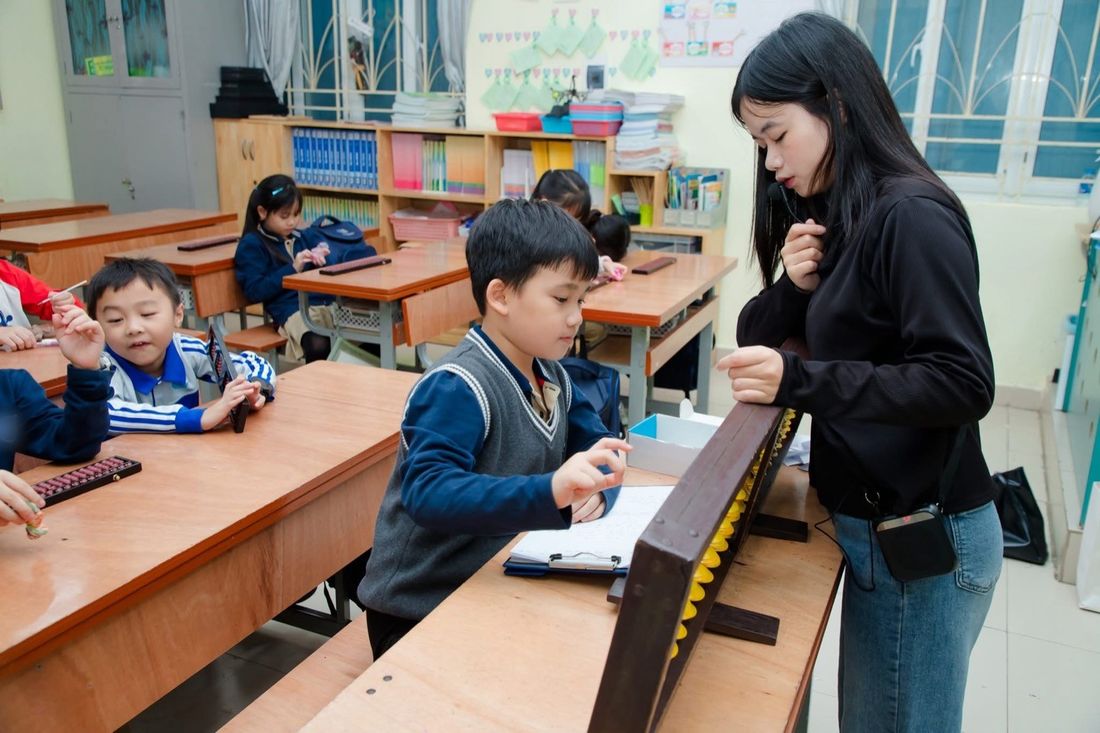
Kumon: look at the example on the worksheet, understand it, then do the problems. Soroban: move the beads – the hands remember first, the head understands later, then the image moves into the head.
Children aged 5–7 usually learn more easily with their hands; older children and children who love reading are the opposite. This is the first thing to look at in your child.
2. Self-study – or learning in the rhythm of a class
Kumon’s strength is independent study: sit down, work alone, correct your own mistakes. The condition: the child is willing to sit alone with a worksheet, and parents keep up the daily habit – the most common reason families stop Kumon.
In soroban a teacher leads a 60-minute lesson in 7 parts, so children who find it harder to concentrate can still keep up; the work at home is lighter (10 minutes).
3. Written calculation – or mental math
Kumon trains fast, accurate written calculation, gradually moving up to algebra. Soroban trains mental math: after Level 1, many children add and subtract 2-digit numbers with their eyes closed, then go on to multiplication and division.
Goal “getting ahead of the curriculum” → Kumon. Goal “mental math, place value and concentration” → soroban.
4. Worksheets – or study habits
A Japanese-style soroban lesson includes greeting, correct posture, clearing the abacus to 0 and tidying up – many Japanese families choose soroban for this first, and fast calculation second. Kumon’s habit – daily worksheets – happens mainly at home and depends on the parents.
Choosing for your child: 5 questions
- Does your child learn with their hands or their eyes?
Loves building, touching, doing → soroban. Loves books, coloring, writing, sitting still → Kumon.
- How old is your child?
3–4: Kumon has programs for young children; soroban is not suitable yet (fingers are not nimble enough). 5–8: the “golden age” for the image of numbers with soroban. 9 and over: either, depending on your goals.
- Can you keep up a daily habit?
Be honest: Kumon needs a parent sitting beside the child (or reminding them) 20–30 minutes every day, for years; soroban needs 10 minutes and one trip to class.
- What does your family want after 1 year?
“Fast written math, ahead of the class” → Kumon. “Mental math, concentration, study habits” → soroban. “Both” → see below.
- Has your child tried them?
Both offer trial lessons. Watch your child after the trial: what do they tell you, do they want to go back? That is the truest answer.
Should children learn both soroban and Kumon?
They can – quite a few Japanese families do, in the order soroban first, Kumon later:
- Ages 5–8Soroban
Builds the image of numbers, place value and concentration.
- From 8–9Kumon
Uses the ability to sit and study independently, already in place, to get ahead of the curriculum.
Doing both at the same time at ages 6–7 is usually too much: each method needs “every day”, and a grade 1 child only has one evening.
Don’t learn soroban at a place that teaches it worksheet-style (only doing problems, no teacher correcting the hands, no mental math) – the child loses the best of both. Is learning soroban good for children? has 6 questions to help you recognize a class that teaches it properly.
Frequently asked questions
Which is better, soroban or Kumon?
Neither is better for every child. Kumon suits children who like studying independently with worksheets and families who can keep up a daily habit; the goals are fast written calculation and getting ahead of the curriculum. Soroban suits children who learn with their hands and need the rhythm of a class and someone to lead; the goals are mental math with images, concentration and study habits.
Does Kumon use an abacus?
No. Kumon is learned with paper worksheets and does not use an abacus. Soroban is learned with an abacus and then moves on to the abacus in the head.
My child is doing Kumon – should they also learn soroban?
If your child is still 5–8 and your family wants them to be able to do mental math, you could try soroban – but look at your child’s total time across the week. Both methods need “every day”; if your child seems overloaded, choose one and do it well.
After learning soroban, is Kumon still needed?
It depends on your goals. Soroban does not aim to get ahead of the curriculum or teach algebra; if your family wants that at ages 9–10, Kumon or advanced math is a sensible next step, and the foundation of concentration from soroban helps a great deal.
Both are in My Dinh – which trial lesson should we try first?
Let your child try both if you have time, and watch your child after each trial. If you can only choose one: a 5–8-year-old who is active and learns with their hands → try soroban first; a child who likes sitting quietly with books and notebooks, with parents ready to keep up a daily habit → try Kumon first.
Try a free soroban lesson
Classes of 3–5 children at Vinhomes Gardenia (Hanoi), 60 minutes each, taught exactly as in Japan. Phone · Zalo 096.802.8484.
Written by the teaching team of Kodomo Soroban Center, following the method and textbooks of Kodomo School (Japan, teaching soroban since 1976). The center is licensed by the Hanoi Department of Education and Training, and our project is a 2026 EDU-Port Nippon supported project of Japan’s Ministry of Education (MEXT).
About usEDU-Port NipponEducation licenseRelated articles
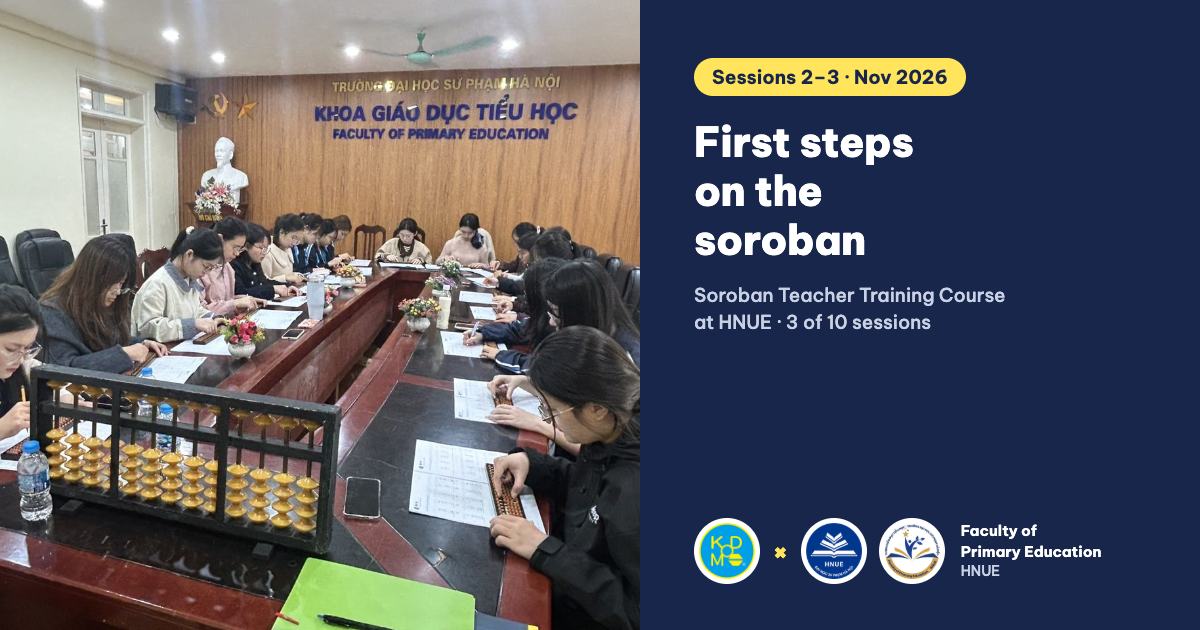
Soroban Teacher Training Course at Hanoi National University of Education – Sessions 2 and 3: First Steps on the Soroban
The Soroban Teacher Training Course at HNUE has completed 3 of its 10 sessions. From Session 2, the students have been learning…

The Soroban Teacher Training Course Begins at Hanoi National University of Education – Session 1: Building a Japanese-Style Classroom
On 31 Oct 2026, the Soroban Teacher Training Course for students of the Faculty of Primary Education, HNUE, began. Session 1: building…

Memorandum of Understanding Signed with Hanoi National University of Education
On 16 Oct 2026, Kodomo Soroban Center (Morita Group Vietnam) signed an MOU with Hanoi National University of Education: a free 10-session…