How to learn soroban at home as a beginner: 7 steps, 10 minutes a day
Do you want to understand how your child calculates on the abacus so you can practice together at home? Or are you an adult who wants to teach yourself soroban from scratch? This article walks you through 7 steps in exactly the order we teach them at Kodomo Soroban Center – from how to hold the abacus to the 5-friend and 10-friend rules – with illustrations and a 10-minute daily practice plan. At the end you will find worksheets and a free book so you can keep practicing.
Learning soroban at home follows 7 steps: (1) choose a 13-rod abacus with 1 upper bead and 4 lower beads; (2) sit up straight and move the beads with your thumb and index finger; (3) set and read numbers; (4) direct addition and subtraction – just adding and removing beads; (5) the 5-friend rule – using 5; (6) the 10-friend rule – using 10; (7) mental math with an abacus in your head. 10 minutes a day, 1–2 weeks per step. For children, learning at home is for extra practice; finger technique and mental math are still best taught with a teacher watching in person.
Before you start: what home learning can and can’t do
Adults can teach themselves addition, subtraction, multiplication and division on the soroban from a book. For children, learning at home has two limits: it is hard for parents to spot when a child is using the wrong finger (the most common mistake, and the hardest to fix later on), and mental math – the goal of soroban – needs someone to read out the numbers, time the child and lead at a steady rhythm. So this article is most useful for practicing again with your child what they learned in class, or for parents who want to understand soroban before taking their child to a trial lesson.
Step 1 · Choose a soroban
- 1 upper bead and 4 lower beads. This is the standard Japanese soroban. The type with 2 upper beads and 5 lower beads is the Chinese abacus, which is not suitable for learning mental math because some numbers can be set in more than one way.
- 13 rods is enough for children and beginners; 17 or 23 rods are for people taking grading exams. The more rods, the longer the abacus, and the harder it is for a small child to hold.
- Beads that fit the hand and are not too loose. Try pushing one bead up: it should stop exactly where you put it, without sliding on. Wooden or hard plastic beads are both fine.
- Unit dots – one every 3 rods – so you can quickly find the ones and thousands places.
In Hanoi, 13-rod abacuses are widely sold in bookshops and school-supply stores. If your child studies at KSC, the center will advise you on the right kind; there is no need to buy one before the trial lesson.
Step 2 · Posture and how to move the beads
In Japan, posture is the first lesson – even before numbers. Sit up straight with the abacus square in front of you, the left hand lightly holding the frame and the right hand moving the beads (left-handed children also use their right hand, so that later they can move beads and write at the same time). Use only two fingers:
- The thumb pushes a 1-bead up (add).
- The index finger brings a 1-bead down (subtract), and brings the 5-bead down (add 5) or pushes the 5-bead up (subtract 5).
Before each problem, reset all the beads to 0 by tilting the abacus slightly and running your index finger along the bar (in Japan this is called gohasan). The habit of “resetting to 0” before starting is something parents should remind their child about every day.
Step 3 · Setting and reading numbers
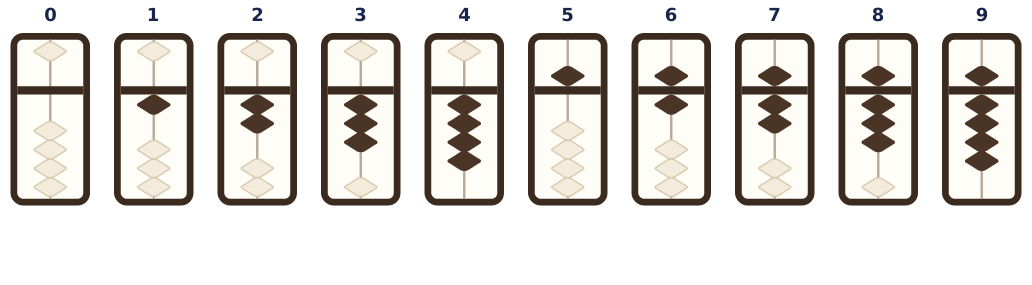
On each rod, the beads touching the bar are the ones that count. The upper bead is worth 5 and each lower bead is worth 1. The number on a rod = 5 × (5-bead touching the bar) + (number of 1-beads touching the bar). Every number from 0 to 9 can be set in exactly one way.
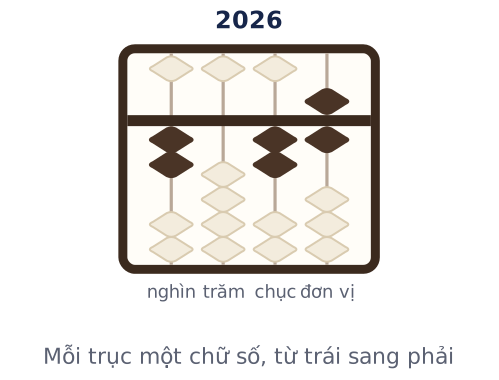
Numbers with several digits are set from left to right, one digit per rod – exactly like writing a number. Choose a rod with a dot as the ones place; the rod to its left is the tens, then the hundreds.
Practice: the parent reads out a number (for example “three hundred and eight”) and the child sets it on the abacus; then swap roles – the child sets a number and the parent reads it. 3 minutes a day for a week, and your child will be setting numbers up to the thousands without thinking.
Step 4 · Direct addition and subtraction (just adding and removing beads)
When there are enough beads, your child simply adds or removes them: 1 + 2 is pushing up two more 1-beads; 6 − 1 is bringing one 1-bead down; 3 + 5 is bringing the 5-bead down. There is only one rule: work from the highest place first, the ones place last. To calculate 23 + 41, your child adds 4 in the tens place and then 1 in the ones place – the same order you read the number. This habit matters when moving on to bigger calculations, and it is different from column arithmetic at school (from right to left), so parents shouldn’t be surprised.
This is exactly the content of Level 0 at KSC: direct addition and subtraction with 1–3-digit numbers. It sounds simple, but this is the stage where finger skills and the image of the beads are built. Worksheets 01–03 are for this step.
Step 5 · The 5-friend rule (using 5)
Want to add 3 + 4, but there is only 1 free 1-bead on the rod? Use the 5-bead: add 5, take away 1, because 4 = 5 − 1. “5-friends” are two numbers that add up to 5: 1 and 4, 2 and 3. When there aren’t enough 1-beads to add n, your child adds 5 and then takes away n’s friend. When there aren’t enough 1-beads to take away n, your child takes away 5 and then adds n’s friend.
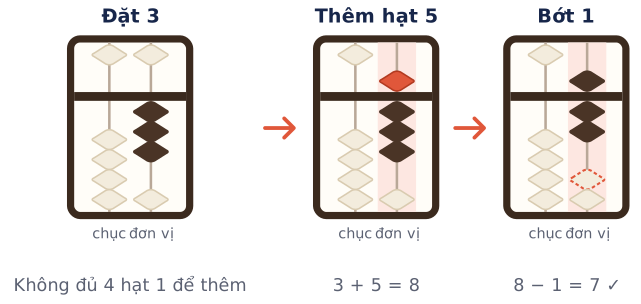
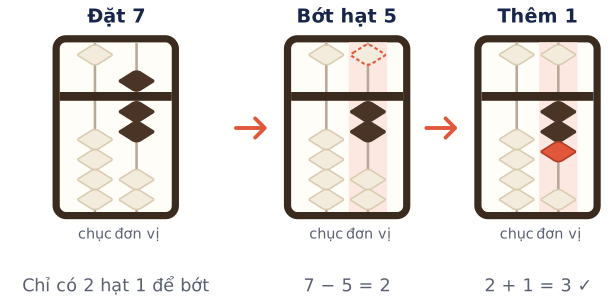
Tip for parents: don’t explain too much in words. Give your child the problem “3 + 4” and let them see for themselves that there are “not enough beads”, and only then hint “but there’s the 5-bead”. A lesson children discover for themselves stays longer than one they are taught. Worksheet 05 contains only problems that need exactly this rule.
Step 6 · The 10-friend rule (using 10)
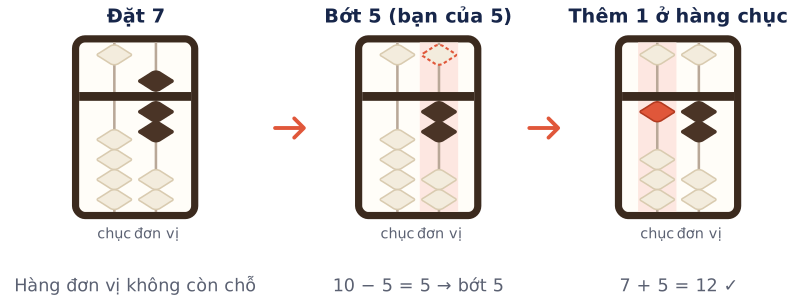
Want to add 7 + 5, but there is no room left in the ones place? Use the tens place: take away 5, add 1 in the tens place, because 5 = 10 − 5. “10-friends” are two numbers that add up to 10: 1 and 9, 2 and 8, 3 and 7, 4 and 6, 5 and 5. When n can’t be added on a rod, your child takes away n’s friend on that rod and then adds 1 on the rod to the left. Subtraction is the reverse: take away 1 on the rod to the left, then add n’s friend.
Some problems need both rules at once – for example 6 + 8: take away 8’s friend, which is 2, but the ones place shows 6 (one 5-bead and one 1-bead), so there aren’t 2 1-beads to take away, and the 5-friend rule is needed as well: take away 5, add 3; then add 1 in the tens place. This is the combined rule, the content of Level 1B at KSC. Don’t rush: let your child become really confident with the 5-friend and 10-friend rules separately first (worksheets 05, 06, 08), and only then mix them (worksheets 09, 10).
Step 7 · Mental math: the abacus moves into the head
This is what makes soroban different from every other calculating tool. Once your child is used to the movements, go through these stages in order:
- Calculate on a real abacus, eyes on the beads.
- Put the hands on the abacus but don’t move the beads; just imagine the beads moving, then say the answer. Start with 1-digit numbers and 2 terms (for example 2 + 3).
- Put the abacus away and close the eyes; the parent reads the numbers slowly one by one, and the child “moves the beads” in their head and says the answer.
- Build up gradually: 3 terms, then 2-digit numbers. At KSC, children start mental math from the 4th lesson and Flash Anzan (numbers flashing quickly on a screen) from the 6th.
The golden rule: your child must see the beads – no “calculating the school way” and then saying the answer. If your child answers correctly but says “I added it in my head”, go back to stage 2 with smaller numbers. The image of the beads only appears when the numbers are small enough for the child to picture.
A 10-minute daily practice plan
Regularity matters more than length. 10 minutes every day works far better than 1 hour on Sunday, because the image of the beads gets “watered” every day.
| Minutes | Activity | Notes |
|---|---|---|
| 0–1 | Sit up straight, reset the abacus to 0, greet with “Let’s begin” | A short ritual helps your child switch into learning mode |
| 1–3 | Read a number – set a number (5 numbers) | The parent reads, the child sets; swap roles |
| 3–8 | 5–10 problems from this week’s worksheet, timed | Write the time on the worksheet; compare with yesterday, not with other children |
| 8–10 | 3 small mental math problems, eyes closed | Only numbers your child can already do confidently on the abacus |
One worksheet a week; when your child gets 80% right within the set time, move on to the next worksheet. This is also the pass mark for the tests at KSC.
5 common mistakes when learning at home
- Moving beads with several fingers, or pushing 1-beads up with the index finger. The number one mistake, and the hardest to fix later. How to spot it: your child moves the beads slowly and the beads often overshoot.
- Doing the ones place first. A habit from column arithmetic at school. Remind your child: “move the beads in the order you read the number”.
- Mixing the 5-friend and 10-friend rules too soon. Each rule needs 1–2 weeks of its own, with problems that use only that rule.
- Doing mental math “the school way” and then saying the answer. Go back to smaller numbers until your child really sees the beads.
- Timing to compete with brothers and sisters. The clock is for your child to compare with themselves yesterday. If your child is afraid of the clock, drop the clock for a week.
Free materials to keep learning
12 worksheets by level (PDF)
From direct addition to the 5-friend and 10-friend rules, mitorizan, multiplication and division. Each worksheet has an answer page so parents can mark it together with their child. Download the worksheets
Introduction to Soroban for Adults
95 pages, explaining each step with bead diagrams, from setting numbers to multiplication and division, with practice exercises and answers. Free. Download the book (in Vietnamese)
Create practice problems
Choose the number of digits, terms and problems, then print them out for daily practice. See the tools
Frequently asked questions
Can you teach yourself soroban at home?
Adults can teach themselves addition, subtraction, multiplication and division from a book. For children, learning at home is good for extra practice; finger technique and mental math are best with a teacher watching in person, because using the wrong finger is a mistake that is hard to fix later.
How many minutes a day should you practice soroban?
10 minutes a day is enough, and works better than 1 hour at the weekend. Split it into: reset to 0 and greet (1 minute), read a number – set a number (2 minutes), 5–10 timed problems from a worksheet (5 minutes), 3 small mental math problems (2 minutes).
What are the 5-friend and 10-friend rules?
5-friends are two numbers that add up to 5 (1–4, 2–3): when there aren’t enough 1-beads, add 5 and then take away the friend of the number you are adding. 10-friends are two numbers that add up to 10 (1–9, 2–8, 3–7, 4–6, 5–5): when a rod has no room left, take away the friend of the number you are adding and then add 1 on the rod to the left.
What kind of soroban should I buy for my child?
One with 1 upper bead and 4 lower beads (the Japanese standard), 13 rods, beads that fit the hand and stop exactly in place when moved, and unit dots. There is no need to buy one before the trial lesson.
How long does it take to do mental math?
With 10 minutes of practice a day, most children can do 1-digit mental math after 2–3 weeks, and 2-digit numbers by the time they finish Level 0 (about 16 lessons). The condition is that your child truly “sees the beads” in their head, rather than calculating the school way and then saying the answer.
Try a free soroban lesson
Classes of 3–5 children at Vinhomes Gardenia (Hanoi), 70 minutes each, taught exactly as in Japan. Phone · Zalo 096.802.8484.

Written by the teaching team of Kodomo Soroban Center, following the method and textbooks of Kodomo School (Japan, teaching soroban since 1976). The center is licensed by the Hanoi Department of Education and Training, and our project is a 2026 EDU-Port Nippon supported project of Japan’s Ministry of Education (MEXT).
About usEDU-Port NipponEducation licenseRelated articles
How do Japanese parents raise independent children? 7 habits from Japanese schools that parents can start today
How do Japanese parents raise independent children? Not with iron discipline, but with 7 habits repeated every day at school and at…
What is Japanese “thinking math”? Soroban, Kumon, Gakken and how Japan teaches children math
What is Japanese “thinking math”? The Japanese don’t call it “thinking math” – they have 3 popular ways of teaching math: soroban…
My child can’t focus when studying – what can I do? 8 ways Japanese classrooms build concentration (for ages 5–8)
Your child can’t focus when studying – what can you do? A realistic view of attention spans at ages 5–8, 5 common…