How to teach kids to tell time: 5 easy steps from o’clock to every minute – with a free printable worksheet
“Mom, what time is it?” Your child can read the digital clock on your phone right away, but gets stuck in front of the clock on the wall. We are Japanese and teach soroban to children in Hanoi. Reading an analog clock isn’t hard if you go in the right order: teach in small steps, add just one new position of the long hand at each step, and connect the clock to familiar times in your child’s day.

Teach your child to read an analog clock in 5 steps, adding one new thing at each step.
- The short hand shows the hour, the long hand the minutes
- O’clock: the long hand points to 12
- Half past: the long hand points to 6
- 15 and 45 minutes: the long hand points to 3 and 9
- Each number on the clock is 5 minutes; single minutes come later
- Link it to daily routines: waking up, meals, bedtime
- A few minutes a day, with a real clock or a homemade one
What grade do children learn to tell time?
Under Vietnam’s current math textbooks (2018 general education curriculum), telling time is spread over the first three years of primary school:
- Grade 1: telling the hour hand from the minute hand and reading o’clock times
- Grade 2: reading the time when the minute hand points to 3 or 6 (for example, 7:15 and 7:30)
- Grade 3: reading the time to 5 minutes and to the minute, and getting used to the “to the hour” way of saying times (“kém” in Vietnamese)
Japan is similar: children learn to read the clock in grade 1, then learn how days, hours and minutes relate in grade 2.
At home, you don’t need to wait for grade 1. From about age 5–6, your child can get familiar with clocks through play: noticing the short and long hands, or hearing you say “It’s 7 o’clock, time for breakfast.” The goal at this age is for the clock to feel familiar – not to read it to the minute.
5 steps to teach your child to read an analog clock
Each step adds just one new position of the long hand. Once your child gets a step right for a few days in a row, move on to the next.
- The short hand shows hours, the long hand minutes
On a homemade clock, color the two hands differently. On a real clock, let your child turn the time-setting knob: when the long hand goes all the way around, the short hand moves only to the next number.
- O’clock: the long hand points to 12
When the long hand is on 12, the number the short hand points to is the hour: the short hand on 3 means 3 o’clock. Ask your child about familiar o’clock times in the day.
- Half past: the long hand points to 6
When the long hand goes halfway around, that’s 30 minutes: 7:30, or half past seven. Show your child that the short hand is now halfway between 7 and 8 – it has gone halfway too.
- The long hand on 3 and on 9
The long hand on 3 means 15 minutes: 7:15. The long hand on 9 means 45 minutes: 3:45, when the short hand is already close to 4. In grade 2, the textbook covers the minute hand on 3 and 6; the 9 is an extra step once your child is confident.
- Count by 5s, then single minutes
Neighboring numbers on the clock are 5 minutes apart. Your child counts from 12: 5, 10, 15, 20… The long hand on 4 means 20 minutes, on 7 means 35 minutes – it’s the 5 times table.
Start at homeOnce your child can count by 5s quickly, show the small marks between the numbers: each mark is 1 minute. The long hand 2 marks past the 4 means 22 minutes.
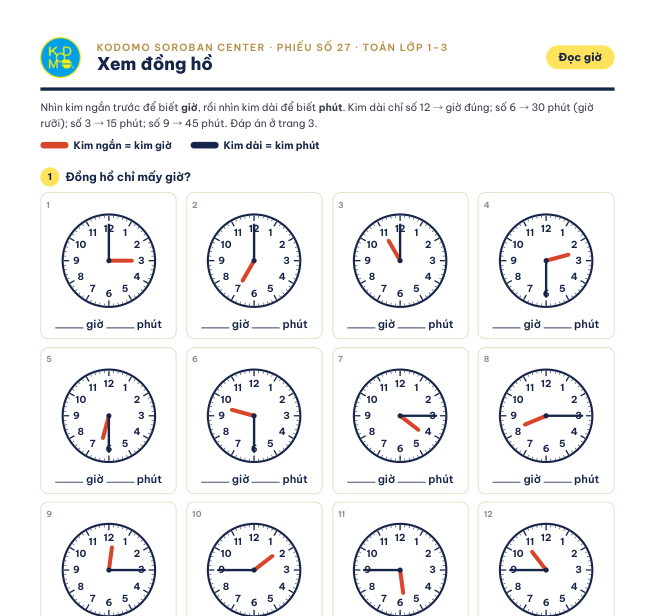
Our clock worksheet follows these same steps: page 1 has 12 clocks to read (o’clock, half past, 15 minutes, 45 minutes); page 2 has 9 clocks to draw the hands on and 6 clocks to read in 5-minute steps; the answers are on page 3. Download the telling time worksheet (free PDF, in Vietnamese).
“Quarter to”: two ways to say the same time
Once the long hand has passed 6 – more than 30 minutes – you can also say the time by how many minutes are left until the next hour. Vietnamese uses the word “kém” (“short of”), just like “to” in English. So 3:45 and quarter to four are the same time.
- 3:45 = quarter to four (15 minutes to 4)
- 2:50 = ten to three
- 6:40 = twenty to seven
How to teach it: count backward from the long hand to 12. With the long hand on 9, there are 3 numbers from 9 to 12, so 15 minutes; the short hand is about to reach 4 – so it’s quarter to four. Teach “to” only after your child reads hours and minutes confidently, so the two ways don’t get mixed up.
Learn through play: 4 ways to practice telling time at home
Your child sees clocks every day, so it’s easy to practice without sitting down at a desk.
Write the numbers 1–12 on a paper plate, cut two hands from card – one long, one short – and pin them in the center. You say a time; your child turns the hands.
Draw a clock face next to each part of the day: waking up, dinner, bedtime. When the time comes, compare it with the real clock together.
When the digital clock shows 7:15, the long hand points to 3. Have your child read both and compare.
“It’s 4:40 now, and we’re going to the park at 5 – how many minutes left?” The long hand goes from 8 to 12: 4 numbers, so 20 minutes.
Hang an analog clock with large, clear numbers where your child often looks, such as the dining room. Asking “what time is it?” a few times a day is enough – short and regular.
Common mix-ups when reading a clock
Many mistakes come from the short hand – it moves slowly, so it’s easy to overlook. Here are four common mix-ups:
“The short hand is near 3, so it’s 3 o’clock.”
If the long hand points to 10, it’s 2:50: the short hand is close to 3 but hasn’t reached it. When the short hand is between two numbers, read the one it has just passed.
“The long hand on 3 means 3 minutes.”
It means 15 minutes. Read the long hand in groups of 5: each number is 5 minutes.
“Quarter to four means it’s already past 4.”
It’s not 4 yet: there are 15 minutes left until 4, so it’s 3:45.
“We have digital clocks, so there’s no need to learn analog.”
An analog clock lets your child see time passing: the long hand has gone halfway, and this much is left until 12. At school, children also learn analog clocks from grade 1.
When your child makes a mistake, ask “which number has the short hand just passed?” instead of giving the answer right away. That question helps them correct themselves next time.
Clocks, the 5 times table and soroban
Reading a clock is a small math problem too: counting by 5s, and understanding that it takes 60 minutes to make an hour.
Here’s how it differs from everyday addition: time doesn’t roll over at 100 but at 60. 9:50 plus 15 minutes is 10:05, not 9:65. Your child takes 10 minutes to make a full hour, and 5 minutes are left – very much like the “make 10” mental math trick.
On a soroban, the upper bead is the “5-bead”, so children who learn soroban get used to seeing numbers in groups of 5 and 10. Counting 5, 10, 15 around the clock face practices exactly that number sense.
At Kodomo Soroban Center (Vinhomes Gardenia, Hanoi), each class has 3–5 children, and each 60-minute lesson – exactly one turn of the long hand – is split into 7 parts. Even the longest part is only about 20 minutes, or 4 numbers for the long hand.
See how a lesson works. The trial lesson is free – sign up on our Contact page or call or message us on Zalo at 096.802.8484.
Frequently asked questions
What age can children learn to tell time?
From about age 5–6, your child can get familiar with clocks: telling the short hand from the long hand and reading o’clock times linked to daily routines. At school in Vietnam, children read o’clock times in grade 1, times with the minute hand on 3 or 6 in grade 2, and times to 5 minutes and to the minute in grade 3. Every child has their own pace, so there’s no need to rush.
Should I teach an analog or a digital clock first?
We suggest starting with an analog clock, because it shows your child how hours and minutes “move”. A digital clock only needs reading numbers, so children usually pick it up very quickly. Once your child is used to the analog clock, put the two side by side: 7:15 on a digital clock means the long hand points to 3.
What does “kém” mean in telling time, and how do I teach it?
“Kém” is the Vietnamese way of saying how many minutes are left until the next hour, like “to” in English: 3:45 is also quarter to four. Teach it after your child reads hours and minutes confidently. Have them count backward from the long hand to 12 (from 9 to 12 is 15 minutes), then see which number the short hand is about to reach.
My child mixes up the hour and minute hands – what can I do?
Color the two hands of a homemade clock differently and repeat a short phrase: “short hand – hours, long hand – minutes”. Let your child turn the time-setting knob on a real clock to see that when the long hand goes all the way around, the short hand moves only one number. When reading the time, always look at the short hand first, then the long hand.
Is there a printable telling time worksheet?
Yes. Our free clock worksheet has 3 pages: page 1 has 12 clocks to read (o’clock, half past, 15 minutes, 45 minutes); page 2 has 9 clocks to draw the hands on and 6 clocks to read in 5-minute steps; page 3 has the answers. Download it from our free soroban worksheets page (the PDF is in Vietnamese).
Try a free soroban lesson
Classes of 3–5 children at Vinhomes Gardenia (Hanoi), 60 minutes each, taught exactly as in Japan. Phone · Zalo 096.802.8484.

Written by the teaching team of Kodomo Soroban Center, following the method and textbooks of Kodomo School (Japan, teaching soroban since 1976). The center is licensed by the Hanoi Department of Education and Training, and our project is a 2026 EDU-Port Nippon supported project of Japan’s Ministry of Education (MEXT).
About usEDU-Port NipponEducation licenseRelated articles
Japanese-style parenting for ages 3–6: 10 small habits many Japanese families keep every day
Japanese-style parenting for ages 3–6 at home: greetings, meals, small chores, waiting while kids try, praise and scolding, early bedtime, picture books…
What is Flash Anzan? How to practice Flash Anzan mental math at home with your child
Flash Anzan is a mental math drill: numbers flash on a screen one by one and your child adds them on an…
How to learn division facts fast and easily: dividing by 2 to 9 – plus a free worksheet
Division facts are just the times tables read backward. 6 ways to learn dividing by 2 to 9, tips for 7, 8…