What is Flash Anzan? How to practice Flash Anzan mental math at home with your child
Numbers flash up on the screen and vanish: 7… 2… 5… A few seconds later, a child calls out “14”. That is Flash Anzan – a mental math drill closely tied to learning soroban in Japan. We are Japanese, teach soroban to children in Hanoi, and the first thing we want parents to know is this: Flash Anzan is not a test of quick eyes; it is a way to make the “abacus in the head” really solid.
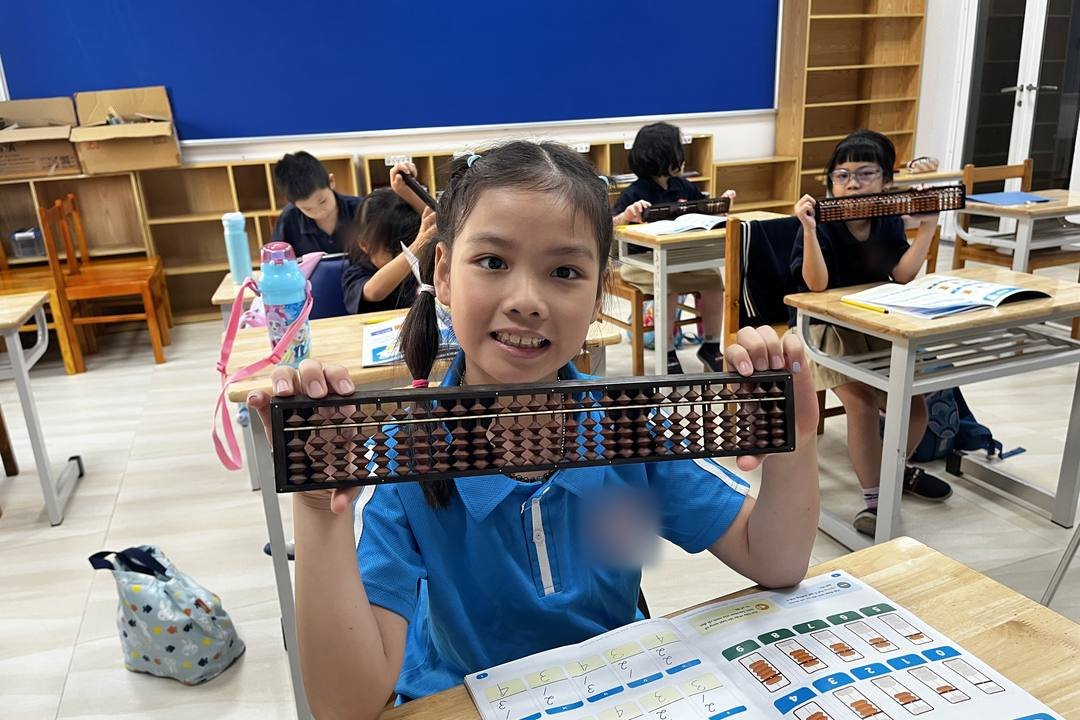
Flash Anzan is a drill in which numbers appear one by one on a screen and disappear, while your child adds them up on an imagined abacus in their head.
- The numbers are too fast to read silently, so your child has to “see” the beads move
- The foundation is a real abacus: move the beads by hand first, Flash Anzan later
- Three settings control the difficulty: digits, how many numbers, speed
- Start with 1 digit · 3 numbers · 1 second per number
- Go up one notch only after 5 correct in a row, and change one setting at a time
- 5–10 minutes a day; slow down after many mistakes, and don’t rush your child
What is Flash Anzan?
In Japanese, anzan (暗算) means mental calculation; flash means a quick burst of light. Flash Anzan is an on-screen drill: each number appears for a moment and then disappears. When the set is over, your child says or types the total.
The numbers vanish before a child has time to think “seven plus two is nine”, so they can only keep up once they have an abacus in their head – see What is Japanese mental math (anzan)?. This article focuses on how to practice Flash Anzan.
In Japan, Flash Anzan is also a competition event. At the All Japan Soroban Championship (全日本珠算選手権大会), Flash Anzan is a separate event with 15 three-digit numbers. Guinness World Records also lists a record for this event:
According to the Guinness World Records website, the record was set in Tokyo in 2024 by a Japanese competitor: all 15 three-digit numbers appeared and disappeared in a total of 1.61 seconds. That is a peak reached after many years of practice – not a goal for a child who is just starting.
What happens in your child’s head during Flash Anzan?
Take a very short set: 7, then 5. For a child who has learned soroban, the set goes through three steps:
- See the number – see the bead pattern
7 appears. Your child doesn’t say “seven” silently; they instantly see the bead pattern for 7 on one rod: one 5-bead and two 1-beads.
- The beads move in the head
5 appears. Your child “adds” 5 on the imagined abacus, exactly as their hand would on a real one: using the 10-friend rule, they take away 5 in the ones column and add 1 in the tens.
- Read the answer
When the set ends, the abacus in the head is already showing the answer. Your child just “reads” the bead pattern: 1 ten and 2 ones – 12.
That is why the foundation of Flash Anzan is a real abacus: the picture in the head only becomes clear after the hand has moved the beads hundreds of times. A study with children in India (Frank & Barner, 2012) found that skilled users hold the mental abacus as an image, split into separate columns, rather than in words.
Before learning on a real abacus, children usually add by reading the numbers silently. That works with small, slow numbers, but it is hard to go further when the sets get longer and faster.
Flash Anzan doesn’t teach your child how to move the beads; it helps them use what their hands already know, faster. If you don’t have an abacus at home yet, your child can get to know the bead patterns on our online soroban and read What is a soroban?.
The three settings that control Flash Anzan difficulty
Every Flash Anzan set is controlled by three numbers. Once you understand them, you will know when to go up and when to go down.
How many numbers are in one set: 3, 4, 5… More numbers means holding the running total for longer. This is usually the first setting to raise.
How long each number stays on screen: 1 second, 0.8 seconds, 0.6 seconds… Raise it once your child is solid at the current number of numbers.
1, 2 or 3 digits. Each digit is one more rod to hold in the head, so this setting goes up last.
Change only one setting at a time. If you add numbers and speed up at once, your child makes mistakes and you can’t tell why. The milestones below follow the path at Kodomo Soroban Center and are only a guide – every child moves at their own pace:
- Just starting1 digit · 3 numbers · 1.5–1 s
Easy enough to get 5 right in a row. The first week is about building the habit, not speed.
- Finished Level 01 digit · 5 numbers · 0.8 s
Start trying 2 digits · 3 numbers · 1.5 s, once your child adds and subtracts confidently on a real abacus.
- Level 12 digits · 5 numbers · 1 s
Add subtraction to the sets.
- Level 22 digits · 10 numbers · 0.6 s
Start trying 3 digits with 3–5 numbers.
How to use our free Flash Anzan tool
On our online mental math trainer page, your child can practice Flash Anzan for free on a phone or computer, with nothing to install.
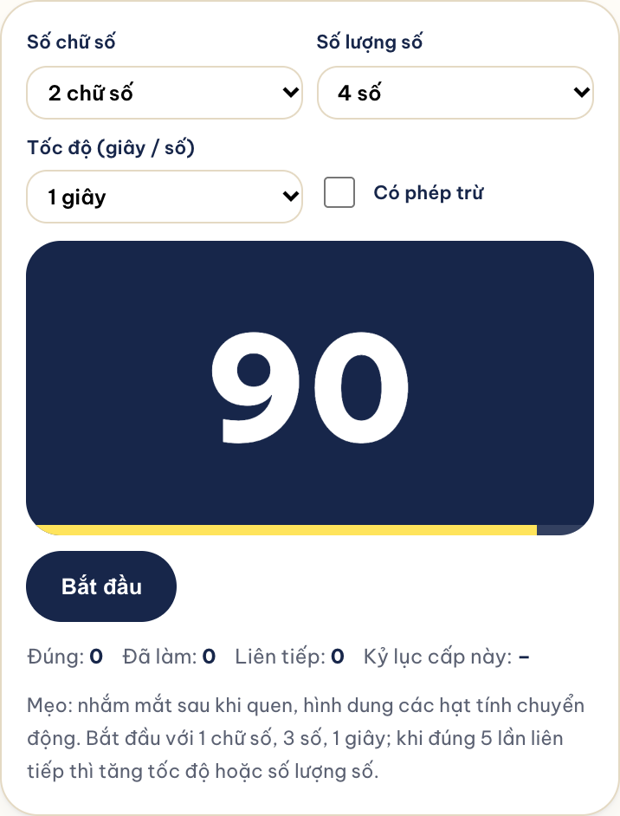
- Choose Digits (1, 2 or 3), How many numbers (from 3 to 15) and Speed (from 2 seconds down to 0.3 seconds per number). Save “Include subtraction” for later.
- Press Start. The screen counts down 3, 2, 1, then the numbers appear one by one; the yellow bar underneath shrinks with the time for each number.
- When the set ends, your child types the answer and presses Check. The tool shows the whole set again so your child can see where they slipped; then press Repeat this set or New set.
- The stats row under the Start button counts correct answers, the current streak and the best streak at that level. After 5 correct in a row, the tool suggests going up one notch.
As the tool’s own tip says, start with 1 digit, 3 numbers, 1 second. Once your child is used to it, they can try closing their eyes (after the last number disappears), picturing the beads, and only then typing the answer. Settings and records are saved on your device.
Practicing Flash Anzan at home: 5–10 minutes a day
You don’t need to be good at soroban – just sit beside your child and keep the rhythm going:
- Same time every day. For example, 5–10 minutes after your child does a worksheet or practices on the abacus.
- Warm up at an easy level. Two or three sets one notch easier to get into the rhythm, then move to their usual level.
- Slow down after many mistakes. Going back one notch isn’t losing; it is how the picture in the head becomes clear again.
- Write down the best level each week. Children love “breaking their own record”.
Three things to avoid:
- Rushing your child. “Hurry up, what is it?” makes the picture in their head fall apart. Wait for them to answer.
- Speeding up because another child is faster. Every child has their own pace; comparing only takes the fun away.
- One long session on the weekend. 10 minutes a day is better than an hour in one go.
Praise your child for focusing and practicing regularly, not only for being fast. Speed will come little by little. If your child finds it hard to focus, see My child can’t focus when studying – what can I do?.
Flash Anzan in our soroban class at Kodomo Soroban Center
At Kodomo Soroban Center, Flash Anzan is not a separate subject; it is part of the lesson itself. Each 60-minute lesson has 7 parts: greeting and getting ready, grid calculation, soroban, mental math and Flash Anzan, then tidying up and the closing greeting. The mental math part always comes right after practice on a real abacus – hands first, then the head.
Each class has 3–5 children, with classes for 5-year-olds and for primary school children, following the path Level 0 → 1A → 1B → 2 with grading exams in the Japanese format. At home, students use their member code to enter the Soroban Practice Room (in Vietnamese) and keep practicing Flash Anzan.
See how a lesson works, our center at Vinhomes Gardenia and our in-school soroban clubs. The trial lesson is free – sign up on our Contact page or call or message us on Zalo at 096.802.8484.
Frequently asked questions
What is Flash Anzan?
Flash Anzan is a Japanese mental math drill: numbers appear one after another on a screen and disappear very quickly, and your child adds them up in their head and says the total. Children who learn soroban can keep up because they picture an abacus and “move” the beads in their head. In Japan, Flash Anzan is also an event at soroban competitions.
At what age can children start Flash Anzan?
There is no fixed age. What matters more is that your child knows the numbers 0 to 9 well and has started moving beads on a real abacus. Kodomo Soroban Center has classes for 5-year-olds; at any age, Flash Anzan starts with 1 digit, few numbers and a slow speed.
Can my child do Flash Anzan without learning soroban?
Yes, at an easy level: 1 digit, 3 numbers, slow speed – at that pace ordinary adding still keeps up. But as the sets get longer and faster, your child needs the bead image in their head, which means learning on a real abacus first.
Is there a free Flash Anzan app?
Our website has a free online mental math trainer (Flash Anzan) that works right in the browser on a phone or computer, with nothing to install. You choose the digits (1–3), how many numbers (3–15) and the speed (from 2 down to 0.3 seconds per number), and you can add subtraction later.
How long should my child practice Flash Anzan each day?
5–10 minutes a day is enough, ideally after a worksheet or abacus practice. Short and regular is better than one long session on the weekend. Stop while your child still wants to keep going, so they look forward to coming back the next day.
Try a free soroban lesson
Classes of 3–5 children at Vinhomes Gardenia (Hanoi), 60 minutes each, taught exactly as in Japan. Phone · Zalo 096.802.8484.

Written by the teaching team of Kodomo Soroban Center, following the method and textbooks of Kodomo School (Japan, teaching soroban since 1976). The center is licensed by the Hanoi Department of Education and Training, and our project is a 2026 EDU-Port Nippon supported project of Japan’s Ministry of Education (MEXT).
About usEDU-Port NipponEducation licenseRelated articles

Japanese-style parenting for ages 3–6: 10 small habits many Japanese families keep every day
Japanese-style parenting for ages 3–6 at home: greetings, meals, small chores, waiting while kids try, praise and scolding, early bedtime, picture books…

How to teach kids to tell time: 5 easy steps from o’clock to every minute – with a free printable worksheet
How to teach your child to read an analog clock in 5 steps: hour and minute hands, o’clock, half past, 15 and…
How to learn division facts fast and easily: dividing by 2 to 9 – plus a free worksheet
Division facts are just the times tables read backward. 6 ways to learn dividing by 2 to 9, tips for 7, 8…