What is Japanese mental math (anzan)? How Japanese children calculate with an abacus in the head
Have you ever seen a video of Japanese children closing their eyes, fingers twitching in the air, and then instantly saying the answer to a long string of numbers? That is anzan – Japanese mental math. We teach the soroban with the method of Kodomo School (Japan, since 1976) and have taught in Hanoi since 2022. The first thing we want parents to know: anzan is not magic or an inborn gift – it is a visual skill trained step by step.
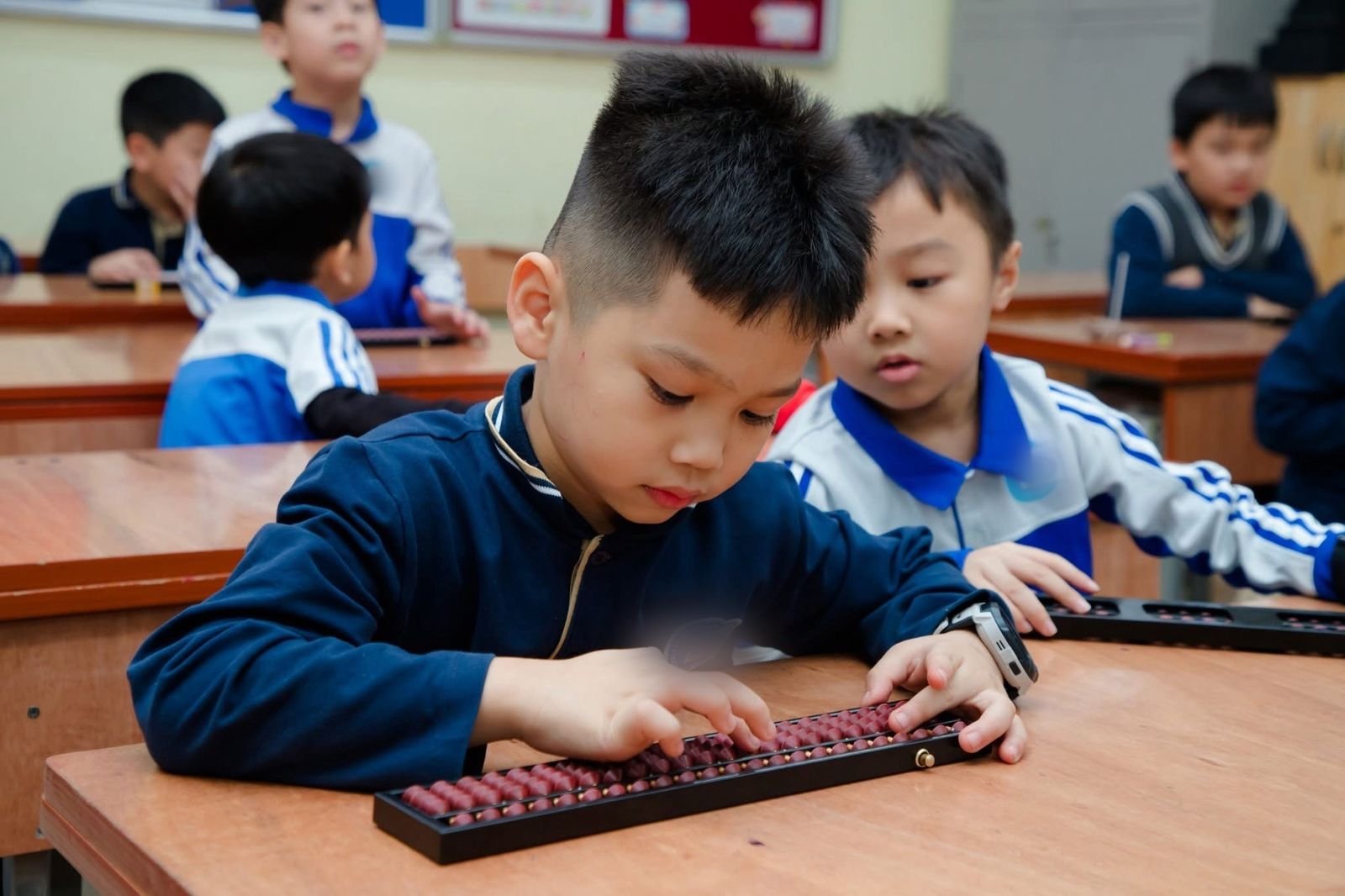
Anzan (暗算) is mental math done by picturing a soroban abacus in the head and “moving” imaginary beads.
- The child sees bead images instead of reciting the calculation
- 3 stages: real abacus → fingers only → in the head only
- The foundation: knowing the 5-friends and 10-friends
- Flash Anzan: numbers flash on a screen and the child adds them mentally
- At KSC: mental math from lesson 4, Flash Anzan from lesson 6
- 2-digit mental math: usually after Level 0 (16 sessions) plus practice at home
What is anzan?
In Japanese, anzan (暗算) simply means mental math – calculating without pencil and paper. For children who learn the soroban, it has a more specific meaning: calculating on an abacus in the head.
The soroban is the Japanese abacus: each rod has one bead worth 5 at the top and four beads worth 1 at the bottom. Every number from 0 to 9 has exactly one bead pattern. After setting numbers by hand hundreds of times, children remember these patterns the way they remember a familiar face. See also What is a soroban?
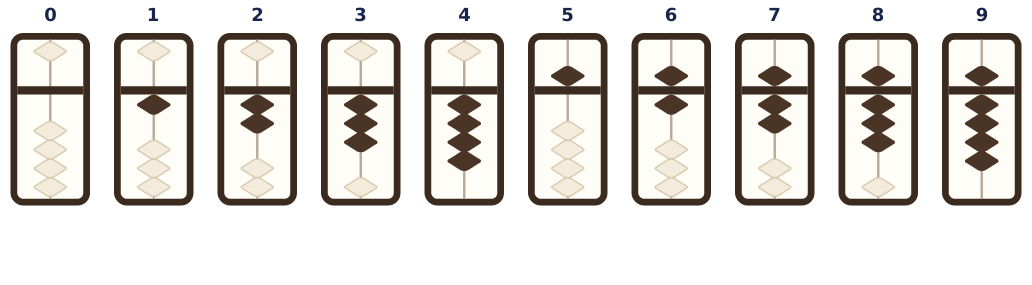
In anzan, the child pictures the abacus, “sets” the first number, then “moves” the next number in, just as on a real abacus. The answer appears as a bead pattern – the child only has to read it. Calculating becomes moving an image, not reciting numbers one by one.
How is Japanese mental math different from ordinary mental math?
Most of us do mental math in words: we silently say “seven plus five is twelve,” hold on to it, then say the next step. Anzan takes a different path:
Anzan – calculating with images
- Beads are visible in the head
- Ones, tens and hundreds each have their own rod
- The answer “appears” – just read it
- Scales up to numbers with many digits
Ordinary mental math – calculating with words
- Recite each step silently
- Keep the “carry the 1” in your head yourself
- Slower as numbers get longer
- Easy to lose the answer halfway
The two are not either-or: anzan simply adds one more tool for handling numbers faster and more surely. If your child is in grade 1 and has not learned the soroban, How to teach a grade 1 child fast mental math explains mental math with “5-dot patterns” – a good stepping stone.
The 3 stages Japanese children go through to learn anzan
In Japan, children move through three stages, each built on the one before:
- Stage 1A real abacus
The child sets numbers and adds and subtracts by hand on the soroban, using the thumb and index finger. Through hundreds of moves, the hand learns the 5-friends and 10-friends.
- Stage 2Fingers only
The abacus is put away. The child moves the beads “in the air” or on the tabletop, eyes following imaginary beads. The fingers help keep the image from drifting away.
- Stage 3In the head only
The hands stay still and the beads move in the head. Many children still move their fingers slightly – that is completely normal.
Order matters more than speed. The image in the head only becomes clear once the child is truly at home on a real abacus. That is why Japanese teachers never teach anzan separately from the soroban.
At Kodomo Soroban Center, children start mental math in lesson 4, with very small numbers. In every lesson, the mental math part comes right after practice on the real abacus.
What is Flash Anzan?
Flash Anzan is anzan practice on a screen: numbers appear one after another, each for just a moment, then disappear. The child adds them up mentally and says (or types) the total at the end.
The numbers flash too quickly to recite in your head, so the child has to use the bead image. That is why Flash Anzan always comes after anzan with a real abacus: the image comes first, speed comes later.

At KSC, children practice Flash Anzan from lesson 6. At home, try our free online mental math trainer: start with 1 digit · 3 numbers · 1 second. After 5 correct answers in a row, add more numbers first, and only then increase the speed.
What does research say about anzan?
A few reliable research findings:
- Children who learn the “abacus in the head” calculate faster and more accurately (Stigler, 1984).
- The abacus in the head is an image: learners hold numbers as bead patterns, not as silent words (Frank & Barner, 2012).
- Skilled users remember much longer strings of digits (Hatano & Osawa, 1983).
- A 3-year trial in India with children aged 5–7 showed clear gains in arithmetic and place value (Barner et al., 2016).
But we should be honest: the clearest benefits of anzan are in calculation and number sense – and they only come with regular practice. Some common misconceptions:
“Anzan will turn my child into a prodigy.”
Research shows clear benefits in calculation and number sense. We do not promise more than that; what parents usually notice is that their child becomes more confident with numbers.
“Only gifted children can do it.”
Anzan is a trainable skill. Children who go through all the steps can all do mental math with small numbers; only the pace differs from child to child.
“Learning anzan will make my child forget how to calculate at school.”
Children still write out calculations and show their work like everyone else. On the soroban, numbers are set from left to right, just as they are written, so there are not two systems to learn.
“You have to be fast right from the start.”
Accuracy first, speed later. Pushing for speed before the image is clear only sends the child back to counting and reciting.
Practicing anzan at home: 5 steps, 10 minutes a day
Parents do not need to be good at the soroban. You only need to follow the order: a few days per step, and move on once your child finds it easy.
- Learn the 5-friends and 10-friends first
5-friends: 1 and 4, 2 and 3. 10-friends: 1 and 9, 2 and 8, 3 and 7, 4 and 6, 5 and 5. These are the two rules your child’s hand uses on the abacus – without them, the image in the head gets “stuck.”
Start at homeA 1-minute quick-fire quiz every day: you say “7!”, your child says “3!”. When your child answers without thinking, they are ready.
- See the pattern, say the number
Set a number from 0 to 9 on the abacus, let your child look for 1 second, then cover it; your child says the number. Then switch roles: you say a number and your child sets it quickly.
- You read numbers aloud, your child uses a real abacus
Slowly read three 1-digit numbers, for example “2, 5, 1.” Your child adds them on the abacus and says the answer. Read clearly, at an even pace, without rushing.
- “Air abacus” with the fingers
Put the abacus away. Your child holds their hand as if moving beads and looks at an imaginary abacus on the table, still with three 1-digit numbers. If they make mistakes, go back to the real abacus a few times.
- Eyes closed – in the head only
Same exercise, eyes closed. After 5 correct answers in a row, add a 4th number, then a 5th. Only then move on to Flash Anzan with the online trainer.
If your child has no abacus basics yet, read How to learn the soroban at home and print some free worksheets. Ten minutes every day beats one hour on the weekend.
How long does it take to learn mental math?
Every child has their own pace, but at Kodomo Soroban Center the usual milestones are:
Adding and subtracting 2-digit numbers mentally usually takes all of Level 0 (16 sessions) plus regular practice at home. After that, children move on to Level 1A, 1B and 2, with grading exams in the Japanese format.
Each class has only 3–5 children, and each lesson lasts 60 minutes: greeting and preparation, grid calculation, soroban, mental math, Flash Anzan, then tidying up. See what happens in a lesson and the best age to start the soroban.
The quickest way to find out where your child stands is a free trial lesson at our center in Vinhomes Gardenia. Call or message us on Zalo at 096.802.8484, or see our center page and contact us.
Frequently asked questions
What is anzan?
Anzan (暗算) is the Japanese word for mental math. For children who learn the soroban, anzan means calculating on an imaginary abacus in the head: they picture the beads, “move” them as on a real abacus, and read the answer from the image.
How is Japanese mental math different from ordinary mental math?
Ordinary mental math means reciting each step silently and keeping track of the carries yourself. Japanese mental math uses the image of an abacus: the child moves beads in the head and reads the answer, so it scales up to numbers with many digits.
What is Flash Anzan?
Flash Anzan is a practice in which numbers appear one after another very quickly on a screen, and the child adds them up mentally and says the total. At Kodomo Soroban Center, children practice Flash Anzan from lesson 6.
How long does it take a child to do mental math on an abacus in the head?
At Kodomo Soroban Center, children start mental math with small numbers in lesson 4 and Flash Anzan in lesson 6. Adding and subtracting 2-digit numbers mentally usually takes all of Level 0 (16 sessions) together with 10 minutes of practice at home every day.
Can you practice Japanese mental math without learning the soroban?
Yes, with small numbers: for example, mental math with “5-dot patterns,” or Flash Anzan with 1 digit, 3 numbers, 1.5 seconds. But to go further – more numbers, faster – a child needs the bead image in the head, which means learning on a real abacus first.
Try a free soroban lesson
Classes of 3–5 children at Vinhomes Gardenia (Hanoi), 60 minutes each, taught exactly as in Japan. Phone · Zalo 096.802.8484.

Written by the teaching team of Kodomo Soroban Center, following the method and textbooks of Kodomo School (Japan, teaching soroban since 1976). The center is licensed by the Hanoi Department of Education and Training, and our project is a 2026 EDU-Port Nippon supported project of Japan’s Ministry of Education (MEXT).
About usEDU-Port NipponEducation licenseRelated articles
Getting your child ready for grade 1 math: what should they know? 5 skill areas, 5-minute daily games and a free checklist
How to prepare your child for grade 1 math: what grade 1 covers in Vietnam, what a 5-year-old should know, 5 skill…
My child is struggling with math – what should I do? Find where they are stuck, then help 10 minutes a day at home
Is your child struggling with math, slow at mental math or afraid of math? A 5-minute check at home, 6 common causes,…
How do Japanese parents raise independent children? 7 habits from Japanese schools that parents can start today
How do Japanese parents raise independent children? Not with iron discipline, but with 7 habits repeated every day at school and at…