The history of the soroban: from China to Japan, and why Japan still teaches the abacus in the computer age
The abacus on your child’s desk has a history of more than 400 years in Japan, and an even longer one in China. Knowing that history helps parents answer a very practical question: why does a country that makes some of the world’s best calculators and computers still put the soroban in its primary school math curriculum, and why are there still thousands of after-school soroban classes?
The abacus came to Japan from China at the end of the 16th century and quickly became one of the basic skills of “reading, writing and abacus” in Edo-period schools. The Japanese refined the Chinese abacus, with 2 upper beads and 5 lower beads, into a version with 1 upper bead and 4 lower beads (standardized in 1938). It is more compact and allows only one way to set each number – and this is exactly what opened the way to visual mental math (anzan). Soroban grading exams have existed since 1928. After a golden age in the 1970s and 80s, the soroban did not disappear but changed roles: from a calculating tool to an educational tool. It is part of the math curriculum in grades 3 and 4, and one of the most popular after-school activities for Japanese children.
Counting boards before the soroban
People have used counting devices for a very long time: the Romans had metal abacuses with beads that slid in grooves, and many civilisations counted with pebbles on ruled boards. But the abacus with a frame, rods and beads strung on the rods – the direct ancestor of the soroban – is the Chinese abacus, called the suanpan (算盤). The suanpan was in wide use in China from around the 12th to the 16th centuries; the mathematics book Suanfa Tongzong (1592) by Cheng Dawei is the most important record of how it was used. Each rod of a suanpan has 2 upper beads (each worth 5) and 5 lower beads (each worth 1), enough to calculate both in the decimal system and in the base-16 system used for weights and measures at the time.
In Vietnam, too, the Chinese-style abacus was used by merchants and physicians for centuries – the clicking abacus was a familiar sight in traditional medicine shops and general stores until the end of the 20th century.
The soroban arrives in Japan: the 16th century
The abacus came to Japan along trade routes at the end of the Muromachi period, around the 1570s–1590s, through the ports that traded with China. The oldest surviving soroban in Japan is said to have belonged to Maeda Toshiie, a famous warlord, and dates from the late 16th century – it still has the shape of a suanpan, with 2 upper beads and 5 lower beads.
What made the abacus take root in Japan was books. In 1622, Mōri Shigeyoshi – known as “the father of Japanese arithmetic” – published Warizansho, a book teaching division on the abacus. His student Yoshida Mitsuyoshi wrote Jinkōki (塵劫記) in 1627: a mathematics book for ordinary people, explaining abacus calculation through everyday problems – exchanging money, working out the area of rice fields, dividing an inheritance. Jinkōki was reprinted hundreds of times over more than 200 years and was one of the best-selling books of the Edo period. Thanks to it, the abacus traveled from merchants’ shops into every village.
“Reading, writing, soroban”: schools in the Edo period
In the Edo period (1603–1868), Japan had a network of terakoya – small schools for the children of ordinary people, often taught by monks, samurai or educated villagers. The three core skills of the terakoya were yomi – kaki – soroban: reading, writing, and calculating on the abacus. By the middle of the 19th century, literacy and numeracy among ordinary Japanese people were among the highest in the world, and the soroban was part of that foundation.
The way a Japanese-style soroban class is run today – a greeting at the start, sitting with the correct posture, preparing your own materials, practicing regularly – has its roots in the terakoya. For the Japanese, the soroban has never been just a way to calculate quickly; it is a way to build good study habits.
The Japanese improve the abacus: from 2–5 beads to 1–4 beads
This is the most important turning point in the history of the soroban, and the reason the soroban is different from every other abacus. The suanpan has 2 upper beads and 5 lower beads, so a number can be set in several ways (5 can be one upper bead, or five lower beads). In the 19th century, the Japanese removed one upper bead; in the 1930s, they removed one lower bead. In 1938, the national textbooks of the Japanese Ministry of Education officially adopted the 1-upper, 4-lower-bead abacus, and it has been the standard ever since.
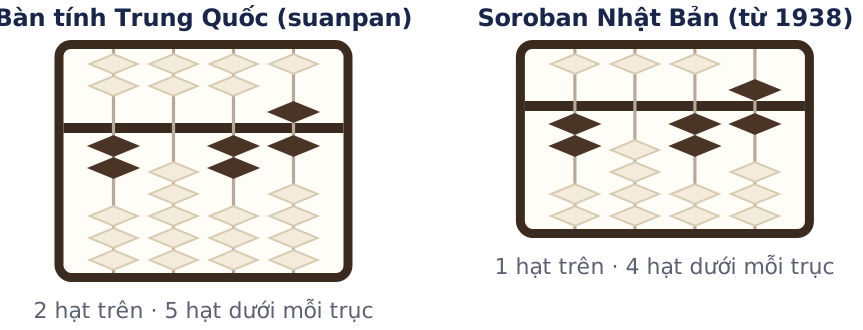
With one 5-bead and four 1-beads, every number from 0 to 9 has exactly one picture. The consequence sounds simple but is huge: the abacus becomes something you can visualize. A learner can close their eyes, “see” the beads, and calculate without a real abacus. Mental math using the image of the abacus – anzan – was born from this change, and it is what still makes Japanese soroban education different today. You can see the structure of the soroban and how to set numbers in detail in What is the soroban?.
Grading exams since 1928, and the 1946 contest against a calculator
In 1928, the Japan Chamber of Commerce and Industry held the first soroban proficiency exam, with a system of grades (kyu) and ranks (dan) like the martial arts: students move up from 10th kyu to 1st kyu, and then on to the dan ranks. This system still exists and is the model for how KSC runs its grading exams at Level 2.
The most famous soroban story took place on 12 November 1946 in Tokyo, just after the war. A US Army newspaper organized a contest between Kiyoshi Matsuzaki – a Japanese post-office clerk with a soroban – and an American soldier using the most advanced electric calculator of the day. Five rounds of addition, subtraction, multiplication, division and a combined problem: the soroban won 4–1, losing only at multiplication. The story has been retold for decades, not to say that the abacus is faster than a machine, but to talk about what the machine does not have: a person who has mastered the soroban calculates with their own brain.
A golden age, the pocket calculator, and a change of role
After the war, the soroban was an essential job skill for bank clerks, accountants and shop staff. The number of people taking grading exams rose steadily and peaked around 1980 at more than two million exam entries a year for the Chamber of Commerce exam alone. Almost every Japanese child of that era had used an abacus.
Then pocket calculators spread in the 1980s, and personal computers in the 1990s. The soroban lost its role as a calculating tool at work, and the number of exam candidates fell sharply. Many people predicted that the soroban would vanish like the slide rule. That did not happen. Instead, the soroban changed roles: from a tool for adults to an educational tool for children. The reason lies in what computers cannot replace – the process of forming images of numbers in the mind, concentration, and the study habits built lesson by lesson.
Since 1968, 8 August has been Soroban Day in Japan (because “8-8” sounds like the clicking of beads, “pachi-pachi”). Flash Anzan – numbers flashing quickly on a screen while the learner adds them on an abacus in their head – was also developed in Japan during this period and became a favorite competition event.
The soroban in Japanese education today
- In the national curriculum: the soroban is part of the Japanese Ministry of Education’s (MEXT) Course of Study for math in grades 3 and 4. Every Japanese primary school pupil learns how to set numbers and do basic addition and subtraction on the soroban at school.
- After school: thousands of soroban classes run all over Japan. Soroban, swimming and English are often named as the three most popular after-school activities for Japanese children. Many families choose the soroban first for study habits, and only second for fast calculation.
- Research: brain-imaging studies in Japan show that people skilled in anzan use the visual–spatial processing areas of the brain when they calculate, rather than the language areas; skilled users can also remember much longer strings of digits than ordinary people (Hatano & Osawa, 1983). Read more in The benefits of the soroban.
- Around the world: since the 1990s, the Japanese soroban method has spread to many countries, and the “Japanese abacus” has become an educational model that the Japanese government introduces abroad.
From Aichi in 1976 to Hanoi in 2022
Our story is a small branch of that history. In 1976, the Morita family opened their first soroban class in Aichi Prefecture, Japan. Fifty years later, Kodomo School has around 90 locations in Aichi and Shizuoka and has taught the soroban to three generations of students. In 2022, the family’s third generation brought the very same method and materials to Hanoi and opened Kodomo Soroban Center – followed by soroban clubs at primary schools. In 2026, Morita Group’s project “Japanese-style soroban education and instructor training in Vietnam” was selected by the Japanese Ministry of Education (MEXT) as an EDU-Port Nippon supported project.
When your child sits down, clears the abacus to 0 and says “Onegaishimasu”, they are doing exactly what children in the terakoya did four hundred years ago. That is why we call this Japanese-style soroban, not just a Japanese abacus.
Timeline
| When | Event |
|---|---|
| 12th–16th centuries | The suanpan (2 upper beads – 5 lower beads) spreads in China; the book Suanfa Tongzong (1592) |
| Late 16th century | The abacus reaches Japan along trade routes |
| 1622 · 1627 | Warizansho by Mōri Shigeyoshi; Jinkōki by Yoshida Mitsuyoshi – a math best-seller throughout the Edo period |
| 1603–1868 | Terakoya teach “reading – writing – soroban” to the children of ordinary people |
| 1928 | The first soroban proficiency exam (kyu – dan system) |
| 1938 | National textbooks adopt the 1-upper, 4-lower-bead abacus; the modern soroban is born |
| 1946 | The soroban beats an electric calculator 4–1 in a contest in Tokyo |
| Around 1980 | The peak: more than two million grading exam entries a year |
| 1976 | The Morita family opens its first soroban class in Aichi (Kodomo School) |
| Today | The soroban in the math curriculum for grades 3–4; thousands of after-school classes; Flash Anzan |
| 2022 · 2026 | Kodomo Soroban Center in Hanoi; the project selected for MEXT support (EDU-Port Nippon) |
Frequently asked questions
Where does the soroban come from?
The soroban is the Japanese version of the Chinese abacus (suanpan), brought to Japan at the end of the 16th century. The Japanese changed it from 2 upper beads and 5 lower beads to 1 upper bead and 4 lower beads, standardized in 1938.
How is the soroban different from the Chinese abacus?
The suanpan has 2 upper beads and 5 lower beads, so a number can be set in several ways. The soroban has 1 upper bead and 4 lower beads, so every number from 0 to 9 has only one way to be set, which makes it easy to picture in the mind – the foundation of anzan mental math.
Do Japanese people still use the soroban?
Not at work; calculators replaced it from the 1980s. But in education, yes: the soroban is in Japan’s math curriculum for grades 3–4, and thousands of after-school soroban classes are still running, because its value lies in concentration, the image of numbers in the mind, and study habits.
What is the soroban grading exam?
An exam system run by the Japan Chamber of Commerce and Industry since 1928, divided into grades (kyu, from 10th kyu up to 1st kyu) and ranks (dan). The exam includes mitorizan (adding and subtracting columns of numbers), multiplication, division and mental math. Level 2 at KSC trains in this exam format.
Try a free soroban lesson
Classes of 3–5 children at Vinhomes Gardenia (Hanoi), 70 minutes each, taught exactly as in Japan. Phone · Zalo 096.802.8484.
Written by the teaching team of Kodomo Soroban Center, following the method and textbooks of Kodomo School (Japan, teaching soroban since 1976). The center is licensed by the Hanoi Department of Education and Training, and our project is a 2026 EDU-Port Nippon supported project of Japan’s Ministry of Education (MEXT).
About usEDU-Port NipponEducation licenseRelated articles
How do Japanese parents raise independent children? 7 habits from Japanese schools that parents can start today
How do Japanese parents raise independent children? Not with iron discipline, but with 7 habits repeated every day at school and at…
What is Japanese “thinking math”? Soroban, Kumon, Gakken and how Japan teaches children math
What is Japanese “thinking math”? The Japanese don’t call it “thinking math” – they have 3 popular ways of teaching math: soroban…
My child can’t focus when studying – what can I do? 8 ways Japanese classrooms build concentration (for ages 5–8)
Your child can’t focus when studying – what can you do? A realistic view of attention spans at ages 5–8, 5 common…