How to learn division facts fast and easily: dividing by 2 to 9 – plus a free worksheet
“My child knows the times tables by heart, yet asked 56 ÷ 7, they start counting.” Many parents see exactly this when their child begins division. We are Japanese and teach soroban to children in Hanoi, and we have good news: there is almost nothing new to memorize in the division tables – they are simply the times tables “read backward”.
Help your child see that every division fact is a multiplication fact they already know, then practice briefly every day.
- Understand division with objects: sharing equally and making groups
- Know the times tables well first: 8 × 7 = 56, so 56 ÷ 7 = 8
- Learn in “fact families”: 2, 3, 6 give four facts
- Easy tables first: 2 and 5, then 3 and 4, finally 6 to 9
- Practice fill-in-the-blank: □ ÷ 7 = 8, 56 ÷ □ = 7
- Ask in random order, 5–10 minutes a day
The division tables are the times tables “read backward”
If your child knows 8 × 7 = 56, they already know 56 ÷ 7 = 8 and 56 ÷ 8 = 7. Division simply asks the question the other way around: “7 times what makes 56?”
The division tables for 2 to 9 contain 80 facts, since each table has answers from 1 to 10. But your child doesn’t need to memorize 80 new facts – they only need to know the times tables really well. Vietnamese textbooks take the same route: the division-by-2 table is built from the 2 times table, and the division-by-5 table from the 5 times table.
If the times tables are still shaky, work on those first with How to learn the times tables fast.
Before memorizing: understand division with objects
In grade 2, children meet division through objects, with two meanings. The same fact, 12 ÷ 3 = 4, answers two different questions:
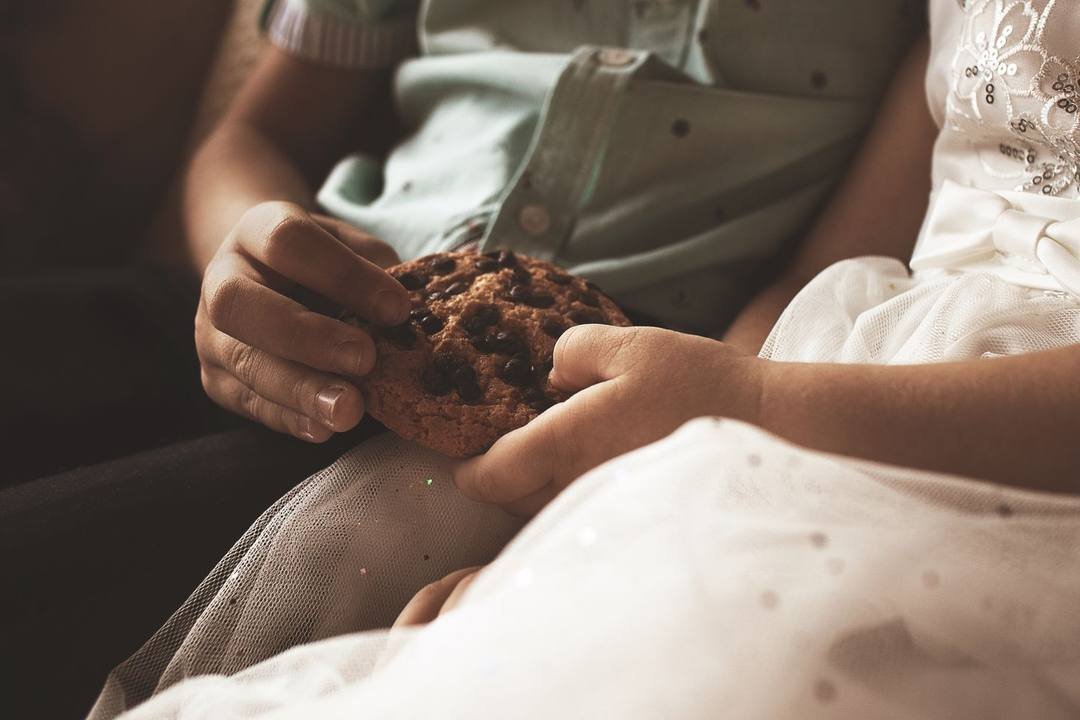
12 cookies shared equally among 3 children. How many does each get? 12 ÷ 3 = 4 (cookies).
12 cookies, 3 on each plate. How many plates? 12 ÷ 3 = 4 (plates).
When they’re done, have your child count again: 4 plates with 3 cookies each is 3 × 4 = 12 – the same number they started with. They will see that multiplication and division are two sides of the same thing.
When sharing snacks or fruit, let your child do the sharing and say it as a sentence: “12 divided by 3 is 4.” Then ask the reverse: “3 people with 4 each – how many in all?”
What grade do children learn the division tables?
Under Vietnam’s 2018 general education curriculum and current textbooks, the division tables are learned together with the times tables, over two years:
- Grade 2Division, dividing by 2 and 5
Children are introduced to division, then build the division-by-2 and division-by-5 tables from the 2 and 5 times tables.
- Grade 3Dividing by 3, 4, 6, 7, 8, 9
After reviewing 2 and 5, they learn the remaining tables. In some textbook series, multiplying and dividing by the same number share one lesson, such as “Multiplying by 7, dividing by 7”.
- In JapanKuku in grade 2, division in grade 3
Japanese children learn all the times tables (kuku) in grade 2 and division in grade 3 – finding each answer with the times tables they already know.
In both countries, multiplication comes first – there’s no need to rush division while the times tables are still shaky.
6 ways to learn division facts fast and easily
The six ways follow an order: understand, remember, then get faster.
- Learn in “fact families”
The three numbers 2, 3, 6 give four facts: 2 × 3 = 6, 3 × 2 = 6, 6 ÷ 2 = 3, 6 ÷ 3 = 2. Write the three numbers on a card, cover one with your hand and ask which number is hidden.
- Easy tables first
Dividing by 2 and 5, then 3 and 4, finally 6 to 9 – the same order as the times tables. Dividing by 2 is “halving”. For dividing by 5, look at the minute hand: at 35 minutes it points to 7, so 35 ÷ 5 = 7.
- Say it aloud, with the multiplication
Say “fifty-six divided by seven is eight”, then add “because seven times eight is fifty-six”. You can also hear where your child stumbles.
- Fill in the blank
Ask in three forms: □ ÷ 7 = 8, 56 ÷ □ = 7 and 7 × □ = 56. Your child has to think – they can’t just recite.
- Ask in random order
Once your child can say a table in order, ask in random order: 48 ÷ 6, 27 ÷ 3, 72 ÷ 8. Any fact that takes a long time gets extra practice the next day.
- 5–10 minutes a day
Short and regular beats one long session on the weekend. The goal is to answer right away, not to recite the times table from the top.
Start at homeAsk a few division facts while waiting for dinner: “Twenty-four divided by six?” Stop while your child still wants to keep going.
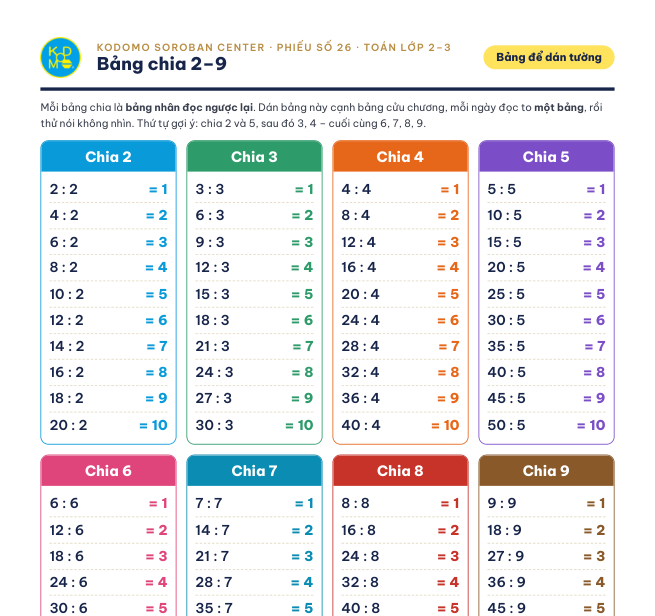
Our worksheet covers all of these: page 1 is a color chart of the division tables 2–9 to put on the wall, each with answers from 1 to 10; page 2 has 40 division facts in random order, 12 fill-in-the-blank problems and 4 fact families (write 2 multiplications and 2 divisions); the answers are on page 3. Download the division tables worksheet (free PDF, in Vietnamese).
Quick tips for each table, including 7, 8 and 9
These tips help your child find an answer again when they forget; the final goal is still to remember it directly.
| Dividing by | Example | How to think |
|---|---|---|
| ÷ 2 | 16 ÷ 2 = 8 | Halve it: 8 + 8 = 16. |
| ÷ 4 | 28 ÷ 4 = 7 | Halve twice: 28 → 14 → 7. |
| ÷ 8 | 56 ÷ 8 = 7 | Halve three times: 56 → 28 → 14 → 7. |
| ÷ 5 | 40 ÷ 5 = 8 | The minute hand points to 8 at 40 minutes. |
| ÷ 9 | 63 ÷ 9 = 7 | Take the tens digit of the number being divided and add 1: 6 + 1 = 7. It works for every fact in the 9 division table. |
| ÷ 7 | 63 ÷ 7 = 9 | Start from 7 × 10 = 70; take away one group of 7 to get 63 – so that’s 9 groups. |
Many children mix up 54, 56, 63 and 64. For 56, remember the sequence “5, 6, 7, 8”: 56 = 7 × 8. See also Mental math tricks for kids.
Common mistakes when learning division facts
Most division mistakes come from a shaky understanding, not from memory:
“You can swap the two numbers, just like in multiplication.”
Multiplication can be swapped (7 × 8 = 8 × 7), division can’t: 56 ÷ 7 = 8, but “7 ÷ 56” is a completely different problem. Teach your child the names: 56 is the dividend, 7 is the divisor, 8 is the quotient.
“Dividing by 1 and dividing by the same number are the same thing.”
8 ÷ 1 = 8 (one person gets all 8 cookies), while 8 ÷ 8 = 1 (8 people get 1 cookie each).
“If there’s a 0, the answer is 0.”
0 ÷ 5 = 0, but you can’t divide by 0: no number times 0 makes 5, so 5 ÷ 0 has no answer.
“Knowing the times tables roughly is enough.”
If finding 56 ÷ 7 means starting again from “seven times one is seven”, division will always be slow. Practice the times tables until they are solid first.
When your child gets it wrong, don’t scold – ask, “So, 7 times what makes 56?” An answer children find for themselves usually sticks longer than one they are told. If your child is starting to dislike math, see My child is struggling with math – what should I do?.
Division and soroban
In Japan, division on the soroban also uses the times tables. For 84 ÷ 4, your child finds each digit of the answer with 4 × 2 = 8 and 4 × 1 = 4, giving 21. So soroban doesn’t replace learning the times and division tables – every division on the abacus is another review of the times tables. See also What is Japanese mental math (anzan)?.
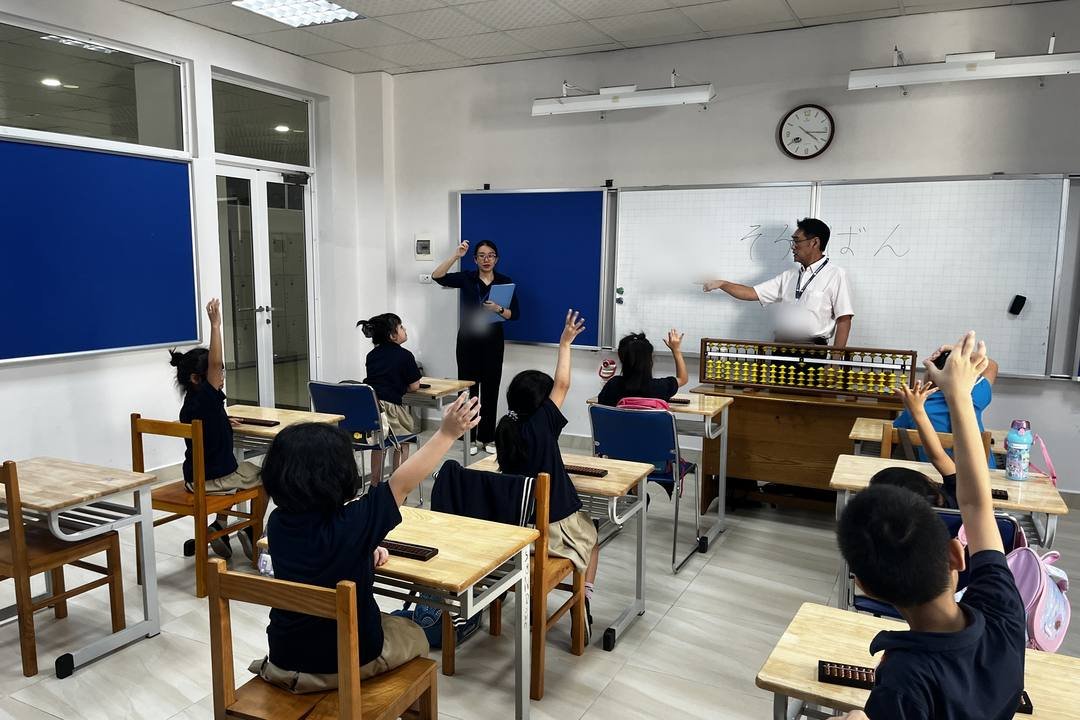
At Kodomo Soroban Center (Vinhomes Gardenia, Hanoi), each class has 3–5 children and each lesson lasts 60 minutes, following the teaching of Japan’s Kodomo School. We also run soroban clubs at schools, like the class in the photo. At home, students use their member code to enter the Soroban Practice Room (in Vietnamese), which has a times table section for making multiplication – the foundation of division – solid.
See how a lesson works; the trial lesson is free – sign up on our Contact page or call or message us on Zalo at 096.802.8484.
Frequently asked questions
Should my child learn division or multiplication first?
Multiplication first. Every division fact is a multiplication fact read backward, so Vietnamese textbooks build the division-by-2 table from the 2 times table and the division-by-5 table from the 5 times table. Once your child knows a times table well, the matching division facts come quickly.
What grade do children learn the division tables?
Under the current curriculum in Vietnam, children learn dividing by 2 and 5 in grade 2, and dividing by 3, 4, 6, 7, 8 and 9 in grade 3 – around age 7–8.
My child knows the times tables but is still slow at division – why?
Usually because they only know the times tables in order. Division asks backward (“7 times what makes 56?”), so they have to run through the whole table. Practice problems like 7 × □ = 56, learn in fact families (7, 8, 56) and ask in random order every day.
Can you divide by 0?
No. No number times 0 makes 5, so 5 ÷ 0 has no answer. On the other hand, 0 divided by any number other than 0 is always 0 – for example, 0 ÷ 5 = 0.
Are there tips for remembering the 7, 8 and 9 division tables?
Yes. Dividing by 8 is halving three times, as in 56 ÷ 8 = 7 (56 → 28 → 14 → 7). For dividing by 9, take the tens digit of the number being divided and add 1 (63 ÷ 9 = 7, because 6 + 1 = 7). For dividing by 7, start from 7 × 10 = 70 and take away one group of 7, so 63 ÷ 7 = 9.
Try a free soroban lesson
Classes of 3–5 children at Vinhomes Gardenia (Hanoi), 60 minutes each, taught exactly as in Japan. Phone · Zalo 096.802.8484.

Written by the teaching team of Kodomo Soroban Center, following the method and textbooks of Kodomo School (Japan, teaching soroban since 1976). The center is licensed by the Hanoi Department of Education and Training, and our project is a 2026 EDU-Port Nippon supported project of Japan’s Ministry of Education (MEXT).
About usEDU-Port NipponEducation licenseRelated articles
Japanese-style parenting for ages 3–6: 10 small habits many Japanese families keep every day
Japanese-style parenting for ages 3–6 at home: greetings, meals, small chores, waiting while kids try, praise and scolding, early bedtime, picture books…
What is Flash Anzan? How to practice Flash Anzan mental math at home with your child
Flash Anzan is a mental math drill: numbers flash on a screen one by one and your child adds them on an…
How to teach kids to tell time: 5 easy steps from o’clock to every minute – with a free printable worksheet
How to teach your child to read an analog clock in 5 steps: hour and minute hands, o’clock, half past, 15 and…